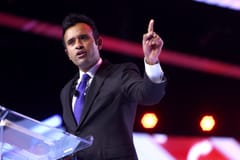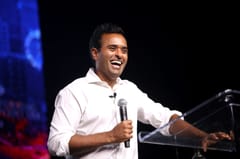
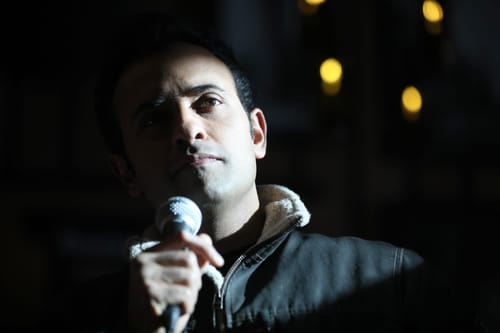
On the morning of Saturday, July 4 — the country’s 250th birthday — Vivek Ramaswamy did what candidates for Ohio governor are supposed to do on the Fourth of July. He worked a parade in Lancaster and shook hands in Upper Arlington. Then, that night, he did something else. A private jet climbed out of Columbus and turned east, and Ramaswamy was aboard, bound for Paris. Days later the same aircraft carried him on to Geneva. It was, according to flight records first reported by the Columbus newsletter The Rooster and covered here, his fifth international trip of the year.
The image — an Ohio parade in the morning, a transatlantic jet by night — is the kind of thing campaigns are built to avoid. But it is also, in miniature, the argument of this entire race. Ramaswamy, the biotech entrepreneur and 2024 presidential candidate who won the Republican nomination on May 5, is asking Ohioans to hand him a state that his own record keeps holding at arm’s length: a fortune built on a drug that failed, a company he moved out of Ohio, a public verdict that American culture is “mediocre,” and a campaign flown largely at 40,000 feet. He says none of that is the real story. “I know the American Dream exists because I’ve lived it right here, in the state where I was born and raised,” he said the night he won the primary. “I will never quit on Ohio.”
He faces Democrat Amy Acton, the physician and former state health director, on Tuesday, Nov. 3, in what a July Siena College poll found to be a dead heat — 47% to 47%. In a state that has not elected a Democratic governor in 20 years, that alone is remarkable, and it is why Ramaswamy’s record is under a magnifying glass. What follows is that record, assembled in one place.
The fortune: a $5 million bet, an $8-figure payday and a drug that failed
Ramaswamy did not build his wealth in Ohio, and he did not build it slowly. In 2014 his holding company, Roivant Sciences, paid about $5 million upfront for intepirdine, an experimental Alzheimer’s treatment that GlaxoSmithKline had abandoned after four failed trials. Ramaswamy spun it into a startup, Axovant, and in 2015 took it public in what was then the largest biotech initial public offering in U.S. history, valuing the company at roughly $2.2 billion. Forbes, which put the 30-year-old on its cover as the “Boy in the Bubble,” reported he made at least $38 million in income the year of the IPO.
In September 2017, intepirdine failed its late-stage trial. Axovant’s stock fell more than 70% in a single day and never recovered; the company was eventually wound down. Ordinary investors who had bought the hype were left with next to nothing. Ramaswamy was not among them: Roivant owned roughly 78% of Axovant, and he held his personal stake through the parent, insulating himself from the wreckage below. Weeks before the failure, SoftBank had poured $1.1 billion into Roivant — not for the Alzheimer’s drug, which it reportedly doubted, but for the wider portfolio, according to reporting by The New York Times. And in 2020, according to a Fortune analysis of his tax returns by Yale management professor Jeffrey Sonnenfeld, Ramaswamy made nearly $200 million reducing his Roivant stake in a deal with Sumitomo shortly before the company’s valuation shrank roughly fivefold after a SPAC-driven public listing.
Sonnenfeld, who founded Yale’s Chief Executive Leadership Institute, told Fortune the fortune was built by “basically a version of pump and dump.” A 2023 Newsweek opinion column went further and called Ramaswamy a fraud outright. Those are other people’s words, and they carry limits worth stating plainly: no regulator has charged Ramaswamy with a crime, and he has never been convicted of one. Ramaswamy has called intepirdine his “single greatest failure” and framed the gamble as a bet on Alzheimer’s patients in a field where the vast majority of drugs fail — a defense drug developers make routinely. His biotech record is nonetheless the foundation on which everything else is built, including the “anti-woke” investment firm, Strive, that he launched after leaving Roivant.
The pandemic he runs against — and the one he lived
The centerpiece of Ramaswamy’s campaign is an attack on Acton’s pandemic record. He brands her “Dr. Lockdown,” accuses her of spreading “COVID ideology,” and says her role in Ohio’s 2020 response “disqualifies her” from office. Gov. Mike DeWine, a Republican who endorsed Ramaswamy, has repeatedly said the closure orders were his own decisions, not Acton’s.
What the attack leaves out is where Ramaswamy himself stood in 2020. As Roivant’s CEO, he advised Ohio’s then-lieutenant governor, Republican Jon Husted — now a U.S. senator — on the state’s COVID response, according to a 2021 op-ed he wrote. A recording obtained by NBC4 that year shows him backing mandatory antibody testing and stay-at-home orders for Ohioans who lacked immunity, an approach sources close to the DeWine administration told the station went beyond what they considered acceptable. On an April 2020 podcast, Ramaswamy floated a national system in which people would be, in his word, “segregated” by immunity status — and one of his companies, the health-data firm Datavant, then worked to build the registry that would sort them, according to Associated Press reporting. Roivant also spent more than $70,000 lobbying the White House and NIH on COVID drug policy in 2020 and 2021.
The pandemic was also lucrative for the empire he founded. In March, Roivant’s subsidiary Genevant and its partner Arbutus announced a $2.25 billion settlement with Moderna over the unauthorized use of their vaccine-delivery technology — $950 million paid upfront in July, with the rest contingent on an appeals ruling. And in 2023, as he entered politics, Ramaswamy paid a Wikipedia editor to remove a reference to his service on Ohio’s “COVID-19 Response Team” from his page; he has called that a simple correction, saying the panel never met. The exculpatory facts belong high: the AP reports Ramaswamy supported vaccines during the pandemic, was vaccinated himself, and encouraged masks, while opposing government mandates for either; he says his registry idea was about restarting the economy; he holds no current role at Roivant and is not a party to the Moderna case. But critics, NBC4 reported, call the overall contrast “hypocritical” — a candidate attacking policies resembling ones he was privately advocating at the same time.
The company that left, and the culture he graded ‘mediocre’
On the economy, Ramaswamy’s critics do not need symbolism; there is a headquarters that packed up and left. In November 2024, Strive — the anti-ESG asset-management firm he co-founded in Columbus in 2022 — announced it was relocating its headquarters to Dallas, with most of its Columbus staff expected to move. Ramaswamy had stepped back from day-to-day leadership before the relocation, and the firm is run by CEO Matt Cole, but he co-founded it, and Ohio union leaders cite the move as evidence he will not fight to keep jobs in the state.
Then there is the culture itself. On Thursday, Dec. 26, 2024, while co-chairing Elon Musk’s federal Department of Government Efficiency, Ramaswamy posted a long argument on X defending why top tech firms “often hire foreign-born and first-generation engineers over ‘native’ Americans.” The reason, he wrote, “comes down to the c-word: culture. Our American culture has venerated mediocrity over excellence for way too long.” A culture that “celebrates the prom queen over the math olympiad champ, or the jock over the valedictorian,” he added, “will not produce the best engineers.” The post, which drew more than 100 million views, was about American culture broadly, not Ohioans by name, and it prompted criticism across the political spectrum, from Nikki Haley to Steve Bannon. Ramaswamy did not call Ohioans “lazy” in those words; that framing is how Acton and other Democrats summarize the post. It has stuck anyway — in part because he has not walked it back, and in part because he made his own fortune in an industry his former company staffed partly with the visa workers he was defending.
His language about everyday costs has followed the same pattern. In an April 2026 New York Times interview, he dismissed Democrats’ emphasis on affordability as a “buzzword,” pitching instead a tech-driven, even “spiritual” abundance. On an October 2024 podcast with Ezra Klein, before he was a candidate, he said he believed Medicare and Medicaid were mistakes — “particularly Medicaid,” he said, “the welfare state, without the work requirements attached to it.” A governor does not control Medicare, which is federal, and Ramaswamy has not proposed abolishing either program in Ohio; his campaign instead promotes a Medicaid-fraud crackdown. But roughly 3 million Ohioans rely on Medicaid and about 2.5 million on Medicare, and Acton has made the “mistake” remark a fixture of her stump speech.
The big ideas, and the math
Ramaswamy’s platform is a series of large promises whose arithmetic his opponents keep pressing. He wants to eliminate Ohio’s income tax, which brought in roughly $11 billion in the last fiscal year. He launched his campaign vowing to abolish property taxes, too, then retreated to a “rollback” toward pre-pandemic levels after DeWine called full elimination “devastating” for schools, police and fire; the conservative Tax Foundation estimated total elimination would cost the state about $20 billion a year, and the progressive group Innovation Ohio estimated his tax plan would blow a roughly $9.8 billion hole in the budget. He has not said in detail how he would fill it.
Some of his proposals have not survived contact with voters. Over the summer he floated a longer school day and a school year with no summer break; his campaign quietly deleted the video. During his 2023 presidential run he proposed raising the voting age to 25 for young people who could not pass a civics test or complete six months of military service. On higher education, he wants to consolidate Ohio’s public universities: “I love universities in Ohio. I want us to have the best universities. But we have too many of them,” he said in a video posted to Threads. “They need to be consolidated.” In a Columbus Dispatch op-ed and at a later campus event he named Cleveland State, the University of Akron, Kent State and Central State — a historically Black university — as struggling, and said, “I don’t think you should be funding subpar universities.” Even DeWine, his endorser, opposes closing or consolidating any of Ohio’s 14 public universities.
He has also made private-school vouchers a central plank and has suggested he might seek to dismantle Ohio’s public-school teachers’ unions while paying teachers on a merit system. The largest single donor to Victors Not Victims, the super PAC supporting him, is Pennsylvania billionaire Jeff Yass, who has given the group $20 million and is among the nation’s biggest funders of vouchers and charter schools. Yass and his allies call the cause “educational freedom”; critics, including school-policy researcher Josh Cowen, call his Ohio spending an effort to weaken public schools. Super PACs are barred from coordinating with campaigns.
The industries he would regulate — and profit from
The clearest conflict in Ramaswamy’s portfolio runs through his signature promise: to turn the Ohio River Valley into “the next Silicon Valley” by aggressively expanding AI data centers and the energy to power them. A May 2026 report from Innovation Ohio, drawn from his own ethics-disclosure filing, found he holds investments across nearly every tier of that industry — chipmakers, cloud operators, industrial real-estate trusts and cryptocurrency. His Dallas-based firm, Strive, has pivoted into a large Bitcoin treasury, and Bitcoin mining depends on precisely the energy-hungry infrastructure he wants to build. As governor, he would appoint the boards of JobsOhio, the Power Siting Board, the Public Utilities Commission and the Tax Credit Authority — the very bodies that subsidize, site and regulate data centers, an industry that has collected an estimated $2.5 billion in Ohio tax breaks since 2017. His two biggest super PAC backers, Yass and New York financier Ross Stevens, are deep in the crypto world.
Ramaswamy frames the buildout as a generational opportunity and says he will make “AI hyperscalers pay for their own energy usage.” Asked about the strain on rural communities, he has said Ohio must “protect our farmland” while producing more power. But he has not endorsed the study commission, the moratorium or the tax-code changes that rural, largely conservative communities — part of his own base — have demanded as data centers consume farmland and drive up electric bills. That resistance, and the conflicts, are the subject of separate reporting.
What the voters already decided
In November 2023, Ohioans wrote reproductive freedom — abortion up to fetal viability, along with contraception, fertility treatment and miscarriage care — into the state constitution, with about 57% voting yes. Ramaswamy opposed it. “I’m upset about this,” he said the day after, calling the amendment part of a “Republican culture of losing.” He describes himself as “unapologetically pro-life,” has praised six-week bans elsewhere as “progress,” and has called for ending federal funding of Planned Parenthood, though he opposes a federal ban and says abortion belongs to the states.
His campaign also touts the endorsement of the Right to Life Action Coalition of Ohio, whose policy document opposes abortion in all cases, including rape and incest, states that it “cannot support any form of contraception,” and opposes in vitro fertilization. The group told NBC News that Ramaswamy assured its leaders he was “totally with” them; his campaign declined to say whether he agrees with its position on contraception. A governor cannot repeal a constitutional amendment, and Ohio’s protection stands regardless of who wins in November.
The money, and the distance
No candidate in Ohio history has spent like this. Ramaswamy has loaned his own campaign roughly $25 million — about 83% of what he raised in 2026 — on the way to what is on track to be the most expensive governor’s race the state has seen. Much of the movement happens by private jet: more than $780,000 in aircraft costs in 2025, including at least $500,000 to lease a plane through V Leasing LLC, a company Ramaswamy himself owns, as the Ohio Capital Journal first reported. His campaign also paid nearly $12,000 to an exclusive Puerto Rico resort, listed as travel. The campaign says he covers the aviation personally and that a jet lets him reach all 88 counties efficiently; TiffinOhio.net has not independently confirmed who was aboard the July 4 flight, which The Rooster tied to Ramaswamy through flight records and an anonymous aviation source.
The spending has also produced a formal complaint. On July 7, Democratic state Sen. Kent Smith asked Ohio’s campaign-finance regulators to examine $509,473 in payments the Ramaswamy–McColley committee made to American Express and reported only as monthly lump sums, rather than itemizing each purchase as state law requires. Here the balance matters, and it belongs up front: the secretary of state’s office said such errors are not uncommon, granted the campaign a one-month extension, and confirmed the campaign updated its filings before the complaint was filed; Acton’s campaign received a filing extension of its own this year; and Phil Richter, who led Ohio’s now-abolished Elections Commission for three decades, called the reporting manageable so long as documentation eventually follows. The disputed sum is less than 2% of the campaign’s spending. “Vivek Ramaswamy and Rob McColley for Ohio is in full compliance with all applicable Ohio campaign finance laws,” spokesperson Evan Machan said, adding that the campaign values transparency. What gives the episode an edge is where it landed: campaign-finance oversight was moved in 2026 into the office of Secretary of State Frank LaRose — who has endorsed Ramaswamy and is himself on the November ballot — after Republican lawmakers eliminated the independent commission Richter once ran.
The office as a way station
Ramaswamy has never held elected office of any kind. The first job he ran for was the presidency, in 2024; when that ended, he took a perch atop DOGE, which he left the day Trump was inaugurated; then he came home to run for governor. When he launched the campaign, he pledged to serve a full four-year term and rule out a 2028 presidential bid. Fifteen months later, The New York Times listed him among potential 2028 candidates, and he has not revisited the pledge since the primary. Even Attorney General Dave Yost, who briefly ran for the nomination himself, told NBC News that Ramaswamy had spent the previous year cycling through larger ambitions. To his critics, the jet to Paris on the night of the 250th is less a scandal than a tell — a glimpse of how a man ranks his obligations.
The complication his opponents leave out
There is a part of the story that cuts the other way, and honesty requires including it. Ramaswamy, a Cincinnati-born son of Indian immigrants who was raised Hindu and made a national brand attacking “identity politics,” has himself become a target of identity-based attacks — not from Democrats, but from the far-right fringe of his own party. His primary rival, Casey Putsch, repeatedly called him an “anchor baby” and “questionably American”; commentator Nick Fuentes and audiences at a Turning Point USA event have challenged his faith and his fitness to represent a majority-Christian state. Ramaswamy has answered those attacks by citing the Constitution. It is a reminder that the case against him is about his record and his choices, not his background.
What Ramaswamy says, and what comes next
Ramaswamy and his campaign reject the portrait his opponents paint. He points to his Ohio roots and his rise from a middle-class household as proof the American Dream is real, and he casts his agenda — lower taxes, cheaper energy, a technology boom and “centers of excellence” in higher education — as the fastest route to prosperity for a state he says has been left behind. He promises to grow Ohio to 15 million people. DeWine, in endorsing him, credited him with helping win business projects “from the coasts.” His running mate, Senate President Rob McColley, and the Ohio Republican Party are with him, and the polls say the race is his to win or lose. No court has found wrongdoing in any of it.
But an election is a hiring decision, and Ramaswamy is asking for the job with a resume Ohioans can now read in full: the drug that failed while he cashed out, the pandemic he profited from and now runs against, the company he sent to Texas, the culture he called mediocre, the universities he would thin, the industries he would both regulate and hold stock in, and the private jet that carried him away from the state’s 250th birthday. Whether that record reads as bold disruption or as a man who never quite wanted to be here is the question on the ballot. Ohioans answer it Nov. 3.