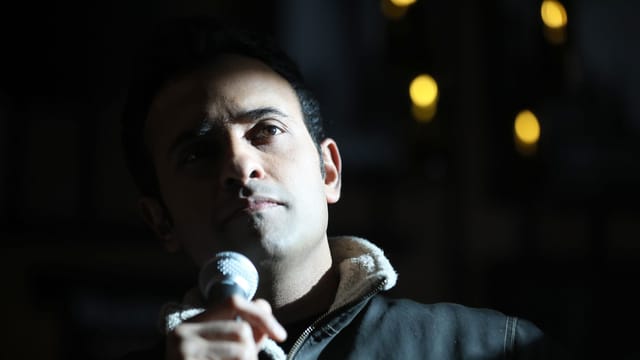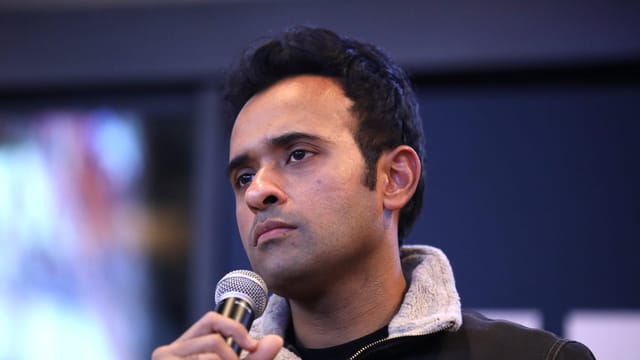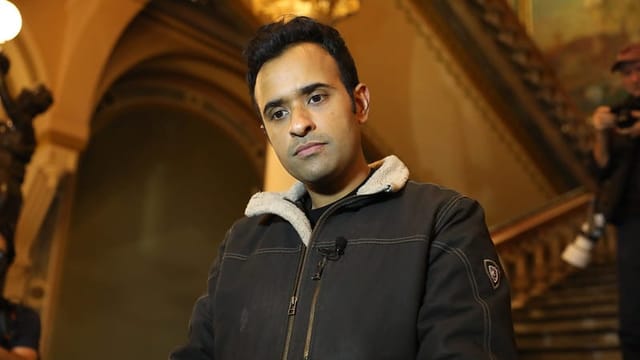
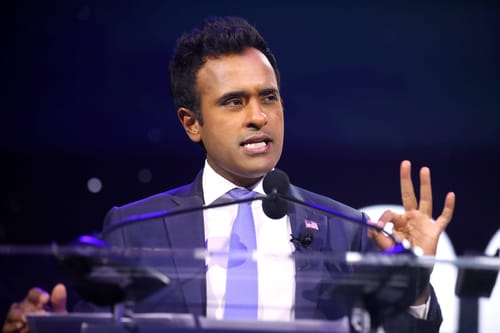

Vivek Ramaswamy had 30 minutes on the schedule. He used 14.
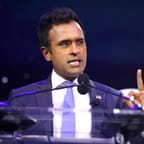
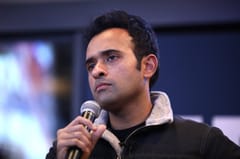
The Republican nominee for Ohio governor walked off the stage Wednesday night at Xavier University in Cincinnati — the city where he was born — after a hall full of young conservative and libertarian activists booed, heckled and talked over him for most of the time he spoke.
The event was the 17th annual Young Americans for Liberty national convention, held July 28 through 30 on Xavier’s campus. Ramaswamy was booked from 8:20 to 8:50 p.m., ahead of YouTube firearms manufacturer Brandon Herrera.
The booing started before he finished his opening thought, according to the Daily Beast, which reviewed video of the full speech. He was heckled over Israel. He told the room the real divide in America was not between Republicans and Democrats but between people who want to win and people who want to whine. When one attendee kept interrupting, Ramaswamy shot back: “You want to give a speech…? Well, you can get on when they give you a slot, alright? So, until they do, can sit down.”
MUST WATCH: "Scammer" Vivek Ramaswamy gets absolutely humiliated by Ohio young conservatives at a Young Americans for Liberty event in his hometown of Cincinnati, walks off stage as crowd boos!
— TiffinOhio.net (@TiffinOhioNews) July 31, 2026
This is Ramaswamy's own base continuing to turn against him in real time. pic.twitter.com/jL9lC5GQww
Then came the line that emptied whatever patience the room had left.
“The truth of the matter is, you know, no matter what happens in whichever direction we go, people in my generation have already made it,” Ramaswamy said. “We’re gonna be fine. It’s gonna be your generation…that pays the price.”
The room erupted. “We don’t want to hear your bulls–t talking points,” one person shouted. “You’re a political cretin and you need to get the f— outta here!”
Ramaswamy tried to push through, asking whether anyone still believed in free enterprise, capitalism and “actual liberty.” Some cheered. He told them they would be carrying the rest of the room on their backs. Then he signed off — “Peace out, see you guys” — and left to another wave of boos, roughly 16 minutes ahead of schedule. Video of the exit had drawn more than 2.7 million views by Friday, Mediaite reported.
The Daily Beast said it contacted Ramaswamy’s office and Young Americans for Liberty for comment. Cincinnati public radio station WVXU reported earlier this month that the campaign had not responded to its own request for an interview with the candidate.
Not a hostile room, on paper
What makes the reception notable is who was in the seats.
Young Americans for Liberty grew out of the Ron Paul movement and calls itself the largest pro-liberty student organization in the country. Its members are not Democrats. They are, by the group’s own description, exactly the constituency Ramaswamy has spent three years courting: free markets, limited government, individual rights. Ramaswamy has repeatedly described himself as the most pro-enterprise and pro-freedom governor Ohio would ever have.
Several national outlets placed the convention in Cleveland. It was not. Young Americans for Liberty’s own convention materials put the event on Xavier’s campus in Cincinnati — the metro area where Ramaswamy grew up, and where he launched his campaign for governor in February 2025.
The fourth time, at least
Wednesday was not new territory. It was the latest entry in a pattern that now stretches back three years, and every audience in it leaned right.
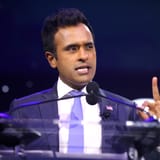
December 2023. At the fourth Republican presidential primary debate, Ramaswamy was booed at least four separate times after going after rivals Chris Christie and Nikki Haley, calling Haley “the only person more fascist” than the Biden administration. Christie’s reply — that Ramaswamy was “the most obnoxious blowhard in America” — drew cheers.
May 2024. At the Libertarian National Convention at the Washington Hilton, Ramaswamy was booed simply for mentioning Donald Trump, who was scheduled to speak the following night. He tried to recover: “You all get to speak your mind, I respect that.” The crowd shouted “no” when he asked whether they agreed with Trump on everything, and booed him again when he suggested only a major-party nominee could win the White House.
December 2024. While co-chairing the Department of Government Efficiency, Ramaswamy posted a lengthy defense of tech companies hiring foreign-born engineers, arguing that American culture had “venerated mediocrity over excellence for way too long.” The response from the right was immediate. Haley answered that there is “nothing wrong with American workers or American culture.” Steve Bannon called the pro-H-1B argument a scam on his podcast. Axios described the fight as a MAGA-world civil war. Newsweek catalogued the blowback from Trump supporters and unlikely critics alike. Ramaswamy was out of DOGE on Inauguration Day. TiffinOhio.net later reported that his own former company, Roivant Sciences, filed 29 H-1B petitions, and that he now backs expanding Ohio subsidies to some of the country’s largest H-1B sponsors.
October 2025. Headlining a Turning Point USA event at Montana State University alongside Gov. Greg Gianforte, Ramaswamy took roughly 30 minutes of audience questions. Several challenged his Hindu faith. One student said, “Jesus Christ is God, and there is no other God,” then asked how Ramaswamy could represent a state that is 64% Christian. Another asked why he would “masquerade as a Christian.” Ramaswamy confirmed his faith and pointed the room to the Constitution and the First Amendment.
TiffinOhio.net examined that longer pattern earlier this month: a candidate who built a national brand attacking identity politics, now facing identity-based attacks almost entirely from his own side.
The primary that mostly did not happen
Some of the resentment traces to how Ramaswamy became the nominee.
He launched in February 2025. Trump endorsed him almost immediately. Three months later, on Friday, May 9, 2025, the Ohio Republican Party’s state central committee endorsed him for governor — nearly a year before Ohioans would vote, and while the field was still forming. The vote, taken by secret ballot behind closed doors, was 60 to 3. The three went to Attorney General Dave Yost, the first Republican in the race, who dropped out shortly after.
Yost’s parting shot — that Ramaswamy had quit on Trump, quit on Ohio and quit his presidential campaign — has followed the nominee all year. Gov. Mike DeWine, who is term-limited, added his endorsement on Wednesday, Jan. 7, 2026. NBC News reported that DeWine had worked behind the scenes to block the early party endorsement in the first place.
What was left of the primary fell to Casey Putsch, a car designer who runs the Genius Garage nonprofit, lives in Perrysburg and describes himself as a Tiffin native. Putsch spent almost nothing and took 17.5% of the vote on May 5, against Ramaswamy’s 82.5%, according to unofficial results. Cook Political Report later pointed to that near-20% protest vote as a measure of Ramaswamy’s weakness inside his own party.
Putsch’s campaign was frequently ugly, including a video in which he fired a rifle while directing racist language at Ramaswamy, and Ramaswamy has publicly called on his own supporters to reject racism and bigotry. But on the question of the coronation itself, Putsch put words to something a good many Ohio Republicans have said more quietly. Asked in January whether it was fair that voters effectively did not get a primary before the endorsements landed, he told News 5 Cleveland it was “not fair at all” and that it undermined the system.
What the numbers say
Three weeks before Xavier, the nonpartisan Cook Political Report moved Ohio’s governor race from Lean Republican to Toss Up. Editor Jessica Taylor wrote that “Ohio Republicans we talked to are not optimistic about Ramaswamy and believe it’s a very tight race,” and quoted an unnamed GOP source: “This was the wrong guy to roll the dice with in this political environment.”
The polling has tracked with that. A New York Times/Siena poll of 601 likely voters taken June 15 through 28 found Ramaswamy and Democrat Amy Acton tied at 47%, with Acton leading independents by 28 points and pulling 6% of Republicans and 8% of Trump voters. A bipartisan AARP survey of 800 likely voters taken June 14 through 16 gave Acton a 47%–44% edge. TiffinOhio.net reported in March on an EMC Research survey that found Ramaswamy drawing only 65% support from Ohio Republicans while Acton had consolidated 82% of Democrats.
David B. Cohen, who directs the Ray C. Bliss Institute of Applied Politics at the University of Akron, offered WVXU a blunter read: “He’s super arrogant. He thinks he knows best. He thinks Ohio voters are stupid.”
The campaign’s answer
Ramaswamy and his team have dismissed the polling and the narrative around it.
In a recent appearance on the show of northeast Ohio conservative Hugh Hewitt, Ramaswamy said good public polling had dried up, said he did not mind Republicans feeling a sense of urgency, and said he would be “the most conservative, the most pro-enterprise, most pro-freedom governor this state has ever had.” He also said he had campaigned in all 88 Ohio counties.
Campaign spokesman Evan Machan was sharper, telling the Tribune Chronicle: “The media writes the same story every July in Ohio. Then they are surprised in November. The fact remains that the media has no idea how to read a poll.”
The northwest Ohio stakes
This corner of the state has been unusually central to a race otherwise decided in Columbus and on television. Ramaswamy’s running mate is Ohio Senate President Rob McColley, a Napoleon-area Republican who represents the 1st Senate District across northwest Ohio. His primary challenger was a Tiffin native. And the issue Putsch hammered hardest — data centers and the tax breaks and electricity costs that come with them — is one where local opposition has come from conservatives as often as anyone else.
The money has not been local. Ramaswamy has loaned his own campaign $25 million, and a supporting super PAC has taken in roughly $42 million, most of it from a handful of out-of-state billionaires including Elon Musk, Jeff Yass and Bill Ackman. On July 4, hours after working a parade in Lancaster, Ramaswamy boarded a private jet to Paris — his fifth international trip of the year.
Wednesday night in Cincinnati, in front of a room of people who came to hear about liberty and free enterprise, he told them his generation had already made it.
Ohio votes Tuesday, Nov. 3.