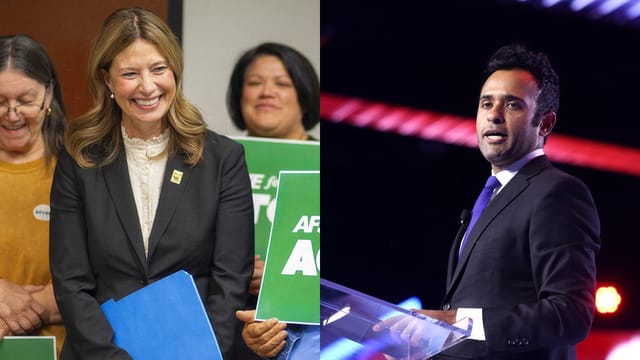

More than 1.7 million Ohio households — 37% of the state — did not earn enough to cover the basics in 2024, according to data released in June by United For ALICE. Amy Acton has built an entire campaign for governor on that gap.
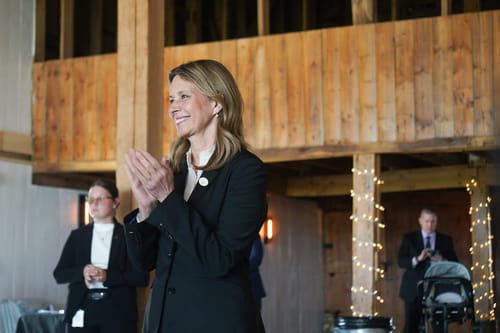
Since announcing her candidacy in January 2025, the Democratic nominee has framed nearly every appearance around what Ohioans pay for housing, power, groceries and health care. Acton is a physician and a Youngstown native who was appointed director of the Ohio Department of Health by Republican Gov. Mike DeWine in 2019 and led the state’s early COVID-19 response before resigning in June 2020. Her running mate is David Pepper, the former Ohio Democratic Party chair who previously served on Cincinnati City Council and as a Hamilton County commissioner.
The centerpiece of her platform is a working families tax cut. Acton is proposing a state earned income credit she says would reach up to 775,000 working families, paired with a child tax credit of $1,000 a year for children up to age 6 and $500 for children 7 through 18, available to households earning up to $85,000. By her campaign’s math, that is about $1,778 a year for a married couple with two children earning $60,000.
“As governor, my priority will be to secure a tax cut for Ohio’s working families to put money back in their pockets, lift families out of poverty, and make sure Ohioans see their hard work pay off,” the plan reads. “This state has put special interests and wealthy elites before working families in this state for far too long.”
The rest of the agenda, released April 6 at a Columbus coffeehouse roundtable, runs through health care and utilities. Acton would launch a state platform called Ohio Rx to use Ohio’s Medicaid pharmacy purchasing power against prescription prices, direct the state to buy and forgive medical debt the way Cincinnati, Cleveland and Toledo have, push for price transparency from insurers and hospitals, and strengthen enforcement against surprise billing and aggressive collections. On energy, she has pledged to appoint utility regulators “not beholden to utility companies,” restore funding for the Office of the Ohio Consumers’ Counsel, and reinstate the efficiency and renewable standards gutted by House Bill 6, the 2019 nuclear bailout at the center of the largest corruption scandal in state history.
“As governor, my number one priority will be lowering costs for working families,” Acton said at the rollout. “I’ll combat high prices with common sense solutions, fight back against the fraud and corruption that raise costs for Ohioans, and work with both sides of the aisle to deliver for our state.”
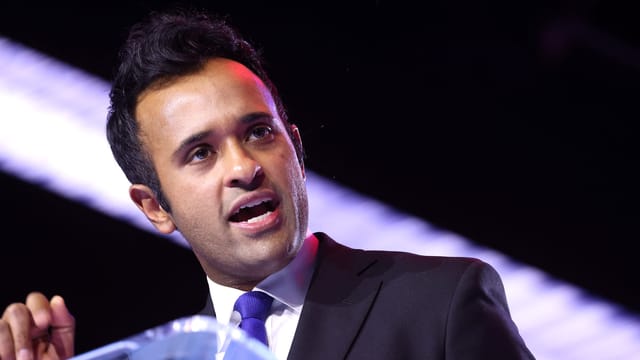
The contrast she draws with Republican Vivek Ramaswamy runs through the same ledger. His signature proposal is phasing out Ohio’s income tax, which brought in more than $10 billion last fiscal year, roughly a quarter of the state’s operating budget, and he has not said what he would cut to cover it. “I think he’s frankly a danger, a real danger, his leadership, to Ohio because he has no idea how to do this,” Acton said.
‘Ohioans are working harder than ever’
The numbers underneath the campaign are not in dispute. United For ALICE — the research initiative that measures households earning above the federal poverty line but below the cost of living where they actually live — found 37% of Ohio households below that threshold in 2024, an improvement from 39% in 2022 but still more than 1.7 million households. The group calculated that a single adult in Ohio needed $27,732 a year to get by and a family of four needed $81,854. Its Essentials Index, which tracks only housing, child care, food, transportation, health care and technology, rose 58% in Ohio between 2007 and 2024, against 52% for the broader Consumer Price Index.
Health coverage has moved faster than any of it. After Congress allowed enhanced Affordable Care Act premium tax credits to lapse at the end of 2025, Ohio marketplace enrollment fell by 161,000 people — 32.4% — according to the Health Policy Institute of Ohio. In the open enrollment period alone, Ohio posted the second-largest percentage drop of any state in the country. Ohio uses the federal exchange rather than running its own, and states with their own exchanges held onto more of their enrollees.
Food assistance is contracting at the same time. A year after the federal budget law cut more than $1 trillion from Medicaid and the Supplemental Nutrition Assistance Program, roughly 100,000 Ohioans have lost SNAP help, the Ohio Capital Journal reported in July. About 1.4 million Ohioans still use the benefit each month at a cost above $270 million, and in October the state’s share of administrative costs jumps from 50% to 75%.
The electric bill
Energy is where the affordability argument meets the biggest fight in Ohio politics. The Public Utilities Commission of Ohio reported this month that residential electric bills in the Columbus area were more than 7% higher than they were a year ago. AEP Ohio, which serves about 1.5 million customers in the state, said bills rose an average of $27 a month in the summer of 2025 on generation costs alone. The Institute for Energy Economics and Financial Analysis estimated that regional capacity prices — driven substantially by data center demand — would add roughly $16 a month to the average Ohio residential bill.
Acton has put her own bill in her campaign literature. “Last summer, Eric and my electric bill went up $140 in one month – and I know I’m not alone,” her agenda reads.
Her plan would require data centers and their investors, rather than ratepayers and local governments, to absorb the added electricity, gas, water and environmental costs they create, end the nondisclosure agreements that keep the deals from residents, and require union labor and community benefits agreements. In July she went further, saying she would back a conditional statewide moratorium on new facilities that fail to meet six conditions. Ramaswamy has rejected a moratorium and argues Ohio should keep building.
What it looks like here
The campaign’s own example household is a Tiffin family. Seneca County has been living the same arithmetic from the other end. Tiffin City Council voted 6-0 on Monday, April 20, to freeze data center development inside city limits for a year — before any project had been proposed — because members wanted to know who would pay for the power first. Weeks earlier, Tiffin voters approved a 0.75% earned income tax levy for the school district, its first operating levy since 2012, generating roughly $3.2 million a year to hold existing programs in place rather than add new ones. Acton campaigned in Tiffin last October, before the primary.
A close race
A bipartisan poll conducted for AARP by Fabrizio Ward and Impact Research in mid-June found Acton at 47% and Ramaswamy at 44% among 800 likely Ohio voters, within the survey’s 3.5-point margin of error. The age split is stark: Ramaswamy led by 10 points with voters 50 and older, a bloc that made up 65% of the state’s electorate in the 2022 midterms, while Acton led by 24 points among voters under 50. A Bowling Green State University survey in April had Ramaswamy up 48% to 47%.
The same AARP poll found 56% of Ohio voters 50 and older worried about their personal financial situation, and 67% of older swing voters. Acton has been campaigning in rural counties that broke heavily for Donald Trump in 2024, and has picked up union endorsements in northwest Ohio, including the state firefighters’ association and the North Central Ohio Building and Construction Trades Council.
Ohio votes Tuesday, Nov. 3.