
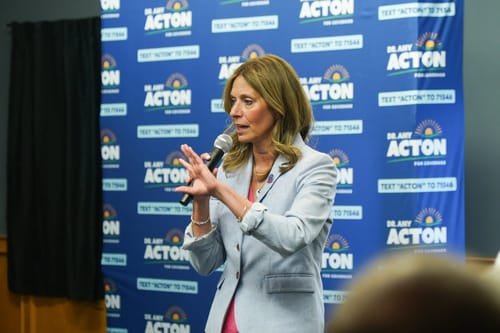

Democratic gubernatorial nominee Dr. Amy Acton said Monday she would support a conditional moratorium on data centers in Ohio, keeping new facilities out of the state unless they cover their full utility costs, are built exclusively with union labor and go up on former industrial land instead of farmland.
“As governor, I will take immediate action and support a conditional moratorium on data centers to ensure they cover one hundred percent of their utility costs, exclusively build with union labor, operate with full transparency, adhere to Ohio’s environmental standards, support the needs of local communities, and bring jobs to former industrial areas that have been left behind,” Acton said in a statement released by her campaign. “Costs are too high, and Ohio families and businesses need protection from data centers driving up costs. Ohio is open for business, but we are not up for sale. If you do not meet these conditions, we do not want you in Ohio.”
The announcement puts the Democratic nominee closer to the position taken by a string of Ohio communities — Tiffin among them — that have paused data center development while the state works out who pays for the electricity, water and infrastructure the facilities consume.
What the conditions would require
According to the campaign, Acton would require data centers and their investors to cover the full cost of the gas, water and electricity they use rather than shifting it to taxpayers or ratepayers, to invest in their own generation, and to demonstrate that a project would not raise electricity prices or degrade regional reliability. The campaign said low-cost, carbon-free and net-zero energy paired with storage would get priority.
The remaining conditions, as described by the campaign, would require that construction, maintenance, operation and upgrades be performed by union workers trained in Ohio; that Ohio’s long-term tax incentives be reined in and paired with clawback provisions; that nondisclosure agreements and the secrecy surrounding site negotiations end; that new facilities be built on brownfields and previously developed industrial sites rather than farmland or the centers of communities; and that air quality and groundwater standards not be loosened for the industry.
The release did not say how Acton would put a moratorium in place — through legislation, executive action, or the state boards a governor appoints. Ohio’s governor names the members of the Ohio Power Siting Board, the Public Utilities Commission of Ohio and the Ohio Tax Credit Authority, the panels that site, regulate and subsidize these projects.
The announcement is an escalation of a position Acton has held since spring. Her ActOn Costs Agenda, released April 6, called for guardrails rather than a bar to entry: data centers paying their own energy costs, union labor on the job, and restoration of the energy efficiency and renewable standards gutted by House Bill 6. Monday’s statement keeps those demands and attaches a consequence for companies that will not meet them.
Ramaswamy’s position
Republican nominee Vivek Ramaswamy has made data center growth central to his campaign and has rejected the idea of a ban. At a town hall in Strongsville this month, he framed the choice as one between two failures of leadership.
“I think we need a leader who just doesn’t say, ‘Hey, open it up, and it’s a free-for-all,’ or a leader who says that they ban it because ‘I don’t understand it,’” Ramaswamy said, according to News 5 Cleveland’s July 23 report on where the candidates stand.
Ramaswamy has said the industry should shoulder its own energy demand. “If you’re going to use a whole bunch of energy as a demand user, a hyperscaler, you should bring at least the energy that you’re using,” he said. On incentives, he told the station’s reporter that the state should stop subsidizing older, more resource-intensive facilities: “We should not be given state incentives to bring something here that guzzles water and drives up electric bills.”
The distance between the two is less about whether data centers should pay their own way — both say they should — than about what happens if they will not. Acton would hold projects out of the state until conditions are met. Ramaswamy would sort good projects from bad ones and keep building.
The local stakes
Seneca County has already been through this argument at the council table. Tiffin City Council voted 6-0 on Monday, April 20, to freeze data center development inside city limits for up to a year under Resolution 2026-42, giving officials time to write zoning rules or decide against the facilities entirely. No data center had been proposed in Tiffin. Findlay’s council approved its own 12-month pause the next day, following earlier moratoriums in Maumee and Waterville.
The state’s stalled attempt at data center rules also runs through this corner of Ohio. House Bill 646 was introduced by Rep. Gary Click, R-Vickery, and Rep. Kellie Deeter, R-Norwalk, and passed the House unanimously in March as a bill creating a study commission. “This legislation originated in the heart of the 88th district, in response to my constituents,” Click said at the time. His district covers all of Sandusky and Seneca counties, Tiffin included.
The version that cleared the House also directed the commission to study “reports of foreign propaganda intended to create opposition to data centers,” a clause listed alongside water use and farmland impacts. The libertarian Reason Foundation submitted testimony urging senators to delete it.
Republican leaders then routed the issue to a new joint committee led by other chairs, reducing Click to an invited participant on his own bill, and senators rewrote it into a regulatory package — a separate electric rate class for data centers, water monitoring and reporting requirements, a provision making nondisclosure agreements subject to Ohio public records law, and a cut in the sales tax break for future projects. The rewrite made it out of Senate committee, then ran out of votes in both chambers before the June recess amid a fight over the tax exemption. It has since been sent back to committee — the version posted on the legislature’s website is labeled as re-referred to Senate committee — and it has never come to a floor vote in the Senate. Lawmakers are not due back in Columbus until November. Sen. Bill Reineke, R-Tiffin, the Senate president pro tempore, sits on the joint legislative committee studying the industry.
Several of Acton’s conditions track provisions already negotiated in that bill. Two do not: no version of H.B. 646 has required union labor, and the Senate rewrite treated brownfield siting as grounds for a larger tax break rather than a requirement.
The money behind the fight
Ohio Department of Taxation figures show the state granted almost $1.57 billion in sales tax exemptions on data center equipment and construction materials last year — nearly 12 times what officials had projected. Gov. Mike DeWine directed the Ohio Tax Credit Authority on May 27 to stop accepting new exemption applications while lawmakers study the industry. The bills landing in mailboxes have moved the other direction, with summer electric costs climbing across the region.
The sitting governor has drawn a different conclusion from the same numbers. In June, DeWine told local officials wary of data centers to negotiate harder rather than refuse, saying communities should “be aggressive” in seeking a deal and “don’t just take what they give you” — while rejecting the idea of shutting the industry out of Ohio altogether. That is the position Acton is now running against from the left, and the one Ramaswamy is running on from the right.
Washington is pushing a voluntary version of the same idea. On July 23, the Trump administration rolled out a Ratepayer Protection Pledge asking hyperscalers, utilities and developers to build, bring or buy the power their facilities need and to cover the delivery infrastructure. More than 200 organizations have signed, including AEP Ohio. The pledge carries no penalty for companies that do not sign. Acton’s conditions would be requirements.
Ohio’s general election is Nov. 3. The winner will appoint the boards that decide where these facilities go, what they pay and who covers the difference.