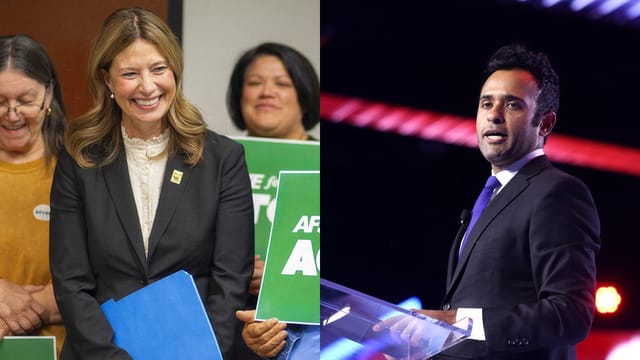
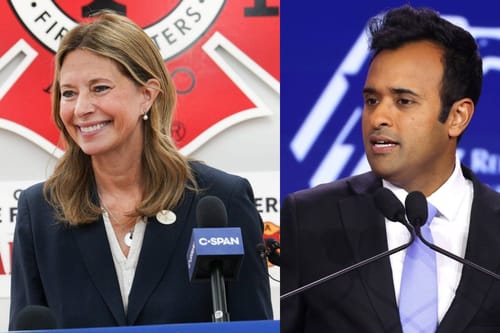

Amy Acton called for an emergency suspension of Ohio’s gas tax Monday morning.
About six and a half hours later, Vivek Ramaswamy announced essentially the same core policy.
The chronology is straightforward: Acton went first. Ramaswamy went second.
Yet when Ramaswamy’s campaign unveiled its 90-day gas tax suspension Monday evening, its announcement carried a remarkable headline: “Vivek Leads and Delivers Real Solutions, While Acton Offers Tweets.”
By then, Acton had already publicly called for the state to suspend the tax.
The Statehouse News Bureau reported Monday evening that Ramaswamy’s announcement came “a few hours” after Acton’s proposal. Subsequent reporting put the gap at about six and a half hours.
It is the second time in less than two months that Ramaswamy has rolled out a major cost-related proposal after Acton had already moved on the issue.
Roughly 7 hours later
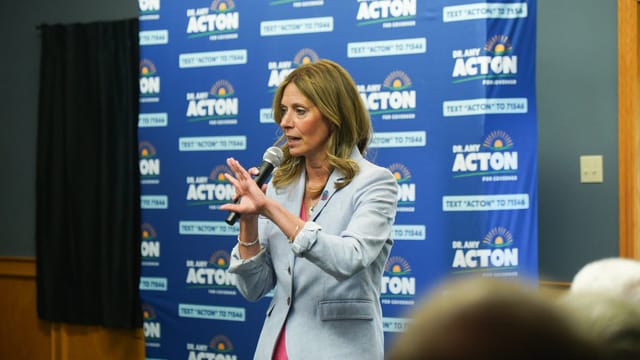
Acton announced Monday morning that she wanted lawmakers to approve an emergency gas tax holiday as gasoline and diesel prices remained elevated.
“I am immediately calling for an emergency gas tax holiday to offer Ohioans some relief,” Acton said. “We are facing an affordability crisis in Ohio.”
Hours later, Ramaswamy announced a 90-day suspension of Ohio’s 38.5-cent-per-gallon gasoline tax and 47-cent diesel tax.
His proposal went further on implementation. Ramaswamy enlisted Republican House Speaker Matt Huffman and Senate President Rob McColley, his running mate, and proposed replacing hundreds of millions of dollars in lost transportation revenue with state funds while lawmakers return to Columbus for a special session.
Those are substantive differences in the mechanics of the two proposals.
They do not change who proposed suspending the gas tax first.
Acton did.
Ramaswamy’s campaign nevertheless presented the Republican candidate as the one leading on the issue and dismissed Acton’s earlier proposal as an “empty statement.”
That posture also contrasts sharply with Ramaswamy’s own comments about affordability earlier in the campaign.
In April, The New York Times reported that Ramaswamy dismissed Democrats’ emphasis on affordability as a “buzzword,” arguing instead for an economic vision based on growth and technological development.
Five months later, his own gas tax announcement repeatedly invoked affordability, saying that “every trip to the grocery store, every fill-up at the pump, every monthly bill costs too much.”
Then there are the data centers
The gas tax sequence is not an isolated example.
On July 27, Acton announced a conditional moratorium on new data centers.
Her proposal said new projects should not proceed unless developers covered their utility costs, used union labor, operated transparently, met environmental standards, supported host communities and directed development toward former industrial areas.
“If you do not meet these conditions, we do not want you in Ohio,” Acton said.
Ten days later, on Aug. 6, Ramaswamy released his own data center plan.
He proposed requiring future data centers to provide free electricity or compensation to nearby households, pay full property taxes and comply with environmental and farmland protections.
And despite rejecting Acton’s terminology, Ramaswamy proposed a halt of his own.
He promised that on his first day as governor he would issue an executive order to “immediately halt the approval of any new data center project announcements in Ohio” until his proposed legislation took effect.
Then Ramaswamy accused Acton of copying him.
“My Democrat opponent recently announced that data centers must not contribute to higher electric bills for ratepayers, a concept that I advocated for in early 2025 long before she started parroting the same,” Ramaswamy wrote in his Aug. 6 announcement.
But his public record from early 2025 tells a very different story about how he was talking about the industry.
Ten times calling the boom ‘good’
TiffinOhio.net previously reviewed Ramaswamy’s recorded statements from March 27 through April 26, 2025.
In at least 10 separate appearances or posts during that one-month period, Ramaswamy described Ohio’s data center boom as “good,” “great” or something he strongly supported.
“We’ve got AI data centers moving to our state. That’s a good thing. It’s a good thing. I want the sectors of the future to come here,” he said March 27.
Days later, he said: “The AI data center boom is good for our region.”
On April 5, he was even more explicit: “We have an AI data center boom in the state of Ohio, which is great. I’m all for it, I’m strongly in favor of it.”
The documented March and April record contained no proposal to stop approvals, no conditional moratorium, no free electricity requirement and no farmland condition.
Ramaswamy’s argument at the time was that Ohio should build more electricity generation quickly enough to accommodate the new demand.
By Aug. 6 — after Acton had made data center restrictions a central campaign issue — Ramaswamy was promising to halt new approvals.
Experts tore into the centerpiece of his plan
Ramaswamy’s most attention-grabbing promise was that families living near new data centers would pay nothing for electricity.
Ashley Brown, a former Public Utilities Commission of Ohio commissioner and former executive director of the Harvard Electricity Policy Group, told The Blade the proposal was a “politically convenient stunt.”
“They’re not even remotely serious,” Brown said. “It’s just a gimmick to get them through the election.”
The problem is fundamental: electricity generation represents only part of a residential electric bill. Customers also pay transmission and distribution charges for the grid infrastructure that delivers electricity to their homes.
Ramaswamy’s campaign has argued that data centers could build excess generation and either credit that electricity to surrounding households or reimburse residents directly. But the proposal depends on legislation that does not yet exist and leaves significant questions about who would qualify and how utility charges would actually be eliminated.
Ramaswamy has money tied to the industry
There is another complication surrounding Ramaswamy’s evolution on data centers: his investment portfolio.
His April 2026 Ohio financial disclosure lists holdings in companies central to the data center economy, including NVIDIA, Microsoft and Amazon.
A May analysis by Innovation Ohio identified holdings throughout the data center supply chain, including semiconductor companies, cloud operators, industrial real estate and digital infrastructure investments.
His 2023 federal financial disclosure valued his position in the Strive U.S. Semiconductor ETF — a fund he helped launch — at between $1 million and $5 million. NVIDIA was the fund’s largest holding when Innovation Ohio reviewed it.
Ramaswamy also directly disclosed stock in NVIDIA, Microsoft and Amazon, companies whose businesses are deeply tied to the construction and operation of AI and cloud computing data centers.
Those investments do not mean Ramaswamy owns an Ohio data center, and diversified holdings do not rise or fall based on any single Ohio project. But they give Ramaswamy a personal financial stake in companies participating in the same broader industry whose growth, infrastructure demands and regulation have become major issues in the governor’s race.
As governor, Ramaswamy would make appointments affecting JobsOhio, the Public Utilities Commission of Ohio, the Ohio Power Siting Board and other state bodies with authority over energy infrastructure, incentives and regulation.
He has not announced that he will divest those holdings.
The timeline keeps pointing the same direction
On two of the biggest cost-related policy shifts of Ramaswamy’s general election campaign, the order of events is documented.
Acton called for an emergency gas tax holiday Monday morning. Roughly six and a half hours later, Ramaswamy announced a 90-day gas tax holiday and released it under a headline proclaiming that “Vivek Leads.”
Acton called for a conditional moratorium on data centers July 27. Ten days later, Ramaswamy announced a temporary halt on new approvals and a package of conditions of his own — while accusing Acton of “parroting” him.
And before either of those moves, Ramaswamy had spent weeks publicly praising the data center boom and had dismissed Democrats’ focus on affordability as a “buzzword.”
The Republican nominee is now campaigning as a candidate focused on bringing down Ohioans’ costs.
But on gas taxes and data centers, the chronology is clear: Amy Acton put the proposals on the table first. Ramaswamy followed.