
This story was originally published by Signal Ohio. Sign up for their free newsletters at SignalOhio.org/subscribe.
Nationwide Energy Partners suffered major political losses this year at the Statehouse and the Ohio Supreme Court amid accusations of gouging customers on their electric bills. But the submetering company’s CEO has found the ear of a powerful politician on the team hoping to win the keys to the governor’s mansion on Election Day.
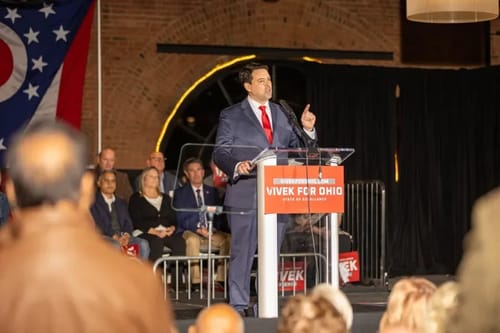
The Columbus company’s CEO, TJ Harper, and Maria Haberman, a senior vice president and lobbyist, scheduled a 30-minute call in July followed by another in early August with Senate President Rob McColley, who is already one of the three most powerful Republicans in the Statehouse and is running to become lieutenant governor under Vivek Ramaswamy.
The Ohio Supreme Court this summer had ordered state regulators to consider Nationwide Energy Partners and other submeterers – which buy electricity at a wholesale rate and resell it to apartment renters at a retail price – as public utilities. Such a designation would apply strict regulations and transparency requirements not previously required of such companies. Nationwide Energy Partners mounted its legislative push to avoid this fate, which was thwarted by Gov. Mike DeWine’s veto pen.
Neither the company nor McColley would say what the three discussed on their calls, but Haberman’s name appears on at least two other entries in McColley’s official calendar, obtained by Signal Statewide through a public records request.
Haberman was just one of the 38 registered lobbyists who appeared on McColley’s calendar this year for calls, meetings and lunches. And she was one of a small subset of lobbyists to have appeared in four separate entries.
The extensive list of government affairs professionals taking up McColley’s time in an election year highlights the endless number of interests seeking allies holding powerful jobs both today and tomorrow.
The Senate presidency**,** McColley’s current role, is by nature one of the three top jobs in state politics, with the governor and speaker of the House as counterparts. Victory in November could boost McColley’s clout, depending on one’s viewpoint. He currently holds a lower profile but wields more explicit power shaping state budgets and laws. He might be more recognizable as lieutenant governor, but the role is less defined and seen as more of a sidekick than a superhero.
Sitting lawmaker, future executive?
Only a few lobbyists matched Haberman’s four appearances on the Senate president’s calendar: They include Kevin Schmidt, of Strategic Public Partners, and Mariah Field, of the CJR Group.
Some lobbyists helped broker meetings between McColley and their clients, the calendar shows. Bill Byers, of Byers Minton, helped arrange a March 4 call between McColley and Palmer Luckey, CEO of Anduril, a company building an advanced weapons facility in central Ohio. It is set to receive hundreds of millions in tax breaks if it meets certain performance standards.
The calendar entries don’t include any details on subject matter. Determining as much is complicated by the fact that many contract lobbyists juggle dozens of clients. Byers, who didn’t return a phone call or email, is currently registered on behalf of more than 60 entities ranging from the Cleveland Browns to the City of Columbus to DaVita Healthcare.
Other CEOs made appearances. One entry on April 15 notes a meeting with the “CEO of SoftBank” and Schmidt, who’s registered to lobby for the company.
Neither the CEOs of SoftBank nor SBEnergy attended, per company spokeswoman Ally Copple. The company and McColley discussed the scope and details of the company’s planned data center in Piketon and accompanying natural gas-fired power plant, which end user OpenAI has called the largest data center in America.
Other data center developers appeared in the calendar. Amazon Web Services, the company’s data center arm, set up a March 4 meeting with McColley and its lobbyist, Kurt Leib.
Some lobbyists are campaign donors
In some cases, the lobbyists and the clients McColley met with were also current or to-be donors to Ramaswamy’s gubernatorial campaign.
For instance, Byers has given more than $33,000 to Ramaswamy’s campaign, state records show. Luckey, Anduril’s CEO and Byers’ client, gave $16,600, the legal maximum for the cycle.
Bobby Kovey, a lobbyist with the Credo Co., met with McColley in January before writing a $10,000 check in June.
Will Hinman and Andy Bowers are listed as having met with McColley in February, several months before the two Hinman Bowers partners each wrote $10,000 checks to the Ramaswamy-McColley campaign in July.
Hinman, in an interview, said he didn’t remember the specific meeting but it probably occurred. He said there’s nothing shocking about lobbyists meeting with lawmakers – it’s a standard and “unsensational” part of the job. He said it would be inappropriate to discuss contributions in an official (meaning nonpolitical) context.
“I don’t think that it’s front of mind,” he said. “When we’re meeting with officials, we’re talking about issues that are pending and of importance to our clients and not discussing political activity at all.”
Along with contract lobbyists, some single-focus advocates appeared in McColley’s calendars. These include Rob Sexton, a consultant for the Buckeye Firearms Association, Chris Dorr, of the Ohio Gun Owners, and Pat Tiberi of the Ohio Business Roundtable, among others.
There’s nothing illegal or unusual about a legislative leader meeting with lobbyists – lawmakers want to hear from businesses, and lobbyists want their clients’ issues in lawmakers’ ears.
A problem arises, however, when the corporate world has open channels to political power that the public lacks, according to Catherine Turcer, executive director of Common Cause Ohio, which advocates for open government and stronger transparency laws.
Turcer (who is herself a lobbyist) said data centers are a telling example. The calendars reflect several lobbyists representing data centers among other clients who managed to lock down time with McColley. She compared that to a shared feeling of disenfranchisement from Ohioans around the state who have felt unheard and unable to stop data centers from coming to town.
“So often, these folks facing real problems in their community have a hard time getting the ear of the senate president and other elected officials,” Turcer said.
“It’s business as usual in some ways, but the problem is business as usual means Ohio voters don’t have the same kinds of access, and their needs may not get a fair hearing.”
Signal Ohio is a nonprofit news organization covering government, education, health, economy and public safety.