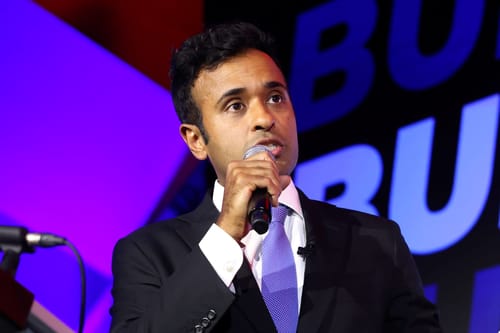

Vivek Ramaswamy is promising Ohioans something politicians almost never promise: an electric bill of zero.
Under his data center pledge, Ramaswamy says residents living near a newly built data center “will no longer pay for their home’s electricity.” His campaign says the idea is simple enough that “the mechanics are straightforward.”
Energy experts examining the proposal have reached a very different conclusion.
A former commissioner of the Public Utilities Commission of Ohio says the pledge is not based in reality and called it a “politically convenient stunt.” A researcher who has spent decades studying computing and energy says he is not sure how it would work. The president of the Ohio Chamber of Commerce says the plan is so undefined that its economics cannot yet be understood.
And an examination of Ohio electric bills and the regional power grid reveals a more basic problem: generating electricity is only part of what Ohioans pay for, and privately generated power does not simply spill onto the public electric grid and erase thousands of household bills.
‘It’s just a gimmick’
Ramaswamy unveiled the pledge Aug. 6 as political opposition to massive data center development continued to intensify across Ohio.
His plan would create what he calls a “benefit zone” around a new data center. The campaign says excess electricity from generation built alongside the facility would be credited to residential customers inside that zone. Alternatively, the data center company could directly reimburse residents for their electric bills.
Ramaswamy’s campaign offered an example: a 1,000-megawatt power plant could supply 700 megawatts to a data center while the remaining 300 megawatts “flows to the grid” and is credited to nearby households. The campaign claims even 100 megawatts of excess capacity could power 75,000 to 100,000 homes and says most Ohio counties could fit entirely within one of its benefit zones.
“The mechanics are straightforward,” Ramaswamy’s campaign said.
Ashley Brown, a former PUCO commissioner and retired executive director of the Harvard Electricity Policy Group, told The Toledo Blade otherwise.
Brown called the proposal a “politically convenient stunt” and said there was no evidence of serious policy work supporting it.
“They’re not even remotely serious,” Brown said. “It’s just a gimmick to get them through the election.”
Brown’s objections are not primarily political. They begin with one of the most basic unanswered questions in the proposal: What exactly does Ramaswamy mean by “free electricity”?
About half your electric bill isn’t generation
Electricity generation is only one part of an Ohio household’s electric bill.
The Office of the Ohio Consumers’ Counsel, the state agency representing residential utility customers, explains that Ohio electric bills consist primarily of generation, transmission and distribution costs.
Generation, the electricity itself, typically accounts for about half of a bill. Transmission and distribution, the infrastructure required to move that electricity across the grid and ultimately into a home, typically account for roughly the other half.
Distribution pays for local power lines, substations, meters, maintenance, billing and other infrastructure. The Consumers’ Counsel says those charges continue as long as a home remains connected to the grid.
Its consumer guide to electric bills is even more explicit: customer, transmission and distribution charges must still be paid to the utility regardless of how a customer’s electric generation is obtained.
That distinction exposes a hole at the center of Ramaswamy’s pitch.
If his promise means a data center supplies only the electricity generation itself for free, homeowners could still receive substantial utility bills for transmission, distribution and other delivery costs.
If Ramaswamy instead means exactly what his campaign says — that residents “will no longer pay for their home’s electricity” — then the data center would have to cover much more than the cost of producing power.
Ramaswamy’s own proposal acknowledges that possibility by saying companies could simply reimburse residents for their electric bills. But that would transform the promise into an open-ended requirement for a private company to pay potentially tens of thousands of complete household utility bills.
The published plan does not specify a maximum household usage, a maximum dollar reimbursement, how long the obligation lasts, what happens if electricity prices spike or how a company’s obligation changes as the population within the benefit zone changes.
Brown questioned why a company contemplating a multibillion-dollar investment would voluntarily accept an expense that could fluctuate for reasons outside its control.
The business group that endorsed him can’t make out the economics
That concern is not confined to Ramaswamy’s political opponents.
The Ohio Chamber of Commerce PAC endorsed Ramaswamy in July, with Chamber President and CEO Steve Stivers praising his approach to taxes, energy development and economic growth.
Weeks later, Stivers told The Blade that Ramaswamy’s free-electricity proposal was “so undefined” that he could not reach a clear opinion on it.
Stivers pointed directly at questions Ramaswamy has not answered: How large is a benefit zone? What happens if the power plant does not generate enough electricity to cover everyone within it? Would the data center then have to make an additional cash payment to residents?
The lack of specifics, Stivers said, makes it difficult to understand the economics.
That assessment is especially striking because it comes from the leader of an organization that endorsed Ramaswamy less than a month before he released the plan.
The electricity does not simply ‘flow to the grid’
There is another problem with Ramaswamy’s supposedly straightforward example.
His campaign describes a 1,000-megawatt plant supplying a 700-megawatt data center and says the remaining 300 megawatts simply “flows to the grid.”
But Signal Ohio found that exporting excess power from a private, behind-the-meter generating plant onto the broader electric grid requires the plant to connect to that grid and obtain corresponding approvals.
Ohio is part of PJM Interconnection, the regional grid operator serving all or portions of 13 states and Washington, D.C. The rules governing giant data centers that locate alongside their own power plants have become complicated enough that the Federal Energy Regulatory Commission ordered PJM to develop new rules governing such arrangements.
FERC said the rules are necessary to address grid reliability, consumer costs and the relationship between large loads and the generating facilities beside them.
In other words, the unused 300 megawatts in Ramaswamy’s campaign example do not automatically become a pool of free electricity that can be assigned to every house surrounding a data center.
Signal also identified another unanswered question: Ramaswamy’s pledge does not make clear whether a new data center would actually be required to build more generating capacity than it needs in the first place.
If a facility builds enough generation only to satisfy its own enormous demand, there may be little or no excess electricity available to support the promise.
‘I’m not sure how it would work’
Jonathan Koomey, a researcher who has studied computing, electricity consumption and energy efficiency for decades, reached much the same conclusion when asked about Ramaswamy’s plan.
“I’m not sure how it would work,” Koomey told the AP.
Koomey specifically pointed to distribution costs, which still have to be paid to move electricity into residential homes.
He also said he was unaware of another state operating a comparable program.
The criticism undercuts one of the central selling points of Ramaswamy’s rollout. His campaign does not describe the free-electricity component as an aspiration that still needs to be designed. It describes the mechanics as settled and straightforward and predicts that entire counties containing data centers could pay nothing for electricity.
Nearly a month later, significant questions about those mechanics remain unanswered.
Free power could create another cost problem
Brown also warned that completely eliminating the marginal cost of residential electricity could have an unintended consequence.
Electric rates give customers an incentive to conserve power. If electricity usage becomes effectively unlimited and free to the household, Brown said consumption could increase. Higher demand can require still more generation, transmission and distribution investment, increasing costs elsewhere on the system.
That concern comes as the Ohio Consumers’ Counsel warns that data centers are already driving extraordinary electricity demand and may require major investments in transmission lines and substations.
A hyperscale data center can consume as much electricity as 100,000 homes, according to the agency.
The Consumers’ Counsel has advocated a considerably narrower approach to protecting Ohio families: make exceptionally large users pay the costs they create.
In testimony before state lawmakers in June, Consumers’ Counsel Director Maureen Willis said the principle should be straightforward: when massive electric loads require significant new investment in generation, transmission or distribution, the customers creating those costs should bear them.
That is fundamentally different from requiring a data center not only to pay its own infrastructure costs, but to assume the residential electric bills of an entire surrounding community.
The campaign says a businessman can make it happen
Ramaswamy’s published plan offers little explanation of how the unanswered financial and regulatory questions would be resolved. Instead, his campaign argues that major technology companies will agree to the terms if Ohio’s governor demands them.
The pledge says Ramaswamy is confident hyperscale data center operators would be willing to “fully cover the cost of power” for nearby residents and argues that making it happen requires “the acumen of a businessman, not a bureaucrat.”
His plan also promises a day-one executive order halting approval of new data center projects until the General Assembly enacts the framework into law.
Brown questioned whether an Ohio governor has the constitutional authority to impose such a sweeping halt in the first place.
The AP reported Aug. 27 that Ramaswamy’s campaign did not provide additional details when asked about the proposal for its story.
Ramaswamy’s campaign also didn’t immediately respond to TiffinOhio.net’s request for comment.
The promise itself remains remarkably simple: Let a data center into your community and your electric bill disappears.
The system required to make that happen is anything but.
A former Ohio utility regulator calls the proposal an election gimmick. An independent energy researcher says he does not know how it would work. The leader of the state’s largest business organization, which endorsed Ramaswamy, says the economics remain undefined. Ohio’s consumer advocate says generating electricity accounts for only about half of a typical bill. And regional and federal regulators are still developing rules governing the very grid arrangements Ramaswamy presents as straightforward.
Ramaswamy has promised Ohioans free electricity. What his campaign still has not provided is a detailed explanation of how Ohio would actually deliver it.