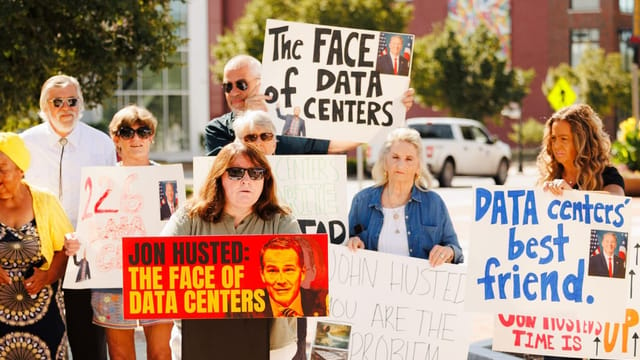
The same technology giants that fought Ohio’s effort to make large data centers shoulder more of the electricity infrastructure costs they create are now behind the voluntary framework Sen. Jon Husted is selling as the basis for his “Ratepayer Protection Act.”
Amazon, Google, Microsoft and Meta opposed a first-of-its-kind Ohio settlement designed to protect residential customers from being stuck with infrastructure costs created by massive new data centers, according to the Office of the Ohio Consumers’ Counsel, the state agency charged with representing residential utility customers.
The companies did not merely object around the edges.
According to the Consumers’ Counsel, they backed a competing proposal that would have lowered financial obligations for data centers and shifted more of their costs onto other customers — including Ohio families.
The Public Utilities Commission of Ohio ultimately rejected that approach and approved the settlement supported by AEP Ohio, the Consumers’ Counsel, PUCO staff and others. The resulting tariff requires new, large data centers to pay for at least 85% of their contracted electricity capacity for as long as 12 years, even if they ultimately use less power than they reserved.
The Consumers’ Counsel said the companies’ competing proposal included shorter contractual commitments, lower demand charges and reduced exit fees for data centers — with more financial risk falling on everyone else.
Now Husted is promoting a federal “Ratepayer Protection Act” based on a voluntary pledge signed by Amazon, Google, Meta, Microsoft and other technology companies.
And unlike the Ohio tariff those companies fought, Husted’s federal legislation would not require states to actually impose the proposed protections.
Big Tech fought the tougher version in Ohio
The Ohio fight offers a concrete test of how some of the biggest data center operators behave when regulators move beyond voluntary promises and actually put financial requirements into utility rates.
AEP Ohio asked state regulators in 2024 to create a special tariff for enormous new data center loads after warning that speculative projects and unprecedented electricity demand could leave existing customers exposed to billions of dollars in infrastructure costs.
A settlement eventually supported by AEP Ohio, the Consumers’ Counsel, PUCO staff, Ohio Partners for Affordable Energy and others established long-term financial commitments for new large data centers.
The Consumers’ Counsel said Amazon, Google, Microsoft and Meta challenged that tariff and supported their own settlement that would have shifted costs they caused onto residential customers’ utility bills.
PUCO approved the consumer-backed settlement anyway.
Under that tariff, new large data centers must generally pay for at least 85% of the electricity capacity they reserve for up to 12 years. The structure is meant to reduce the risk that a utility builds expensive infrastructure for a massive project that is later delayed, downsized or abandoned — leaving ordinary customers to pay for investments made to serve a project that never fully materialized.
The Consumers’ Counsel described the policy as a “cost-causer pays” approach: the customer creating extraordinary new costs should bear those costs rather than spreading them across millions of households.
That is precisely the principle Husted now says he wants to establish nationwide.
But his legislation stops short of actually establishing it nationwide.
Husted’s bill codifies principles from the companies’ own pledge
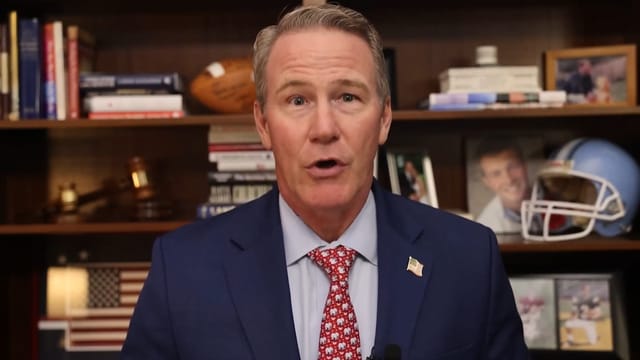
Husted’s office says the Ratepayer Protection Act would prevent families and small businesses from paying for energy infrastructure needed to support enormous new data centers.
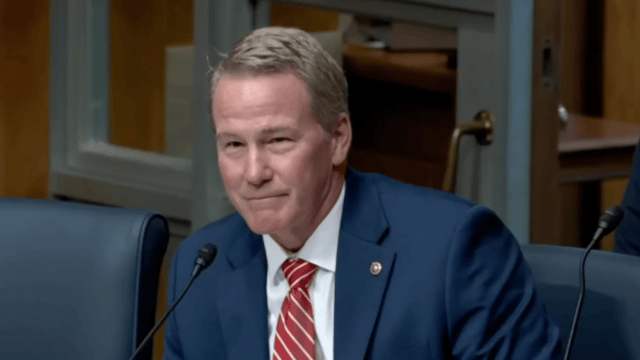
“The company that is creating enormous new demands for electricity should pay the costs required to serve them,” Husted said while pushing the legislation on the Senate floor.
But the framework Husted is advancing was built around commitments already embraced by the technology companies themselves.
The House Energy and Commerce Committee says the legislation “codifies the principles underpinning” President Donald Trump’s Ratepayer Protection Pledge.
That voluntary pledge was signed by Amazon, Google, Meta, Microsoft, OpenAI, Oracle and xAI.
Those companies pledged to cover the energy and infrastructure costs associated with their new data centers rather than shifting those expenses onto existing customers.
So the contrast is unusually stark.
In Ohio, Amazon, Google, Microsoft and Meta opposed a binding settlement designed to make large data centers shoulder more of their own infrastructure costs.
In Washington, Husted is touting legislation that codifies principles from a voluntary pledge signed by Amazon, Google, Microsoft, Meta and other technology companies — while leaving state regulators free to decide not to adopt the proposed standard at all.
The ‘protection’ is optional
Husted has repeatedly described the Ratepayer Protection Act in much stronger terms than the legislation’s actual federal mandate.
His office says the bill would “ensure” that data centers pay for the energy and grid upgrades they need so families and businesses are not forced to absorb those costs.
But Husted’s own description of the legislation acknowledges what it actually requires: states must consider establishing the standards.
The House Energy and Commerce Committee says the same thing. The bill would amend the Public Utility Regulatory Policies Act to require state regulatory authorities to “consider creating a large-load standard.”
Consider.
Not adopt.
Not enforce nationwide.
Not require every data center to pay those costs.
A state regulator could conduct the federally required proceeding, consider Husted’s proposed standard and decide not to adopt it.
That means Husted is calling legislation the “Ratepayer Protection Act” even though Congress itself would not require the ratepayer protection to take effect.
If a state voluntarily adopts the standard, large electricity users of at least 100 megawatts could be required to cover the full incremental cost of generation, transmission, distribution and other infrastructure necessary to serve them and provide financial assurances protecting other customers from stranded costs.
But Husted’s bill leaves the final decision with state regulators.
Ohio has already demonstrated what a stronger approach looks like.
And Amazon, Google, Microsoft and Meta fought it.
Husted spent years helping bring data centers to Ohio
The federal legislation also comes from a senator who spent years publicly promoting the expansion of the data center industry in Ohio.
A Sept. 23 PolitiFact review found that Husted actively promoted data center investment and defended tax incentives for the industry while serving as lieutenant governor.
In 2019, Husted publicly defended a 15-year sales tax exemption estimated at $43.5 million for Google’s New Albany data center, arguing that the investment could have gone somewhere else if Ohio collected the tax.
In 2023, Husted joined Gov. Mike DeWine and JobsOhio in announcing Amazon Web Services’ planned $7.8 billion Ohio expansion and said the investment moved Ohio closer to becoming “the tech center of the Midwest.”
Later that year, DeWine and Husted announced an Aligned Data Centers project in Erie County that received a 75% sales tax exemption for 15 years while projecting 18 full-time jobs.
And in 2025, Husted praised another $10 billion Amazon investment, saying artificial intelligence and data centers were “crucial to America’s economic superiority.”
Data centers received about $2.5 billion in Ohio state and local tax incentives between 2017 and 2024, according to figures cited by PolitiFact. The Ohio Tax Credit Authority formally approved state exemptions, while Husted repeatedly promoted the projects and defended the incentive strategy as lieutenant governor.
Ohio electric prices have climbed as the data center fight intensified
The fight is unfolding as Ohio households are already paying significantly more for electricity.
According to U.S. Energy Information Administration data released Sept. 24, the average residential electricity price in Ohio rose from 17.38 cents per kilowatt-hour in July 2025 to 19.45 cents in July 2026 — an increase of nearly 12% in one year.
Data centers are not the sole cause of that increase. Electricity prices are affected by generation costs, fuel prices, transmission expenses, capacity markets and other factors.
But the extraordinary new demand created by data centers has become a central concern for regulators and consumer advocates because serving facilities requiring hundreds of megawatts can require new power generation, substations, transmission lines and other infrastructure.
The Ohio Consumers’ Counsel has repeatedly warned that without special protections, those investments can create substantial financial exposure for customers who had nothing to do with creating the demand.
That is why Ohio adopted its data center tariff.
And it is why the companies’ opposition to that tariff matters when Husted now points to their voluntary pledge as the foundation for his federal legislation.
Republicans privately called data centers Husted’s ‘anchor’
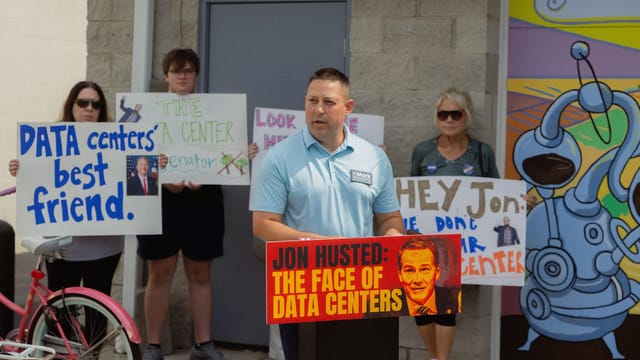
The issue is no longer merely regulatory. It has become a major political vulnerability for Husted heading into November.
An Aug. 18 National Republican Senatorial Committee memo obtained by Axios and The Washington Post warned technology companies that attacks on Husted’s data center record were working.
“More than any other thing in this race, data centers are the anchor hanging around Husted’s neck,” the NRSC wrote.
The Republican campaign committee said Democratic challenger Sherrod Brown was focusing on Husted’s data center record “because it works” and warned that if Husted loses with data centers blamed for his defeat, politicians elsewhere could become reluctant to support additional projects.
The Ratepayer Protection Act predates that memo. Husted introduced the Senate legislation in July.
But after Republicans privately identified data centers as his biggest political problem, Husted made the legislation a prominent part of his public response. On Sept. 17, he went to the Senate floor seeking unanimous consent to pass it and called the bill “the most meaningful bipartisan step Congress could take” to protect Americans from higher electricity costs.
Husted’s stated principle is difficult to dispute: enormous electricity users should pay the extraordinary costs they create.
Ohio regulators already put a version of that principle into an enforceable tariff.
Amazon, Google, Microsoft and Meta fought it.
Now Husted is asking voters to accept a federal bill based on principles from a pledge signed by those same companies — a bill that requires every state to consider protecting ratepayers, but does not require a single state to actually do it.