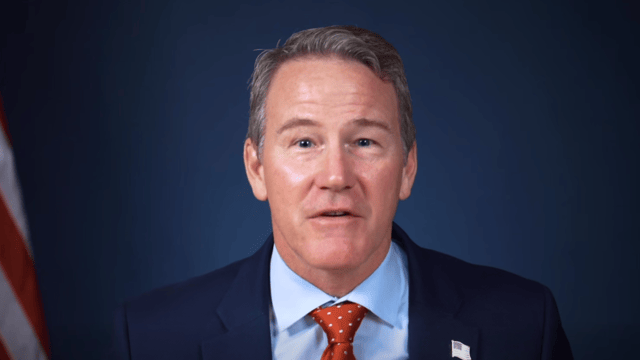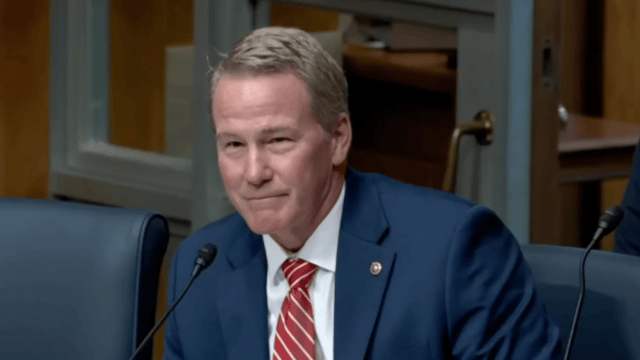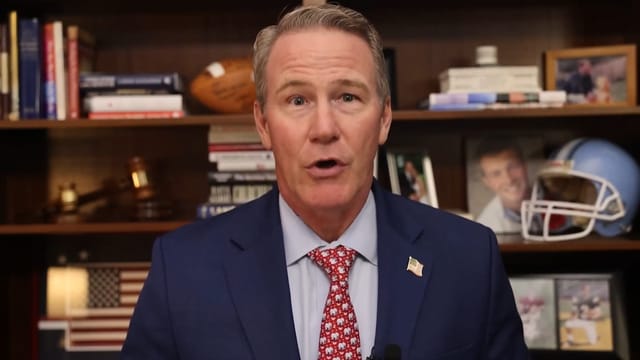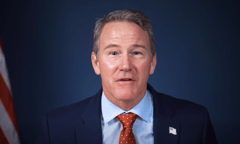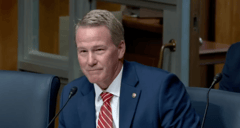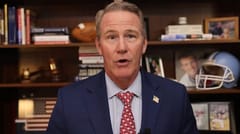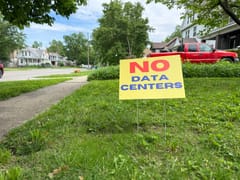
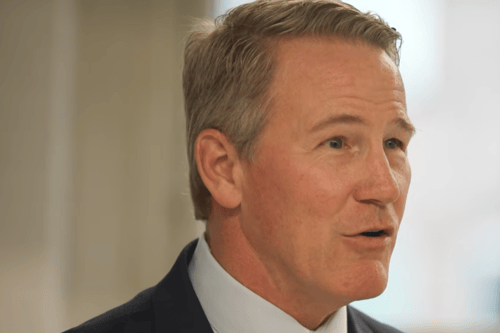
U.S. Sen. Jon Husted, who spent six years as Ohio’s lieutenant governor recruiting the data center industry to the state, told an interviewer that Ohioans themselves are responsible for the demand behind the buildout now reshaping their electric bills.
“When we look in the mirror, we are the problem,” Husted said in the shocking interview.
Asked about data centers, Husted said in full:
“But we just have to realize, you know, we’re in this world in which we-we’ve created the demand. We, the people, have created the demand for these data centers because we use all of these digital products that it processes, and if we don’t want them, then don’t use them. I mean, you can go back to the bunny ear antenna on your TV — you don’t need a data center. But if you’re connected to a wire, you’re using the data center. So, understand, like, when we look in the mirror, we are the problem.”
The remarks came in an interview Friday on Strictly Speaking with Bob Frantz.
Husted’s office and campaign have consistently claimed he is working to keep data center costs off household bills. On Thursday, July 16, he introduced the Ratepayer Protection Act, S. 5028, which would push states to consider requiring large electricity users to cover the full cost of the generation and transmission built to serve them. Announcing the bill, Husted said the country must expand energy infrastructure “without passing the costs on to working families and small businesses.” The measure was referred to the Senate Energy and Natural Resources Committee. A House companion, H.R. 9340, cleared the Energy and Commerce Committee 52-0.
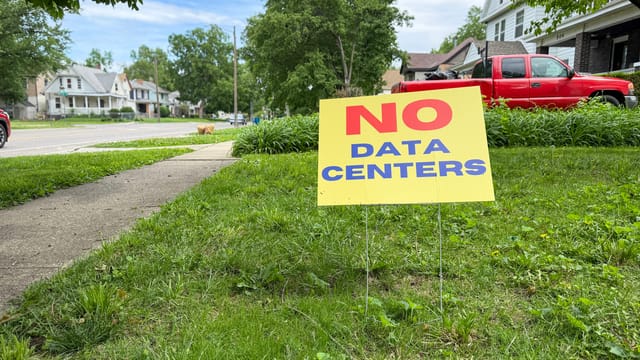
Husted has also said repeatedly that siting decisions belong to communities, telling the Washington Examiner this month that data centers “should remain a local decision.” He joined President Donald Trump at the White House in March for a roundtable on the administration’s Ratepayer Protection Pledge, under which several technology companies committed to fund the power and infrastructure for new facilities.
The record behind the remark
Husted did not create Ohio’s data center incentive. The state’s sales tax exemption for data center equipment dates to the Kasich administration’s first budget in 2013, when Husted was secretary of state. But as lieutenant governor from January 2019 to January 2025, he became the state’s most visible salesman for the industry, and the incentive’s cost exploded on his watch.
TiffinOhio.net reported this week that Husted’s campaign has collected roughly $69,750 from political action committees and employees tied to Google, Amazon, Microsoft, Oracle, American Electric Power, Duke Energy and Vistra, according to federal filings through June 30. Husted publicly defended a $43.5 million tax break for Google’s New Albany campus in 2019.
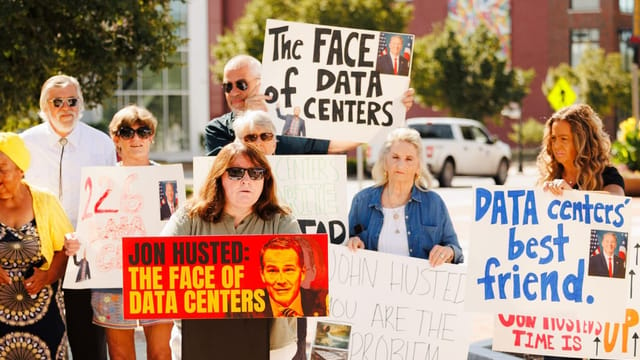
Democratic nominee Sherrod Brown has built a series of television ads around that history, labeling Husted “the face of data centers in Ohio” — a phrase the campaign attributes to The Plain Dealer. Brown, who won the Democratic primary in May, has called for eliminating Ohio’s data center tax break outright, a position that puts him at odds with building trades unions that have backed Husted.
What the numbers show
Ohio now has more than 200 data centers, the fifth-highest total of any state, according to the Office of the Ohio Consumers’ Counsel. Companies plan to invest up to $40 billion more in Ohio facilities by 2030.
The state’s sales tax exemption for those facilities cost Ohio about $1.6 billion in 2025, roughly 11 times the Department of Taxation’s $136 million forecast, and about $555 million in 2024. The disclosure prompted Gov. Mike DeWine to pause new exemption requests while a legislative select committee reviews the industry. State Sen. Bill Reineke, R-Tiffin, sits on that panel.
Household bills have climbed alongside the buildout. In testimony to the Ohio House Energy Committee, Policy Matters Ohio researcher Molly Bryden reported that the average Ohio residential electric bill in July 2025 was $214, a 25.7% increase over the prior year and the third-largest increase in the country, citing federal Energy Information Administration data. Average monthly residential electricity costs in Ohio have risen 34.9% over the past decade even as residential demand fell 9.3%. Bryden noted that data centers are not solely responsible for rising costs, but that the pace and scale of their growth carries serious consequences without stronger ratepayer protections.
What it means in Tiffin
Tiffin is served by AEP Ohio, the utility whose rates and data center policies have been reworked repeatedly by the Public Utilities Commission of Ohio over the past year. The National Energy Assistance Directors Association projects the typical Ohio household will spend about $745 on electricity from June through September, up 7.8% from $691 a year ago.
More households are falling behind. AEP Ohio’s disconnection rate reached 15%, roughly four times FirstEnergy’s, as bills climbed 53% since 2021. Ohio has no summer shut-off protections comparable to its winter disconnection safeguards. Households earning under $57,750 for a family of four may qualify for help through the state’s Summer Crisis Program, which runs through Sept. 30.
The political response
Ohio Democratic Party Senior Communications Advisor Tony Wen said in a statement:
“It’s absolutely disgraceful that Jon Husted is blaming hardworking Ohioans for their skyrocketing electricity bills caused by the record number of data centers that he helped bring to the state. Jon Husted could not be more out of touch with the people of Ohio, and they will hold him accountable in November.”
Husted, appointed by DeWine in January 2025 to fill the seat JD Vance vacated to become vice president, faces Brown in a Nov. 3 special election for the remainder of that term. The race is among the most closely watched in the country and could determine control of the Senate.