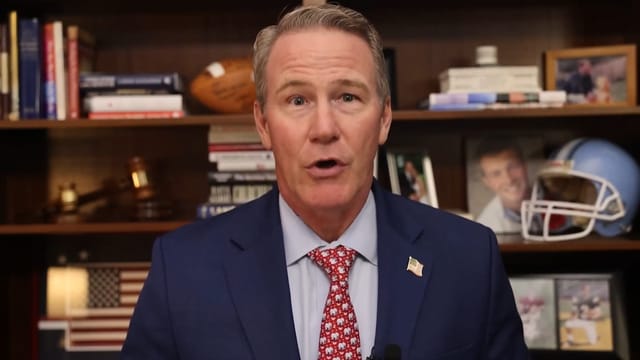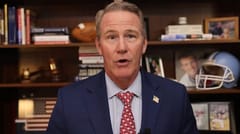
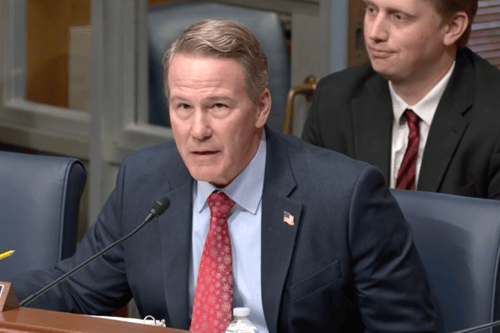
U.S. Sen. Jon Husted’s campaign has accepted about $69,750 from political action committees and employees tied to the technology and power companies at the center of Ohio’s data center fight, according to federal campaign finance filings covering the period through June 30.
The money is a small fraction of what the Republican has raised. Husted’s campaign reported $14.35 million in total receipts and $9.42 million in cash on hand at the end of June. The contributions traced to data center and utility interests amount to less than half of one percent of that.
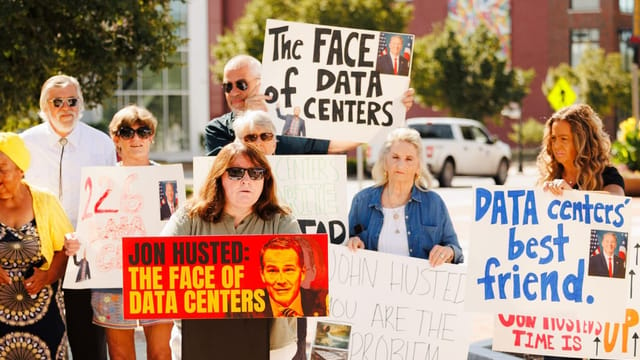
But the donations arrive as data centers have become one of the defining issues of Husted’s race against Democrat Sherrod Brown — and as Husted’s own record of recruiting those facilities to Ohio has become the subject of television advertising.
Federal filings show corporate political action committees affiliated with Google, Amazon, Microsoft and Oracle gave the campaign $16,000 combined. Employees and executives of Google, Microsoft, Meta and Oracle contributed another $28,750, including two Oracle contributors who each gave $7,000, the maximum allowed for the primary and general elections combined. The filings list their occupations as the company’s chief technology officer and founder, and its president and chief executive.
Corporate PACs are funded by voluntary employee contributions rather than company treasuries.
A further $25,000 came from the PACs of three electricity companies with direct exposure to data center growth: American Electric Power, Duke Energy and Vistra. AEP’s Ohio utility serves the central Ohio corridor where much of the state’s data center construction has concentrated.
Husted introduced a ratepayer bill this month. It has no cosponsors.
On Thursday, July 16, Husted introduced the Ratepayer Protection Act, which would push states to make large electricity users — data centers among them — cover the cost of the power generation and transmission upgrades built to serve them, rather than letting utilities spread those costs across household bills.
“If America wants to lead the world in AI and strengthen our national security, we have to build the energy infrastructure to support it,” Husted said in announcing the measure, adding that the country must do so “without passing the costs on to working families and small businesses.”
The bill’s reach is narrower than its title suggests. It works through the Public Utility Regulatory Policies Act, a 1978 law whose federal standards require state regulators only to consider adopting them. Nothing in the measure compels a state to act.
The bill has attracted no cosponsors and was referred to the Senate Energy and Natural Resources Committee, whose chairman, Sen. Mike Lee of Utah, said last month that he did not have data center legislation identified as a priority. Husted’s office has said he is encouraged by bipartisan support for a companion measure in the House and intends to keep working with the committee. That House version, sponsored by Reps. Gabe Evans, a Colorado Republican, and Kathy Castor, a Florida Democrat, is the vehicle that has actually advanced.
Husted has also worked the issue outside Congress. On Wednesday, March 4, he joined President Donald Trump, Energy Secretary Chris Wright and technology executives at a White House roundtable promoting the administration’s Ratepayer Protection Pledge, a voluntary commitment under which companies including Amazon, Google, Meta, Microsoft, Oracle, OpenAI and xAI would build, buy or bring their own power supply for new artificial intelligence data centers.
“Requiring companies to fund their own power protects working people from higher bills,” Husted said in a statement released by his office that day.
Husted told the Washington Examiner this month that siting decisions should stay local. “Data centers are, and should remain, a local decision. Every community has different priorities, and local leaders are best equipped to decide what’s right for their residents,” he said in a comment to the publication. He said many communities welcome the facilities for tax revenue and construction jobs, while others have “legitimate questions and concerns, and those local decisions should be respected.”
A record that goes back to 2019
The advertising against Husted reaches back to his tenure as lieutenant governor.
In November 2019, Google secured two separate incentives for a central Ohio data center: a 15-year abatement on New Albany property taxes, and a 15-year state sales tax exemption estimated at $43.5 million and approved by the Ohio Tax Credit Authority.
The local abatement was granted under Ohio’s Community Reinvestment Area law, which exempts the value of newly constructed buildings but, as New Albany notes, does not abate the increased value assessed on the land itself. The city argues that describing such agreements as “tax breaks” wrongly implies a company owes nothing at all, and says its abatements never permanently excuse a corporation from paying taxes.
Husted defended the incentives at the time and said the economic return would outweigh the cost. He said the investment would fuel the state’s economy for years and give Ohio a case to make globally, adding that when the question is where the tech hub of the Midwest is, he believed the answer would be Columbus. He also said charging sales tax would have driven Google out of Ohio.
Brown’s campaign has built an advertisement around that history. The ad calls Husted “the face of data centers in Ohio” — a characterization the ad attributes to The Plain Dealer, not to Brown himself — and says Husted cut tax deals and sped approvals while residents absorbed rising electricity costs. “Jon Husted: Who’s he really working for?” the narrator asks.
Brown has separately called for Ohio to end its data center tax break altogether.
The race
Husted and Brown meet on Tuesday, Nov. 3, in a special election for the Senate seat previously held by Vice President JD Vance. Gov. Mike DeWine appointed Husted to the seat in early 2025. The Cook Political Report rates the contest a toss-up.
Brown, who represented Ohio in the Senate for three terms, lost to Republican Bernie Moreno in 2024.