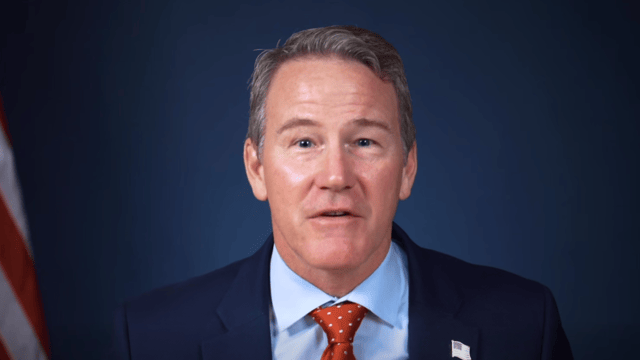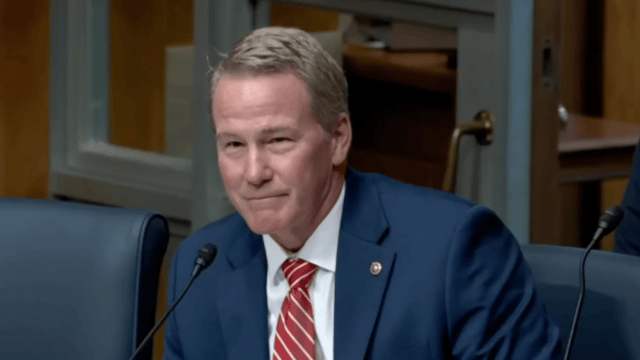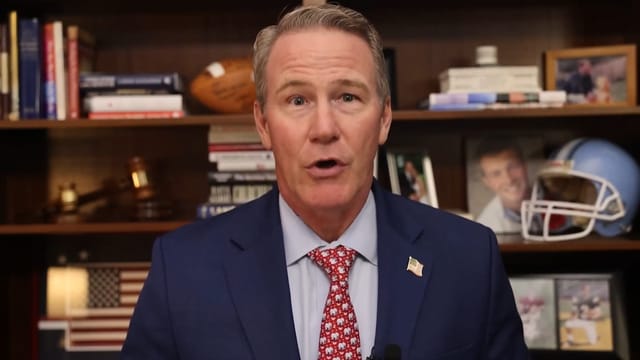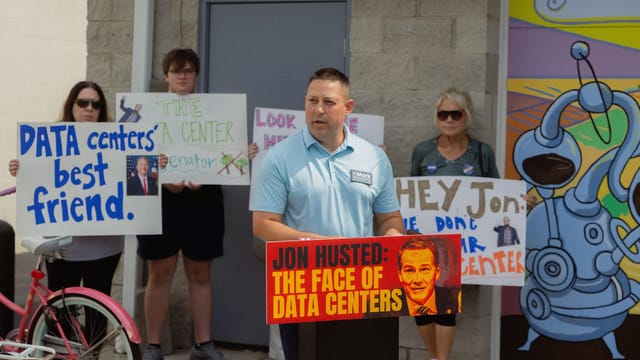
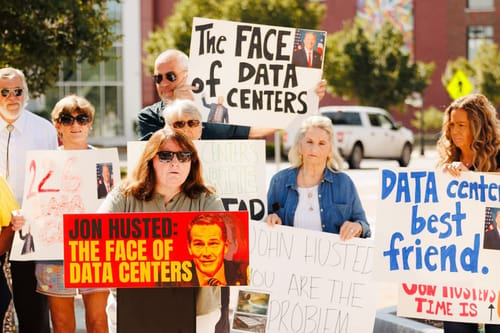
LIMA, Ohio — Ohio’s increasingly bitter fight over data centers reached downtown Lima this week, where local officials, candidates and residents gathered to accuse U.S. Sen. Jon Husted of helping fuel the industry’s rapid expansion while Ohioans contend with higher electric costs.
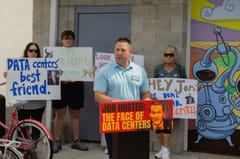
About a dozen people attended the rally Tuesday near the Veterans Memorial Civic and Convention Center, according to local media reports. Photos from the event showed demonstrators holding signs calling Husted the “face of data centers,” accusing him of favoring the industry and pointing back at his recent declaration that “we are the problem.”
The protest comes as data centers have moved from a development issue to a potentially defining issue in Ohio’s U.S. Senate race.
On Wednesday, Axios reported that the National Republican Senatorial Committee privately warned major artificial intelligence companies that public opposition to data centers is threatening Republicans’ chances of holding Husted’s seat. The memo said Democrats have made the issue a “centerpiece” of their campaign against Husted and warned that it would continue to dominate the race unless public perceptions change.
That is the same argument protesters in Lima were making from the sidewalk.
“Jon Husted is blaming you and I for using the tools modern life requires, while ignoring the fact that he helped flood the state with massive, power-hungry data centers without a coherent plan, without including citizens in the planning, without considering the costs that the people and the environment would pay,” Lima City Councilwoman Jeannine Jordan said at the rally.
Jordan said Ohio needs “leadership that starts with people, not with corporations.”
The criticism centers on Husted’s years promoting the data center industry while serving as lieutenant governor from 2019 until his appointment to the U.S. Senate in 2025.
Husted publicly celebrated major investments from Google and other technology companies during that period, describing data centers as essential to the digital economy and presenting Ohio as a growing technology hub. He did not create Ohio’s data center sales-tax exemption, which predates his tenure as lieutenant governor, but he became one of the administration’s most visible advocates for attracting the projects.
The cost of that incentive has since exploded. Ohio Department of Taxation figures showed the sales-tax exemption cost the state nearly $1.57 billion in 2025, compared with a previous projection of $136 million. Gov. Mike DeWine paused consideration of new exemptions in May while state officials and lawmakers examine the industry’s impact.
Separate state records show Ohio has committed at least $2.3 billion in long-term sales-tax exemptions to data center operators, including Google, Meta and Amazon.
Lew Modic, a Democratic candidate for Allen County commissioner, told the Lima crowd that residents have too little information about the agreements being made around data center development.
“The way we have done this has been behind closed doors and so much secrecy,” Modic said, according to WLIO. “Nobody knows what’s in it for us as a community long term and the information is not coming out.”
Chris Gibbs, a Shelby County farmer and chairman of the county Democratic Party, focused on what he said his own operation has experienced.
“Just in my case alone, AES has jacked rates 26% in the past 12 months, and over the past 24 months, my rates on those accounts have increased 37%,” Gibbs said.
The broader increase in electricity costs is not in dispute, although data centers are not the only factor pushing bills higher. A report released this summer projected that average Ohio residential electric costs could approach $800 for the summer, while the regional PJM grid faces rapidly growing power demand, aging generation and transmission constraints.
Data centers are a significant part of that demand growth. PJM, which manages the electric grid serving Ohio and 12 other states plus Washington, D.C., has been developing new rules aimed at preventing large electricity users from putting reliability and costs onto other customers.
Husted has responded to the backlash by arguing that data center operators, rather than households and small businesses, should pay for the new power infrastructure their facilities require.
In July, he introduced the Ratepayer Protection Act, legislation that would require states to consider standards aimed at making large electricity users cover the generation, transmission and other infrastructure costs needed to connect them to the grid.
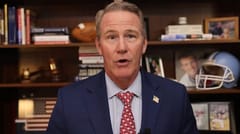
“If America wants to lead the world in AI and strengthen our national security, we have to build the energy infrastructure to support it,” Husted said when announcing the legislation. “But we must do that without passing the costs on to working families and small businesses.”
But Husted also drew criticism after explaining the growth of data centers in a July interview by pointing to consumers’ own use of digital technology.
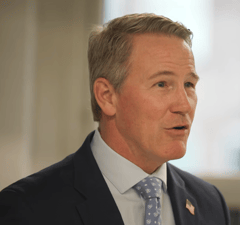
“We, the people, have created the demand for these data centers because we use all of these digital products that it processes,” Husted said. “So, understand, like, when we look in the mirror, we are the problem.”
Husted has also said decisions about whether individual data centers should be built should remain with local communities.
Democratic nominee Sherrod Brown has made Husted’s record on the issue a central piece of his campaign, running advertisements portraying him as the “face of data centers in Ohio.” The two candidates have increasingly offered competing approaches to the industry’s expansion, with Brown calling for an end to state data center tax breaks and Husted supporting continued development with protections intended to prevent costs from being shifted to other ratepayers.
The Lima rally offered another sign that the fight is moving well beyond Columbus and the large projects concentrated in central Ohio.
And Wednesday’s Republican campaign memo made clear that Husted’s own party sees the political danger.
According to Axios, the NRSC warned that if voters continue blaming data centers for higher costs and other local impacts, the backlash could spread well beyond Ohio.