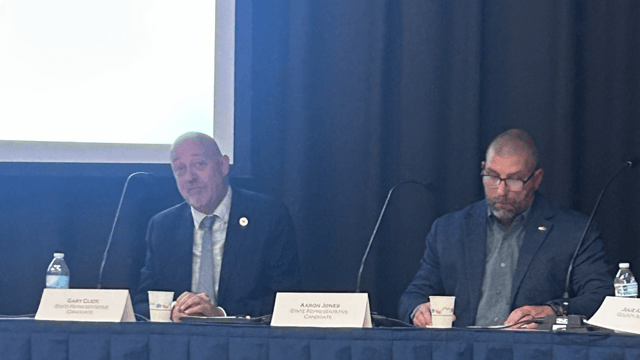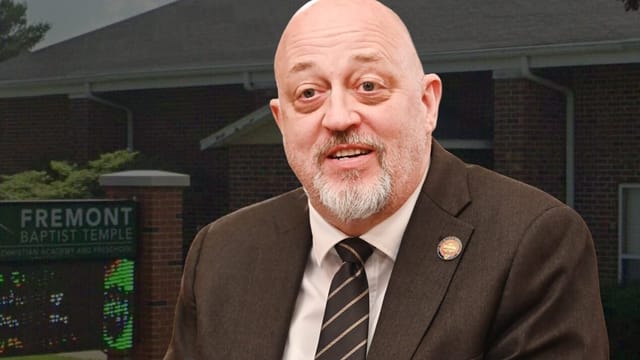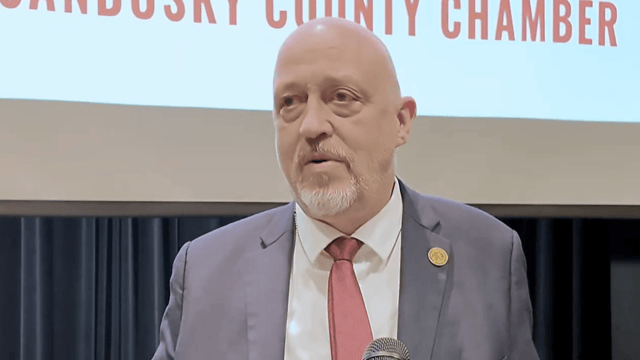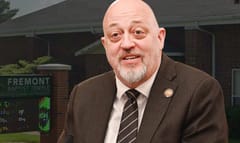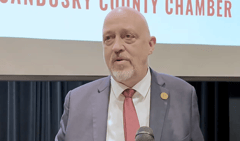

The signature data center bill that HD-88 state Rep. Gary Click has spent months promoting has been effectively sidelined by his own party’s Statehouse leadership.
House and Senate leaders on Wednesday announced the creation of a new Joint Data Center Committee that will study the economic, environmental and security impacts of data center development — the same scope that Click’s House Bill 646 would have assigned to a separate study commission. The joint committee can be assembled and begin work substantially faster than the commission Click proposed, the new co-chairs said.
The new committee will be led by House Energy Committee Chair Rep. Adam Holmes (R-Nashport) and Senate Energy Committee Chair Sen. Brian Chavez (R-Marietta). Click is not a member.
Click (R-Vickery) told the Toledo Blade the newly created joint committee would likely make the commission he proposed in HB 646 moot, but framed the outcome as collaborative.
“We began with an open concept anticipating input from our colleagues in both chambers. This is the culmination of those efforts,” Click said, according to The Blade. “I look forward to a final product that will provide a reasoned and rational response to the questions Ohioans are posing.”
A signature bill that stalled in the Senate
HB 646, co-sponsored by Click and Rep. Kellie Deeter (R-Norwalk), was introduced in January and passed the Ohio House unanimously in March. It would have created a 13-member Data Center Study Commission within the Department of Development, charged with submitting a report and legislative recommendations within six months of the bill’s effective date.
The bill was referred to the Senate Financial Institutions, Insurance and Technology Committee, where it has not advanced in roughly two months. Senate leaders had Click’s legislation on their desk and elected to build a different vehicle instead.
Click has repeatedly held up HB 646 as evidence that he is responsive to constituent concerns. In a March statement issued after the House vote, Click said, “This legislation originated in the heart of the 88th district, in response to my constituents. They have questions that deserve answers.”
The bill has been backed by the Ohio Farm Bureau and drew supportive testimony from agricultural and environmental stakeholders. Click told Signal Cleveland in March that he had received positive feedback from House GOP leaders on the legislation.
Bill directed commission to study “foreign propaganda”
Beyond its procedural fate, HB 646 also drew attention for an unusual provision tucked among its mandatory areas of study: a requirement that the proposed commission examine “reports of foreign propaganda intended to create opposition to data centers.”
That language appears in the Ohio Legislative Service Commission’s official bill analysis alongside more conventional topics such as environmental impact, effects on the electrical grid and consumer utility rates, water usage, farmland preservation, and noise and light pollution. It frames the possibility that citizen opposition to data centers may be the product of hostile foreign influence rather than legitimate local concern.
The provision drew formal opposition during the bill’s committee process. In testimony submitted to the House Technology and Innovation Committee, the libertarian-leaning Reason Foundation recommended deleting the foreign propaganda language outright, writing that the commission’s report “must studiously avoid the appearance of bias in how it presents its findings.”
TiffinOhio.net reported on the provision in February. The Joint Data Center Committee’s mission statement, as articulated Wednesday by Holmes and Chavez, contains no reference to foreign propaganda. The co-chairs said the committee will focus on the economic, environmental and security impacts of data center development through discussion with experts, stakeholders and Ohio citizens.
Leadership handed the work to its committee chairs
The new joint committee places data center policy in the hands of the lawmakers who already oversee Ohio’s energy and technology committees — and bypasses Click structurally as well as procedurally.
Holmes chairs the House Energy Committee. Chavez chairs the Senate Energy Committee. Rep. Thad Claggett (R-Newark), who chairs the House Technology and Innovation Committee — the panel that held the original sponsor hearings on HB 646 in February — is also a member of the new joint committee.
Click chairs the House Community Revitalization Committee, which has no jurisdiction over energy or technology policy. He sits on the Ways and Means, Education and Children and Human Services committees, per his official Ohio House profile.
The committee structure means that the chairs who would normally shepherd a data center study through the legislative process are now doing that work directly, without HB 646 as the vehicle and without Click in the room as a voting member.
Click reduced from sponsor to invited participant
Chavez said Click, Deeter, Sen. Michele Reynolds (R-Canal Winchester) and Sen. Kent Smith (D-Euclid) are “expected to participate” in the committee process, according to The Blade’s reporting. That is the language typically used at the Statehouse for non-members allowed to attend and offer input but who do not hold a vote on the body.
Click’s role in the work he initiated has effectively been reduced from prime sponsor of the underlying legislation to invited participant on the body doing the equivalent work.
Committee membership and timeline
The Joint Data Center Committee has eight members — four from each chamber, with six Republicans and two Democrats. Senate members are Chavez, Sen. Bill Reineke (R-Tiffin), Sen. Shane Wilkin (R-Hillsboro) and Sen. Willis Blackshear Jr. (D-Dayton). House members joining Holmes are Claggett, Rep. Heidi Workman (R-Rootstown) and Rep. Chris Glassburn (D-North Olmsted).
The first two meetings are scheduled for May 27 and May 28, with at least one meeting per week planned after that. Chavez said the committee will distribute a summary of its findings to local governments to help inform decisions on data center siting.
Holmes and Chavez said they expect testimony from representatives of Meta and Google, as well as from the Ohio EPA, Ohio Department of Natural Resources, the Public Utilities Commission of Ohio and the Office of the Ohio Consumers’ Counsel.
Political context
The 88th House District covers Seneca and Sandusky counties. Click narrowly won a bruising Republican primary on May 5 over Tiffin Republican Eric Watson, a first-time candidate, and faces Democratic challenger Aaron Jones, a local manufacturing supervisor, Tiffin City Councilman and Army veteran, in the November general election.
The joint committee will meet as supporters of a separate citizen-led constitutional amendment to ban construction of large new data centers continue collecting signatures. Backers of that effort must submit 413,487 valid signatures by July 1 to qualify for the November ballot.