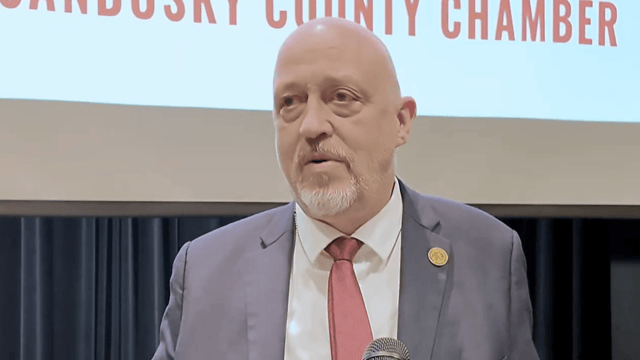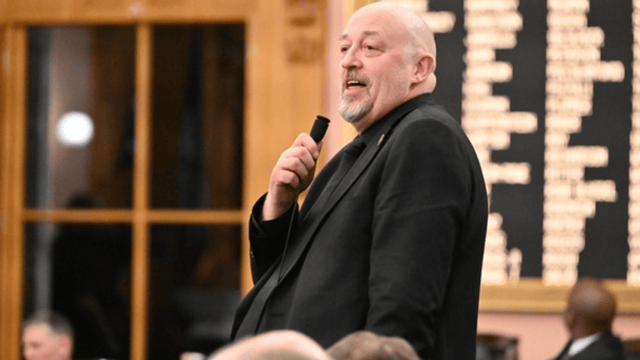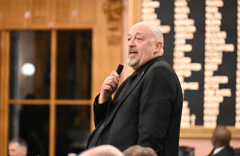


State Rep. Gary Click marked Independence Day by posting an artificial-intelligence video that inserted his own likeness into the signing of the Declaration of Independence.
Click, a Vickery Republican serving his third term in the Ohio House, published the roughly 12-minute video to his official Facebook page early Saturday, July 4. In it, an AI-rendered figure resembling Click appears among the Founding Fathers in a candlelit colonial chamber; a companion frame shows a modern, blazer-clad likeness of Click holding up a smartphone to take a selfie with several bewigged figures. On-screen text during the clip reads “ABUSES AND USURPATIONS.”
“Have you ever dreamed of visiting the Founding Fathers during the most notable times of American history? I have. Now, thanks to AI, I’ve done it,” Click wrote in the caption. He described the piece as a decade-and-a-half-old audio dramatization to which he added “video enhanced by my imagination,” and urged followers to “take time to learn about the founding of our great nation.”
The post drew a mix of reactions. As of Sunday it showed 31 likes and other positive reactions alongside 28 comments and nine shares. Several commenters were sharply critical.
“Does your arrogance and ego ever stop? For you to insert your likeness into such a noble event is more than I can take. So inappropriate. So distasteful,” one commenter wrote.
Another objected to the historical framing, noting that Thomas Jefferson’s original draft of the Declaration contained a passage condemning slavery that the Continental Congress struck. “If we are going to tell our story, honestly, we should do so with the truth and not what makes us feel comfortable,” the commenter wrote, adding that the United States still needs to “strive for the ‘more perfect’ part.”
A third comment was blunter: “I’m glad that the beloved pet pig of George Washington finally got to be represented in this biopic. Oh my bad, it’s just Gary.”
A lawmaker aligned with the AI buildout
The Fourth of July video is a lighthearted turn for a legislator whose recent policy work has placed him squarely on the side of the industry that AI depends on. Generative AI tools like the one Click used run on data centers — the large, power- and water-hungry computing facilities spreading across Ohio.
Click is a joint sponsor, with Rep. Kellie Deeter (R-Norwalk), of House Bill 646, legislation he introduced in January to respond to that expansion. As the bill passed the House, it would have created a Data Center Study Commission charged with examining data centers’ effects on the environment, the electrical grid, water supplies, farmland and the local economy — and, in a clause with no parallel elsewhere in the bill, “reports of foreign propaganda intended to create opposition to data centers.”
That wording appears verbatim in the Ohio Legislative Service Commission’s official analysis of the bill, which lists Click and Deeter as primary sponsors. The commission’s mandatory study topics also include data centers’ “value to national security and artificial intelligence development.”
The provision would place community opposition to data centers on the same footing as environmental or infrastructure concerns while framing it as a potential foreign-influence problem rather than ordinary civic dissent. The libertarian Reason Foundation submitted testimony recommending the language be deleted, cautioning that the commission’s work should avoid the appearance of bias.
The issue is not abstract in Click’s district, which covers all of Sandusky and Seneca counties. Kara Hetrick, who lives outside Gibsonburg near a proposed data center site, told lawmakers at a hearing she objected to the state spending money to study the question at all. “Now we’re going to have more wasteful tax dollars to study a so-called foreign propaganda,” she said, “when really all it is, (is) we the people voicing our concerns with opposition.”
Click has defended the measure as a response to those same constituents. “We have heard the concerns of our communities and taken time to speak with those in the industry,” he said when the bill was introduced. “We feel that this is the best approach to ensure that every voice is heard.”
Where the bill stands
HB 646 passed the Ohio House unanimously, 97-0, on March 19, 2026. In the Senate, lawmakers scrapped the study-commission framework and rewrote the measure into a broader regulatory package addressing data-center electricity rates, water use, tax breaks and public-records access to nondisclosure agreements. That substitute version — which no longer contains the study commission or its “foreign propaganda” clause — remains in the Senate Energy Committee, with lawmakers signaling further action when the General Assembly returns to Columbus in November.
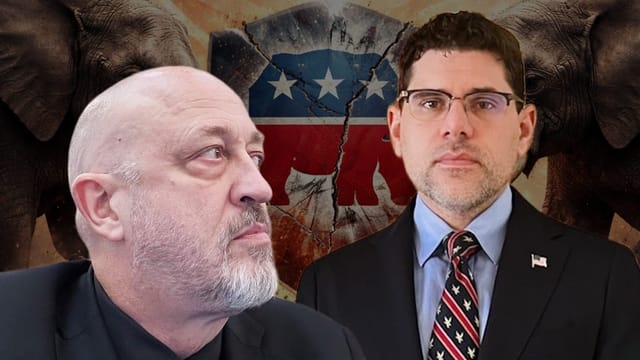
The Fourth of July post is not Click’s first brush with AI-generated content. TiffinOhio.net reported in February that Click drew criticism from fellow Republicans after weighing into a dispute over an AI-generated video during his primary campaign.
Click narrowly won the May 5 Republican primary over challenger Eric Watson, of Tiffin. He faces Democrat Aaron Jones, a U.S. Army veteran and Tiffin City Councilman, in the November general election.