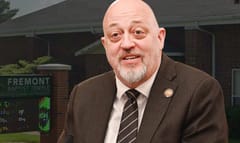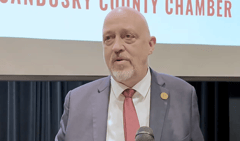
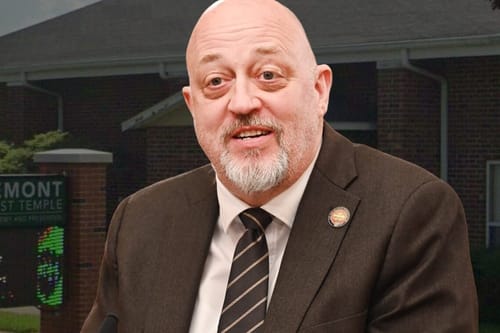
State Rep. Gary Click won his Republican primary on May 5. He also lost his home party’s gun group, his party’s abortion abolitionists, his home county, and 6,260 of the roughly 13,100 Republicans who showed up to vote in Ohio’s 88th House District.
None of that cost him the nomination. Click, a three-term Republican from Vickery, finished with 6,859 votes to Eric Watson’s 6,260 — 52.28% to 47.72%, a margin of 599 out of 13,119 cast across Sandusky and Seneca counties. He is on the November 3 ballot. His opponent is Democrat Aaron Jones of Tiffin.
It also has not obviously cost him the seat. District 88 has not been close in a general election in more than a decade. Click carried it by 25.8 points in 2020, by 35.6 in 2022, and by 33.2 in 2024, when he beat Democrat Dianne Selvey 35,367 to 17,762. Republican primary turnout this May was more than twice the Democratic turnout — 13,119 ballots to 4,893 for Jones, who ran unopposed. On the district’s recent history alone, Click is the favorite.
What is different this year is the shape of the coalition underneath him.
A year of subtraction
The erosion started with the movement groups.
Ohio Gun Owners rated Click a C-minus in late March, citing his refusal to complete the organization’s candidate survey in 2024 and 2026 and his December 2024 vote against advancing the Second Amendment Preservation Act. Five days before the primary, the group cut him to an F, alleging he had accepted and refused to return campaign money from gun-control lobbyists. Ohio Gun Owners did not name the contributors it was describing. Click has rejected the group’s account and called its executive director, Chris Dorr, a “fraud.” The Buckeye Firearms Association, meanwhile, gave Click an A and endorsed him. Watson held Ohio Gun Owners’ “Aq” rating — its top grade for non-incumbents — and Buckeye’s survey-only “Aq.”
End Abortion Ohio endorsed Watson after he scored 100% on its survey. Click declined to take it, and called the group “clowns” in a Facebook post, saying he would refuse its endorsement “under any condition.” The comment thread that followed was filled with people who identified themselves as fellow conservatives and Christians telling Click he was wrong.
Watson also collected endorsements from former Arizona sheriff Mark Lamb, the Coalition of Concerned Voters of Ohio, and secretary of state candidate Marcell Strbich — a coalition spanning guns, abortion and election administration, each of which used its announcement to criticize Click directly.
The subtraction was not only from the grassroots. Sen. Bernie Moreno was dropped from the promotion for Click’s March 28 campaign kickoff. Click’s name disappeared from Vivek Ramaswamy’s endorsements page in April, as Web Archive snapshots show, and was restored within hours of this outlet’s reporting. Click told followers reports of the removal were “greatly exaggerated.”
And his own political brand did not travel well. All three down-ticket candidates Click endorsed lost their primaries the same night he survived his: Andrew King for Ohio Supreme Court, Kristina Roegner for treasurer, and Josh Williams in the 9th Congressional District.
What the grassroots actually objects to
The complaints from Watson’s side of the party were specific, and they were mostly about direction rather than personality.
Watson attacked Click for co-authoring House Bill 646, which would create a 13-member data center study commission rather than impose the moratorium Watson wanted, saying Click had “gone completely establishment.” He campaigned on abolishing property taxes, opposing digital identification legislation, and on Click’s fundraising: a TiffinOhio.net review of Click’s contributions from 2020 through 2025 found less than 14% came from individual donors inside Sandusky and Seneca counties. Click ran on his legislative record, his chairmanship of the House Community Revitalization Committee, his sponsorship of House Bill 68, and his relationships with House Republican leadership — the same relationships Watson used against him.
Click’s answer to the challenge was largely to dismiss it. He told the Fremont News-Messenger that Watson’s campaign was “in the ditch” — “You move to the right of Gary Click and you’re in the ditch” — and closed the race branding Watson “the Arizona Kid.” Watson’s family has been in Seneca County for generations; Click moved to Ohio from Indiana in 2006.
The break has not healed
Two developments since the primary suggest the fracture is still open.
On July 23, Watson said he will not endorse Click and does not expect to, describing a private post-primary meeting that left him unpersuaded on data centers and digital ID. In the same statement, Watson said he and his wife are moving to Wayne County, outside the district.
Two days later, Tiffin City Councilman Kevin Roessner said Click’s campaign had portrayed him as a supporter when he is not one. Roessner said he wore a campaign-supplied shirt at an America 250 event, that he keeps his voting choices private, and that he has not endorsed anyone. The campaign post remained online, unedited, three weeks later.
What the numbers do and do not say
The temptation is to read 6,260 Watson votes as 6,260 potential Jones votes. The arithmetic does not support that, and nothing in the record does either.
Watson ran to Click’s right. His platform — abolishing property taxes, opposing digital ID, expanding gun rights, ending abortion without exception — is not one Jones is running on. Watson has declined to endorse Click; he has not endorsed Jones, and there is no indication he intends to. Voters who reject an incumbent in a closed primary routinely come home in November, and there is no public polling in District 88 to suggest otherwise.
What the primary does establish is narrower, and still meaningful. It shows that roughly 6,000 District 88 Republicans were willing to fire a sitting member of their own party, that the organized conservative infrastructure in this district worked against him rather than for him, and that he lost Seneca County — where Jones lives, works and holds elected office — by about 8 points. It also shows that the general electorate here is roughly four times the size of the Republican primary electorate: 53,129 people voted in this district in 2024, against 13,119 Republicans in May.
That gap cuts both ways. It means Watson’s 6,260 is a small share of a November electorate. It also means Click’s November coalition has to include tens of thousands of voters who were not part of the primary at all, at a moment when the volunteers, group endorsements and door-knockers who normally supply a Republican incumbent’s ground game spent the spring working against him.
Jones has been building the other side of that equation. He has picked up endorsements from the UAW, the Ohio Federation of Teachers and VoteVets. He is a 1991 Clyde High School graduate, a four-year Army veteran who served with the 3rd U.S. Infantry Regiment, a production supervisor at Toledo Molding & Die with more than 20 years at the plant, and a Tiffin City Council member representing the city’s 1st Ward. He is running on utility bills, property taxes and jobs.
The measurable test is not rhetorical. It is financial. Whether the Ohio Republican Party and leadership-aligned PACs put money into District 88 this fall, and whether Jones can raise enough to be competitive on a map this red, will say more about the state of Click’s support than any endorsement list. Those numbers arrive with the next round of campaign finance filings.
Click is seeking his fourth and final consecutive term; Ohio limits House members to eight consecutive years.
The general election is Tuesday, November 3.