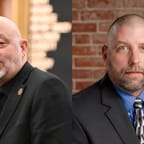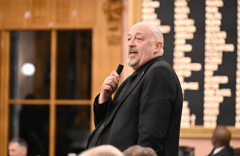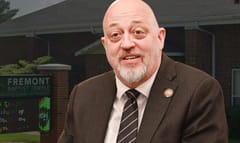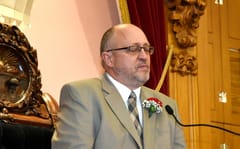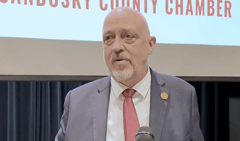
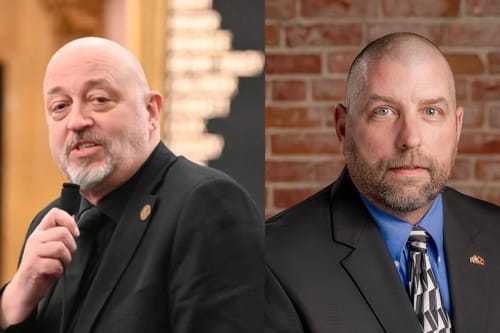
Nearly half of the Republicans who voted in Ohio House District 88’s May primary tried to replace state Rep. Gary Click with a political newcomer who claimed artificial intelligence data centers could harvest people’s thoughts while they slept.
Click survived by approximately 600 votes, losing Seneca County outright and holding the Republican nomination through a stronger showing in his home county of Sandusky. The three-term incumbent emerged from the contest with a fractured conservative base that continued fighting him publicly throughout the general-election campaign.
On Tuesday, he faces Democrat Aaron Jones of Tiffin, a city council member, U.S. Army veteran and longtime manufacturing supervisor who has secured endorsements from organized labor, teachers and veterans. Jones is challenging Click’s record on school funding, property taxes, government surveillance and the influence of special interests, presenting himself as an alternative to the Republican leadership that has controlled Ohio’s state government for years.
The election follows a bruising year for Click. Conservative organizations endorsed his primary opponent and subsequently attacked his conduct. A Republican county committee member publicly accused him of failing his constituents. Campaign finance records disproved his allegation that local Democrats had funded his primary challenger, and two elected officials disputed his public descriptions of their political support.
A three-term incumbent nearly defeated by a political newcomer
Click entered the May 5 primary with the advantages of incumbency: established fundraising relationships, institutional Republican support and six years of experience representing Seneca and Sandusky counties. His opponent, Tiffin businessman Eric Watson, was making his first run for public office and campaigning to Click’s right on property taxes, digital identification, gun legislation and data center development.
Watson’s campaign featured extraordinary claims about artificial intelligence surveillance. In a recording obtained by The Blade, he claimed data centers could harvest both conscious and unconscious thoughts, including while people were asleep. Click himself described such assertions as extreme and conspiratorial in legislative testimony supporting House Bill 646, which proposed creating a state commission to study data center development.
Click had dismissed Watson early in the campaign, declaring in February, “You move to the right of Gary Click and you’re in the ditch.” His reelection effort enjoyed support from prominent Republican officials, including Ohio House Speaker Matt Huffman, Treasurer Robert Sprague and House Majority Whip Nick Santucci.
When the votes were counted, Click had received approximately 52.3% to Watson’s 47.7%. Watson won a majority of the Republican primary vote in Seneca County, and Click’s districtwide margin was approximately 600 votes.
The bitterness carried into the summer. In July, Watson told TiffinOhio.net he would never endorse Click, even after the two met following the primary. Watson said their conversation failed to resolve disagreements involving government overreach, digital identification and data centers. He also announced plans to relocate outside District 88.
Click later disparaged the challenger who had nearly defeated him. During a recorded conversation obtained by TiffinOhio.net, the incumbent said he might have voted for Democrat Aaron Jones if Watson had won the Republican nomination.
“If it was between Eric and Aaron, I might have voted for Aaron,” Click said, laughing, “because Eric’s a nut.” He then added: “Don’t you repeat that.”
Conservative groups rebel against Click
Watson’s near-upset exposed a deep divide between Click and conservative organizations focused on gun rights, abortion and election administration. Several backed Watson, criticizing the incumbent’s voting record and his relationships with Republican leaders in Columbus.
Ohio Gun Owners gave Click a C-minus in March, citing disagreements over gun legislation and his refusal to complete candidate surveys. Days before the primary, the organization downgraded him to an F. Click publicly attacked executive director Chris Dorr as a “fraud,” prompting a lengthy rebuttal from Dorr. The competing Buckeye Firearms Association supported Click and awarded him an A rating.
End Abortion Ohio, an organization advocating a complete legal ban on abortion, endorsed Watson and criticized Click for refusing to support its preferred personhood legislation. Click responded by calling the organization “clowns” and declaring that he would refuse its endorsement under any circumstances. Self-identified conservatives and Christians challenged him in the comments beneath his Facebook post.
The Coalition of Concerned Voters of Ohio, which advocates eliminating electronic voting machines, also endorsed Watson and criticized Click over his withdrawal of support for legislation concerning hand-counted paper ballots. The endorsements brought together several strands of the Republican activist movement in opposition to a sitting legislator who had portrayed himself as firmly conservative.
The conflict continued into the fall. In September, Coalition of Patriots II, a northwest Ohio constitutional conservative organization, accused Click of vindictiveness after he announced a Vivek Ramaswamy town hall in Tiffin shortly before another gathering the Coalition had arranged with the Republican gubernatorial nominee.
The organization said it had scheduled its event first and excluded Click from its invitation list because of the continuing disagreements following the primary. It accused him of arranging a competing appearance to undermine the gathering. Click advertised his town hall at Tiffin University for 5:30 p.m., one hour before the Coalition’s scheduled event in Risingsun.
The dispute drew criticism from Cary Theis, an elected member of the Seneca County Republican Central Committee representing Eden North. In a Facebook comment beneath the Coalition’s post, Theis wrote: “Too bad Gary doesn’t work for the people.”
Click’s campaign paid to promote HB 6, defended it through May 2026
Click’s public statements have also repeatedly conflicted with campaign finance records, archived websites and other documentary evidence.
His record on Ohio’s scandal-tainted House Bill 6 provides one of the clearest examples. In September 2019, Click’s campaign paid for Facebook advertising promoting HB 6 while Ohioans were gathering signatures for a referendum to repeal the legislation. The sponsored advertisement praised Ohio’s political leaders for supporting the law and included the hashtag “#YestoHB6.”
The campaign continued defending the legislation for years after federal authorities exposed the roughly $60 million bribery conspiracy surrounding its passage and preservation. Former Ohio House Speaker Larry Householder was convicted of racketeering in March 2023 and sentenced to 20 years in federal prison.
As recently as May 5, 2026, Click’s campaign website described HB 6 as “a necessary investment,” according to an archived copy of the page. The endorsement remained online years after Householder’s arrest, trial and conviction.
During the general-election campaign, Click responded to criticism of his HB 6 record by emphasizing that he had not cast a vote for the original legislation in 2019. He was not yet a state lawmaker when it passed. His paid campaign advertising from that year, however, established his public support for the law, and his own website continued defending it through May 2026.
Click later co-sponsored legislation repealing portions of HB 6. His campaign website has since removed the statement describing the law as a necessary investment and now emphasizes those subsequent repeal votes. The earlier promotion and endorsement remain documented in advertising records and archived copies of the website.
False accusations and claims of political support
In August, Click publicly accused three local Democrats, including his general-election opponent, Aaron Jones, of contributing money to Eric Watson’s Republican primary campaign. He suggested the purported contributions helped explain why Watson had come close to defeating him.
Watson’s campaign finance filings disproved the allegation. Among 104 reported contributions totaling $17,488.05, none came from the three individuals Click named. All three denied making the contributions.
Click deleted his original Facebook post and published a correction acknowledging that his accusation had been “made in error.” The correction omitted the names of the people he had falsely accused.
Other disputes involved elected officials whose support Click claimed during the general-election campaign.
In July, Click’s campaign published a photograph of him with Tiffin City Councilman Kevin Roessner during an Independence Day celebration. Both wore shirts bearing Click’s campaign identification, and the caption said the incumbent was honored to have Roessner’s support.
Roessner said he had attended the community celebration as an elected official, that the campaign supplied the shirt and that he had not endorsed Click. After Click continued publicly defending his characterization of the councilman’s participation, Roessner responded on Click’s own campaign page, reaffirming that he would not endorse anyone in the race and asking Click to “adjust your messaging accordingly.”
A similar controversy emerged during a September NAACP candidate forum in Fremont, where Click told voters that Democratic state Rep. Darnell Brewer of Cleveland supported him over Jones.
Brewer rejected Click’s characterization, explaining that their bipartisan legislative cooperation constituted a working relationship rather than an endorsement. Brewer also affirmed his support for the Ohio Legislative Black Caucus’s endorsement of Jones.
Click’s credibility problems extended into candidate forums. Earlier in the year, he accused the League of Women Voters of the Tiffin Area of effectively excluding him from a primary event, despite the organization’s documented history of repeated invitations. At an October debate before Fremont Ross High School students, he misstated basic facts concerning the Constitution, American alliances in the Middle East and campaign finance rules while urging the students to exercise critical thinking.
Jones challenges Click’s record and political establishment ties
Jones brings a markedly different professional background to the race. He has served on Tiffin City Council since 2024, spent four years in the U.S. Army and worked for more than two decades in manufacturing. His campaign has focused on school funding, property tax relief, government transparency, local control and the concerns of working families.
He has secured support from labor, education and veterans organizations, including the Ohio Education Association and Ohio Federation of Teachers. Those endorsements have provided organized backing for his challenge to a three-term incumbent supported by influential Republicans in Columbus.
Jones has criticized state policies that shift financial pressure onto local schools and property owners. He has advocated stronger local authority over data center development and greater restrictions on government surveillance, connecting those issues to decisions made by state lawmakers that directly affect residents of Seneca and Sandusky counties.
Click’s previous general-election margins demonstrate the district’s Republican voting history. In 2024, he defeated Democrat Dianne Selvey by 35,367 votes to 17,762, receiving approximately two-thirds of the vote. He also won comfortably in 2020 and 2022.
This year, Click enters the general election after nearly half of his party’s primary voters supported another candidate and several conservative organizations continued opposing him after the nomination was settled. Jones has spent the campaign asking voters to judge the incumbent’s record on education, economic policy, government accountability and the priorities of the communities he represents.
Tuesday’s election will determine who represents Seneca and Sandusky counties as Ohio lawmakers confront continued disputes over public school funding, property taxes, data center expansion and government surveillance.
Click is seeking the fourth and final House term permitted under Ohio’s legislative term limits. Jones is asking voters to replace him after a year in which the incumbent’s fiercest political opposition first emerged from within the Republican Party itself.