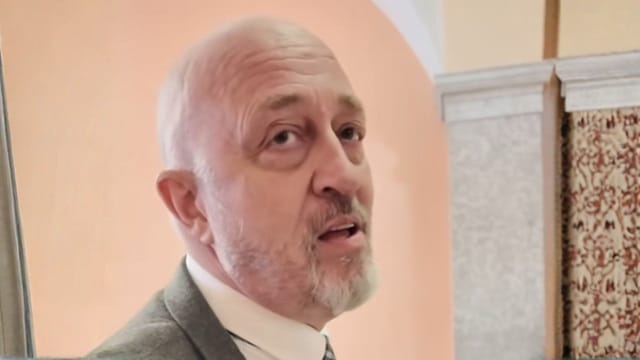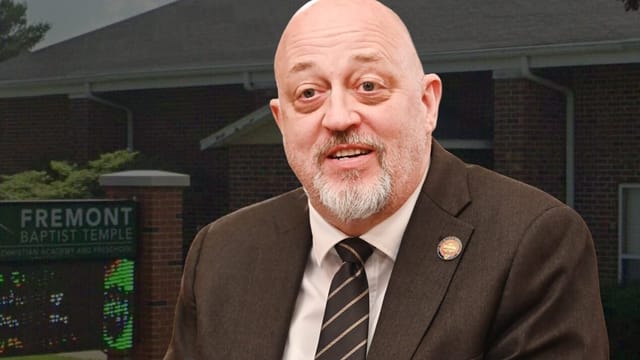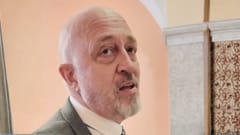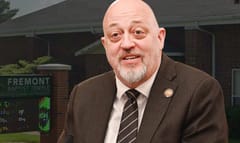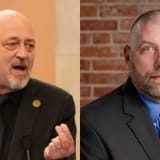
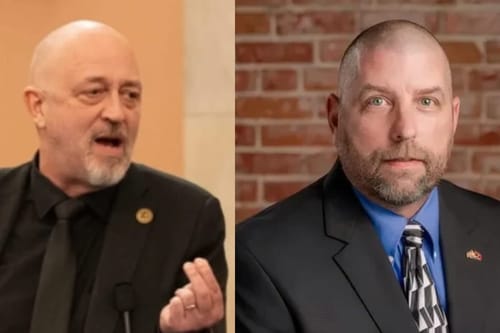
FREMONT, Ohio — State Rep. Gary Click repeatedly urged students to use their “critical thinking skills” during a debate at Fremont Ross High School, then misstated basic facts about the U.S. Constitution, America’s Middle Eastern allies and political campaign contributions while accusing his Democratic challenger of “lying to teenagers.”
The three-term Republican incumbent incorrectly attributed language from the Declaration of Independence to the Constitution, falsely described Israel as America’s only ally in the Middle East and suggested super PACs would not contribute to challenger Aaron Jones because they did not want to support him, although such organizations cannot donate directly to candidates.
The sharpest confrontation came after a student asked about transgender rights. Click defended his legislation restricting gender-affirming medical treatment for minors and accused Jones of lying when the challenger criticized his record. Jones responded by directing students to a website scrutinizing Click’s claims, prompting an interruption from the incumbent and applause from the student audience.
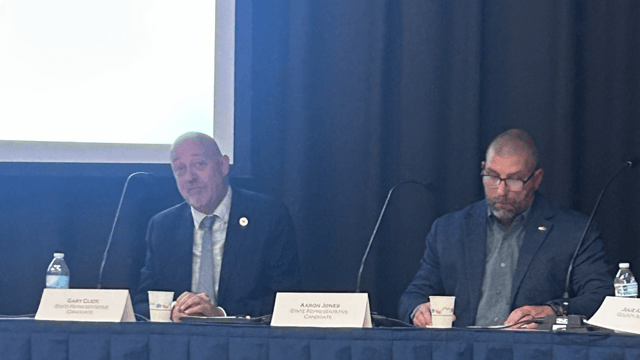
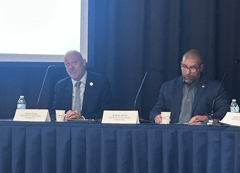
The hourlong debate was organized by the Sandusky Register, a sister newspaper of Tiffin’s Advertiser-Tribune, as part of its Register in Schools debate series. Sponsored by the Greater Sandusky Partnership and moderated by Register publisher Jeremy Speer, the event gave Fremont Ross students an opportunity to question the two candidates for Ohio’s 88th House District, which encompasses Seneca and Sandusky counties.
The candidates addressed abortion, campaign finance, artificial intelligence, government surveillance, school safety and the war with Iran. Throughout the debate, Click emphasized his six years in the Ohio House and repeatedly argued that students should evaluate what candidates had accomplished rather than what they promised. Jones, a Tiffin City Council member, Army veteran and manufacturing supervisor, challenged Click’s record and argued that Republican leadership had failed to address the district’s problems.
Click accuses Jones of lying over transgender rights
The confrontation began when Fremont Ross junior Gabriel Flores asked how the candidates would affect the transgender rights movement in Ohio.
Click responded that everyone should be treated respectfully regardless of their identity, while defending restrictions on gender-affirming medical treatment for minors. He argued that decisions involving permanent physical changes should be reserved for adults.
“As an adult, do what you want. Do what you feel like is you,” Click said. “But as a minor, we think you ought to take that time, finish growing up, and then make that decision as an adult.”
Click sponsored House Bill 68, which restricted gender-affirming medical care for minors and barred transgender girls and women from participating on female school sports teams. Republican lawmakers enacted the legislation in January 2024 by overriding Gov. Mike DeWine’s veto. It took effect that April.
Jones immediately challenged Click’s assertion that he treated everyone respectfully.
“My opponent doesn’t do what he just said, first of all,” Jones responded.
Jones argued that Ohio lawmakers had deliberately targeted transgender people and other members of the LGBTQ community through legislation, and that those efforts had no place in state government.
“I truly do believe, and I stand by anybody’s right to love who they love, to be who they want to be,” Jones said. “They shouldn’t be discriminated upon. They shouldn’t be shunned.”
Jones promised that if elected, “there will not be culture wars” and that everyone would have a seat at the table.
Click rejected the criticism, arguing that certain policies described as transgender rights were not rights at all. He referred students to LGB Courage, an organization associated with activist Jamie Reed, whom he described as a friend, and alleged that some parents had pressured gay children into transitioning because they did not accept their sexual orientation.
Click asserted that such cases were documented but did not identify any specific examples during the debate.
“Some of these things that are called rights are not rights,” Click said.
He then accused Jones of dishonesty directly.
“I support everyone making their own decisions, and I have never attacked anyone for their identity, contrary to what Mr. Jones says,” Click said. “That’s a great talking point, but it’s a lie, and you shouldn’t be lying to teenagers.”
Jones responded by pointing to a website established to challenge the incumbent’s public statements.
“There’s two people on this stage, and only one of them has a GaryClickFacts.com,” Jones said.
Click interrupted, saying the website was “put out by your party.” Jones told him to wait his turn, drawing applause from the audience.
Jones then defended his integrity by invoking his military service.
“When it comes to truth and integrity, I served this country honorably for four years and would do it again tomorrow if anybody that I served with ever asked me,” Jones said.
The exchange centered on a legislative record that is not in dispute. Click was the primary sponsor of House Bill 68, which imposed restrictions on transgender minors’ medical care and athletic participation. His insistence that he has never attacked anyone because of their identity does not change the restrictions his legislation placed on transgender Ohioans.
Click’s claims about super PAC money conflict with campaign-finance rules
Another confrontation emerged when Fremont Ross junior Keith Nelson asked the candidates about removing money from politics and reducing the influence of super PACs.
Click defended political action committees, arguing that they often represent the interests of ordinary workers and organizations seeking a voice in government.
“A lot of people try to make super PACs and lobbyists like they’re bad and they’re evil,” Click said.
He pointed to labor unions and construction trades organizations that collect contributions from members and use those funds to support candidates. Citing the operating engineers union, Click argued that such contributions could help elect lawmakers willing to advance legislation addressing worker safety.
Jones acknowledged that political campaigns require money but argued that large contributions from wealthy donors and outside interests threaten the independence of elected officials.
“I’ve been doing it for the last 10 months, and I haven’t taken a dime from a super PAC, not one,” Jones said.
He said nearly all his campaign contributions had come from residents of the 88th District and questioned why politicians should depend on large contributions from people with little connection to the communities they represent.
“At the end of the day, who are you working for?” Jones asked. “When someone’s writing you a big check, who are you working for at that point?”
Click responded by suggesting that Jones had no super PAC support because those organizations did not consider him worth supporting.
“He hasn’t taken a dime from super PACs, ’cause they won’t donate to him,” Click said. “That’s the bottom line.”
The explanation was misleading. Super PACs are independent-expenditure organizations that cannot contribute directly to candidates’ campaign committees. They can instead raise and spend money independently to support or oppose candidates, including through political advertising.
The Federal Election Commission explains that super PACs cannot make direct, in-kind or coordinated contributions to federal candidates. Ohio law similarly distinguishes independent expenditures from spending authorized or coordinated by campaigns.
Traditional political action committees, including the labor PACs Click described, are different. They can contribute directly to candidates under applicable campaign-finance laws.
“Gary’s right. The super PACs haven’t given me any money, because I’m not taking it,” Jones said. “I don’t need it. He might need it. I don’t need it.”
Jones then invoked billionaire Elon Musk’s involvement in Ohio politics, asking students why someone who does not live in the state would invest heavily in its elections.
“Elon Musk, does he vacation in Ohio?” Jones asked. “Why is he so interested in Ohio politics?”
The argument over campaign contributions followed an earlier exchange about prescription drug prices, during which Jones accused elected officials generally of accepting money from pharmaceutical companies that compromised their independence. Click rejected any suggestion that he had been bought by the pharmaceutical industry and cited his legislative work on insulin pricing and emergency prescription refills.
Click cites the Constitution but quotes the Declaration of Independence
Click made another factual error when a student asked the candidates directly about abortion.
“That’s easy. I’m against it,” Click said.
Explaining his opposition, the Republican incumbent invoked what he described as constitutional protections for life.
“The Constitution says this: You have the right to life, liberty, and the pursuit of happiness,” Click told the students.
The phrase does not appear in the Constitution. It comes from the Declaration of Independence, adopted in 1776. Click incorrectly identified one of the country’s most recognizable founding passages while arguing about constitutional rights.
Click went on to declare that he would always oppose abortion.
“I’m always pro-life. I’m not ashamed of it. I’m always gonna be that way,” he said.
Jones responded by pointing to Ohio voters’ approval of a constitutional amendment protecting reproductive freedom in November 2023. He argued that decisions about abortion should remain between patients and their medical providers rather than politicians.
“I think government should not tell people what to do with their bodies, whether it be a male or a female,” Jones said. “I think those conversations need to be held with your medical provider.”
Click then characterized Jones’s remarks as an expression of support for abortion, pressing him to state his personal position rather than referring to the decision Ohio voters had already made.
Jones rejected Click’s interpretation.
“I never said I was for or against abortion,” Jones said. “I’m simply standing by what the law is and by what each individual’s choices should be.”
Ohio’s reproductive freedom amendment, which took effect in December 2023, protects individual reproductive decisions, including abortion. The amendment permits certain restrictions after fetal viability but requires exceptions when a treating physician determines an abortion is necessary to protect the pregnant patient’s life or health.
Click’s personal opposition to abortion remains unchanged, but Ohio voters placed reproductive freedom protections in the state Constitution despite opposition from anti-abortion lawmakers and organizations.
Click falsely calls Israel America’s only Middle Eastern ally
The candidates offered sharply different views of the war with Iran and the United States’ relationship with Israel after a student asked about the American-Israeli alliance.
“I support Israel,” Click said.
He then asserted that Israel was the only democracy in the Middle East and America’s only ally in the region.
“That is our only ally in the Middle East,” Click told the students.
The claim was false. The United States maintains significant security partnerships with several Middle Eastern countries, including Bahrain, Egypt, Jordan, Kuwait and Qatar. Those countries, like Israel, have received major non-NATO ally designations or equivalent formal recognition from the United States.
Click argued that supporting Israel did not require agreeing with every decision made by the Israeli government. He invoked the October 7, 2023, Hamas attacks to defend Israel’s right to exist and its security relationship with the United States.
Jones took a sharply different position, criticizing the Trump administration’s decision to involve American forces in military operations against Iran. He argued that the United States had been drawn into a war serving Israeli interests rather than America’s own.
“Israel saw an opportunity with a guy in office who’s easily persuaded, and he conned us into fighting their war,” Jones said. “Once again, we’re fighting their war.”
Jones said the issue was personal because his nephew serves as a helicopter pilot with the 82nd Airborne and is deployed in the region.
“We got conned into this war against Iran, from Israel. That’s what happened,” Jones said. “And we need to stop it and start thinking about America.”
Click returned to the conflict in his closing remarks, defending American military action against Iran and asserting that the country posed an imminent danger through its nuclear capabilities.
“They would have brought them to America if we did not destroy those nuclear capabilities,” Click said.
Click presented no evidence during the debate supporting his prediction that Iran would have brought nuclear weapons to the United States. The statement went substantially beyond his argument that Iran should not be permitted to develop a nuclear weapon.
The disagreement reflected a broader divide between the candidates: Click defended the military operation as necessary for American security, while Jones argued that the war had been a choice made by the Trump administration and was putting American service members at risk.
Click calls for banning Flock cameras, but his bill would allow immigration enforcement use
Although the candidates disagreed sharply on several issues, they found common ground over government surveillance.
Fremont Ross sophomore Ava asked what they would do to regulate access to information collected by Flock automated license plate recognition cameras and whether misuse by authorities should be criminalized.
Click cited House Bill 1011, legislation he introduced to temporarily restrict the use of automated license plate recognition systems and certain mass surveillance technology.
“I’m not just worried about individual officers misusing it, to be honest,” Click said. “I’m worried about the government misusing it.”
He told students that he ultimately favored a complete ban.
“I don’t trust the government with all that information, so I would like to see a total ban ultimately,” Click said. “But the pause is just the starting place.”
His proposal, however, would not permanently eliminate the technology. It establishes a one-year moratorium with exceptions, including emergency alert systems and use by federal immigration agents enforcing immigration laws.
Click’s own September 11 announcement expressly identified an exception for Immigration and Customs Enforcement agents. The legislation remains pending and has not passed the Ohio House.
The exception matters because Click’s stated concern about government misuse of surveillance data would coexist with permission for federal immigration enforcement authorities to use the technology.
Jones supported stronger restrictions on the cameras and questioned whether their usefulness justified the privacy implications and cost.
“I don’t support government, you know, Big Brother watching everything,” Jones said. “I would agree with Gary that a complete ban is probably better.”
Jones argued that police departments could spend the money on protective equipment, safety improvements and other operational needs rather than automated surveillance.
Neither candidate offered a specific proposal to criminalize misuse of the collected data, which was part of the student’s original question.
Data centers and local jobs draw contrasting approaches
The expansion of artificial intelligence and data centers also came under scrutiny after senior Lydia Hicks asked whether the candidates supported regulating AI.
Click cited House Bill 646, which he sponsored to address data center development and establish a state study commission. The legislation passed the Ohio House in March but has not received final approval from the Senate.
He argued that AI could be a useful technology but warned that data centers were expanding faster than lawmakers could establish meaningful safeguards.
Jones similarly acknowledged the benefits of technological innovation while warning about automation, employment displacement and the broader consequences of increasingly powerful AI systems.
Both candidates said regulation would be necessary, although Jones emphasized that many of the most consequential decisions would require federal involvement.
When another student asked about improving Ohio, Jones connected the technology discussion to economic conditions in Seneca and Sandusky counties. He argued that communities were losing young people because the region lacked sufficient career opportunities, particularly for college graduates seeking employment outside a narrow range of industries.
“If you graduate from college and you live in Seneca or Sandusky County, there’s not a whole lot of opportunity,” Jones said.
He called for greater investments in manufacturing, skilled trades and professional employment rather than treating data centers as a solution to the district’s economic challenges.
“We don’t need data centers to do that. We need manufacturing facilities,” Jones said. “We need professional facilities here to keep people here.”
Click countered by emphasizing industrial development and his endorsements from manufacturing and skilled-trades organizations. He also cited funding for Vanguard-Sentinel Career and Technology Centers, arguing that his work in Columbus had already produced tangible benefits for the district.
Click also cited Keith’s Law, which established a voluntary database intended to help first responders identify individuals with special needs.
His repeated argument was that students should judge him by those legislative accomplishments rather than promises about what he would do if reelected.
Affordability, prescription drugs and the gas tax
Students also questioned both candidates about rising household costs, including groceries, housing, electricity and prescription medications.
Jones argued that working families were struggling under an affordability crisis that disproportionately affected middle-class households. He cited his experience supervising manufacturing employees who work full-time jobs yet still struggle financially.
He called for adequate funding for public education and protecting assistance programs for working families rather than balancing state budgets through cuts affecting people with limited resources.
“We can’t cut benefits for people that are working that need that extra assistance,” Jones said. “It’s a hand up, not a handout.”
Click responded by discussing what he called the benefits cliff, in which workers can lose public assistance as their earnings increase, sometimes leaving them financially worse off despite earning more money.
He described how his mother struggled with that problem while raising three children and cited bipartisan legislation he had worked on to address it.
On prescription drug costs, Jones blamed the influence of pharmaceutical industry money in politics, arguing that corporate contributions compromised elected officials and contributed to high medication prices.
Click rejected any suggestion that he personally had been purchased by the pharmaceutical industry, pointing instead to legislation addressing insulin pricing, emergency prescription refills and education about sudden unexpected death from epilepsy.
The candidates found more agreement when junior Caleb Seibert asked what Ohio should do after the state’s temporary gas tax suspension expires.
Click defended the 90-day tax reduction and said lawmakers would have to evaluate economic conditions before deciding whether additional relief was warranted. Jones supported the temporary suspension but said the state could not indefinitely forgo transportation revenue without accounting for the consequences.
The gas tax holiday, enacted through House Bill 519, began October 4 and runs through January 2, 2027. The legislation includes a $725 million transfer from state reserves to offset the temporary reduction and preserve transportation funding.
Both candidates acknowledged that Ohio lawmakers cannot directly control global oil prices. Jones also criticized the ongoing war with Iran, tying the conflict to economic uncertainty and higher energy costs.
Students challenge candidates over school safety and online predators
Several students used the debate to question the candidates about issues affecting their own safety and education.
Junior Gracie Overmeyer asked how Ohio should address school shootings, particularly as schools impose stricter cellphone restrictions.
Jones supported the use of school resource officers, controlled building access and other security measures, while acknowledging the fear students face in an environment where school violence remains a concern.
Click cited legislation he said was prompted by an incident at Old Fort schools involving a student who brought a loaded gun to school. He described changes allowing conditions to be imposed before certain students return following serious disciplinary incidents, including counseling requirements.
Both candidates supported restrictions on student cellphone use during the school day. Jones compared the problem to cellphone distractions among adults at the manufacturing plant where he works, while Click defended state efforts requiring school districts to establish policies.
Another student asked about protecting minors from online grooming. Jones cited investigations by the Tiffin Police Department targeting online predators and argued that law enforcement should continue receiving resources for that work.
Click emphasized personal safety online and supported legislation requiring age verification for certain applications and websites.
The candidates also addressed college affordability. Jones favored stronger state funding, additional grant opportunities and expanded access to education. Click highlighted Ohio’s College Credit Plus program and scholarship opportunities intended to encourage students to attend college and remain in the state.
When sophomore Kaitlyn asked why excused school absences still counted against students’ attendance totals, both candidates admitted they did not know the applicable rules.
Jones said he would need to consult school officials. Click likewise acknowledged that he did not know whether the issue was governed by state law or local policy and invited the student to contact his legislative office.
The exchange was one of the few moments in which both candidates openly acknowledged not having an answer rather than attempting to defend a position.
Click defends Republican record as Jones calls for change
The candidates closed the debate by returning to their competing arguments about experience, accountability and the direction of state government.
Jones criticized nearly two decades of Republican control in Columbus, arguing that the party responsible for governing Ohio could not credibly distance itself from the problems facing the state.
“In the state of Ohio, one party’s been in charge for 19 years, and that same party says they need to fix the problems,” Jones said. “But they’ve been in charge for 19 years, so we have to look at who caused the problems.”
Click defended the Republican governing record, pointing to the state’s rainy day fund as evidence of fiscal improvement. He then attacked Jones for criticizing state government without detailing accomplishments from his three years on Tiffin City Council during the debate.
“Aaron has done nothing but complain and tell you what he will do or what should happen,” Click said. “He’s been on the city council for three years, and he’s not told you one thing that he has done that helps the city of Tiffin.”
Click returned once more to the message he had introduced at the beginning of the event, telling students to use their critical thinking skills when evaluating the candidates.
That appeal came after a debate in which Click had accused his opponent of lying, misstated the source of a famous founding document, falsely described America’s alliances in the Middle East and presented a misleading explanation of super PAC contributions. Those statements were made before students participating in an event specifically intended to encourage informed civic engagement.
Jones framed the election as a choice between continuing Republican leadership and changing the direction of state government, while Click asked voters to reward his legislative record with another term.
Voters in Seneca and Sandusky counties will decide between the two candidates in the November 3 general election.