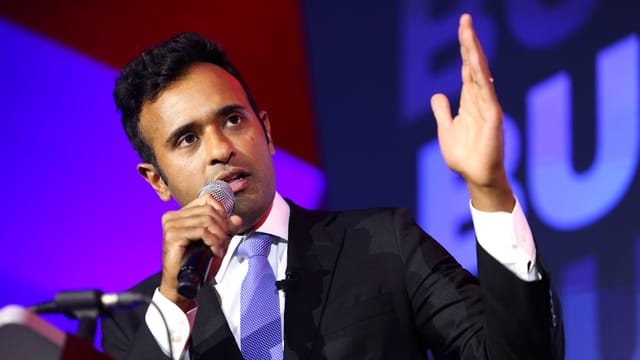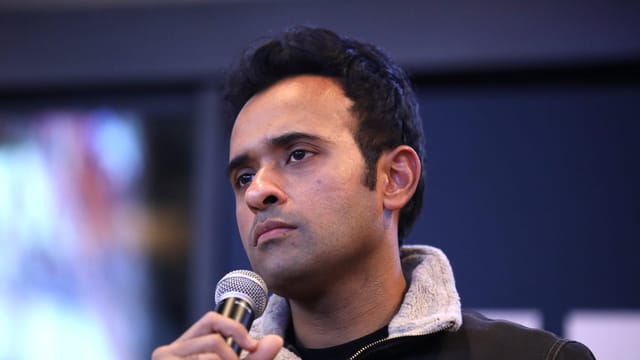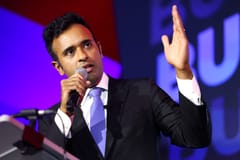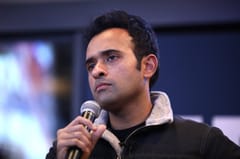

When Vivek Ramaswamy walked onstage at a Butler County aerospace plant on Monday, Feb. 24, 2025, to launch his campaign for Ohio governor, his Republican primary opponent was ready with a one-line résumé.
“I welcome Mr. Ramaswamy to the race for however long he sticks around,” then-Attorney General Dave Yost said in a statement issued during the event. “We’ll see if he actually stays in — Mr. Ramaswamy quit on President Trump and DOGE on day one, he quit on Ohio and moved his company to Texas, and he quit his presidential campaign after a devastating fourth-place finish in Iowa.”
Yost lost the primary and is gone from the race. Ramaswamy won on May 5 and faces Democrat Amy Acton on Nov. 3. But the line has outlasted the man who delivered it, and the record behind it has since grown more complicated in two directions. One of the three departures Yost cited is disputed — Ramaswamy says he was not pushed out of DOGE, and Politico reported that he was. And in December, for the first time, the pattern ran the other way.
Sixty-nine days
Trump announced on Nov. 12, 2024, that Ramaswamy and Elon Musk would jointly lead the Department of Government Efficiency. Sixty-nine days later, on Monday, Jan. 20, 2025 — Inauguration Day — Ramaswamy was out, before the effort had done substantive work.
He has consistently said the decision was his. Asked on Fox News the following Monday whether Musk had fired him, Ramaswamy rejected it twice. “I think that’s incorrect,” he told host Jesse Watters, adding that the two men “had different and complementary approaches” — his own centered on constitutional law and legislation, Musk’s on technology. Pressed a second time, he answered: “No, we had a mutual discussion.”
The administration’s account matched his. Trump transition spokesperson Anna Kelly said on the record that Ramaswamy “played a critical role in helping us create DOGE,” and that his plan to run for governor “requires him to remain outside of DOGE based on the structure that we announced today.” On the morning of the inauguration, Ramaswamy posted a photograph of himself shaking hands with Musk. “A new dawn,” he wrote.
Politico published a different version hours later. Citing three people familiar with Musk’s preferences who were granted anonymity, the outlet reported that Musk had spent the preceding days making clear he wanted Ramaswamy gone, and that Ramaswamy had already been cut out of the effort’s decisions.
The proximate cause, according to that reporting, was a post Ramaswamy made on X in late December 2024, during the Republican fight over H-1B visas, arguing that American tech companies hire foreign-born workers in part because the country’s culture had “venerated mediocrity over excellence.” The comment drew heavy criticism from parts of Trump’s base. “They wanted him out before the tweet — but kicked him to the curb when that came out,” one of the three people told Politico.
A Republican strategist Politico described as close to Trump advisers was blunter. Ramaswamy “just burned through the bridges and he finally burned Elon,” the strategist said. “Everyone wants him out of Mar-a-Lago, out of D.C.”
Not all of Politico’s sourcing cut against him. The outlet reported that a person close to DOGE said Musk did not think it feasible to campaign for office while working on the effort, and that a person familiar with Ramaswamy’s thinking said the two were on good terms and that “the reality is that it wasn’t possible” to do both at once. CBS News reported the previous day that the leadership change followed friction with incoming staff.
Every element of Politico’s account rests on people who were not named. Ramaswamy’s denial is on the record and under his own name, and no one has produced documentation resolving the two. What is not in dispute is the clock. He was appointed in November, gone in January, and campaigning for governor 35 days after that.
One week in February 2023
The exits Yost referred to had a common motive, and two of them happened within days of each other.
Ramaswamy founded Roivant Sciences in 2014 around a specific model: acquire drug candidates that larger pharmaceutical companies had shelved, then develop them through subsidiaries. He stepped out of the chief executive role in January 2021, telling shareholders the move reflected in part his “increasing public engagement” — the year he published “Woke, Inc.” and began building the political profile that would carry him into the presidential race. He stayed on as chairman for two more years. On Feb. 21, 2023, Roivant announced he had left its board the previous day to run for president, crediting him as founder and noting that six medicines developed at its subsidiaries had won FDA approval over the prior decade.
That same week he resigned as executive chairman of Strive Asset Management, the anti-ESG investment firm he had co-founded in Columbus a year earlier and which by that point managed more than $500 million. Co-founder Anson Frericks confirmed the resignation at the time, and Ramaswamy told CNBC that May that he had stepped away and was off the firm’s board for the duration of the campaign.
The campaign those resignations were made for lasted eleven months. Ramaswamy announced on Feb. 21, 2023, and ended it on Monday, Jan. 15, 2024, after finishing fourth in the Iowa caucuses. He endorsed Trump that night.
TiffinOhio.net has examined Ramaswamy’s biotech record in detail, including the 2015 Axovant IPO and the 2017 failure of the Alzheimer’s drug intepirdine. No regulator has charged him with wrongdoing, and he has not been convicted of any crime.
The company that left Ohio
The second item on Yost’s list is the one Ramaswamy most directly contests, because it describes something a company did rather than something he did.
In November 2024, Strive announced it was relocating its headquarters from Columbus to Dallas, taking most of its Columbus staff. Ramaswamy has said the decision was made without him. Asked about it by News 5 Cleveland, he noted he was neither chief executive nor a board member by then, and cast the move as the thing that pushed him toward the governor’s race.
“The new CEO was pursuing a merger and acquisition with a company in Texas, and they had a decision to make about where was the more business-friendly environment to set up that business, and they made the decision to put that in Texas,” he said. “To me, that was actually a moment that motivated me, that said I have a mission, a cause to make sure that we make Ohio more competitive than Texas or any other state in the country.”
The explanation has not retired the issue. Union leaders in northwest Ohio and Democratic lieutenant governor nominee David Pepper have continued to raise the relocation on the campaign trail, and it has surfaced repeatedly in coverage of the race.
December: not an exit
On Tuesday, Dec. 16, 2025, Ambros Therapeutics launched with a $125 million Series A round co-led by RA Capital Management and Enavate Sciences. The company, based in Irvine, California, named Ramaswamy a co-founder alongside board chairman Keith Katkin, with Jay Hagan as chief executive. Trade coverage identified Ramaswamy as a co-founder, an investor and a sitting board member.
Ambros licensed its lead candidate, neridronate, from the Italian firm Abiogen Pharma. The drug has been approved in Italy for more than a decade to treat Complex Regional Pain Syndrome Type 1, a rare and severe chronic pain condition with no FDA-approved treatment in the United States; a German drugmaker discontinued two Phase 3 studies of it in 2019. Ambros said its own pivotal trial was on track to begin enrolling in the first quarter of 2026, and Hagan told the Orange County Business Journal he expected top-line results in early 2028.
The strategy — take an older drug another company set down, and run new trials on it — is the one Ramaswamy built Roivant around a decade ago.
What distinguishes the December launch is its timing and its direction. Every previous departure moved him out of business and toward a campaign. This one did neither. He was already ten months into the race for governor, and he did not leave a company. He started one. He has also kept up out-of-state appearances during the campaign, including a keynote at a Utah energy and data center summit.
Stepping back from a company to seek office is routine, often legally necessary, and Ohio has elected candidates who did exactly that. Yost’s charge was never really about the mechanics of resignation. It was about whether Ramaswamy finishes what he starts — a question Ohio voters answer on Tuesday, Nov. 3.
TiffinOhio.net has covered Ramaswamy’s business record, pandemic-era positions and campaign travel throughout the 2026 cycle.