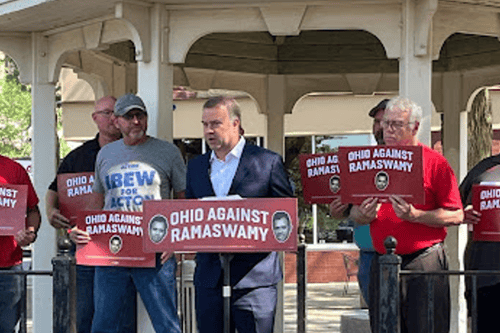

LIMA, Ohio — Democratic lieutenant governor nominee David Pepper joined Northwest Ohio union leaders in Lima on Tuesday to criticize Republican gubernatorial nominee Vivek Ramaswamy over jobs and the cost of living, part of a labor-focused message the Democratic ticket is carrying into the Nov. 3 general election.
Pepper, a Cincinnati attorney and former chair of the Ohio Democratic Party, is running as the running mate of Dr. Amy Acton, the Democratic candidate for governor. Several of Ohio’s largest labor organizations, including the United Auto Workers, have endorsed the Acton-Pepper ticket. The Lima event was organized by the Ohio Democratic Party.
Pepper framed his remarks around Ramaswamy’s past statements on organized labor. “Ramaswamy often talks about the unions he wants to get rid of. Anyone who thinks it’s his job to get rid of the unions he doesn’t like is a threat to all unions,” Pepper said. “We’ve got a guy who says Ohioans are lazy, mediocre and not working hard enough, and every step he proposes would make life harder for everyone except for billionaires like himself.”
Jeff Adams, president of United Auto Workers Local 1219 in Lima, said the race carries high stakes for local families. “There is too much at stake in this election for Lima’s families. We can’t afford a billionaire who will take away our jobs and call our workers lazy,” Adams said.
Gary McPheron, secretary-treasurer of the Lima Building Trades, said union members were weighing the candidates’ records. “Our members are watching to see which candidate will stand alongside them in good and bad times, and that’s not Vivek Ramaswamy. Instead of fighting for Ohio workers, Ramaswamy would take away our jobs and make already high costs even worse,” McPheron said. “Ramaswamy is an out-of-touch billionaire who can’t be trusted to keep jobs in Ohio or lower costs for working families. Our members and Ohioans across the state are working harder than ever. We can’t afford Vivek Ramaswamy.”
The Democrats’ criticism draws on Ramaswamy’s recent public record. In a December 2024 social media post — before he entered the governor’s race — Ramaswamy argued that top U.S. technology companies often hire foreign-born and first-generation engineers because, he wrote, American culture “has venerated mediocrity over excellence for way too long.” He called for a culture that prioritizes hard work over what he described as laziness. The post addressed American culture broadly rather than Ohio workers specifically, and it drew criticism from across the political spectrum. Ramaswamy did not describe Ohioans as lazy in those words; the “lazy” characterization reflects how Pepper and other Democrats have summarized the post. On unions, Ramaswamy has said he might seek to dismantle Ohio’s public-school teachers’ unions while proposing merit-based teacher pay, according to reporting on his education platform.
A biotech fortune built on a failed drug
Much of the “billionaire” framing the union leaders used traces to how Ramaswamy made his money. In December 2014, a company under his Roivant Sciences umbrella bought the experimental Alzheimer’s drug intepirdine from GlaxoSmithKline for $5 million, after GSK had run four failed trials on it. Ramaswamy built a subsidiary, Axovant, around the drug and took it public in 2015 in what was then the largest biotech IPO on record, raising about $315 million and reaching a valuation near $3 billion — even though the company had about eight employees at the time, two of them Ramaswamy’s mother and brother. He reported roughly $38 million in income that year, most of it capital gains. In September 2017, intepirdine failed its late-stage trial; Axovant’s stock fell about 75% in a single day and never recovered. Ramaswamy was largely insulated from the losses because he held his stake through the parent firm, Roivant.
Ramaswamy has called Axovant his “single greatest failure” and said he does not regret how it was run. His campaign has said the drug failed as the vast majority of Alzheimer’s treatments do, and that he was “forced to sell a tiny portion” of his shares in 2015 to bring in an outside investor. No regulator has charged Ramaswamy with wrongdoing, and he has not been convicted of any crime. Critics have been blunter. Jeffrey Sonnenfeld, a Yale School of Management professor who tracks Ramaswamy’s business dealings, told Fortune that “everything about him is a scam,” and told the Associated Press that his biotech record was “classic ‘pump and dump.’” Ramaswamy rejects those characterizations.
Ramaswamy co-founded the anti-ESG investment firm Strive Asset Management in Columbus in 2022. In November 2024, the firm announced it was relocating its headquarters from Columbus to Dallas, moving most of its Columbus staff and roughly $1.7 billion in assets under management to Texas. He launched his campaign for governor about three months later, in February 2025. Separately, the Associated Press has reported that a Roivant subsidiary, Genevant Sciences, and a partner firm reached a $2.25 billion settlement with Moderna over vaccine technology — part of a pandemic-era record TiffinOhio.net has examined in detail.
A self-funded campaign and questions about who benefits
Ramaswamy, whose net worth has been estimated at roughly $1.8 billion, loaned his own campaign $25 million in 2026 — about 83% of what his campaign raised that year. Because the money is structured as a loan, he can repay himself from funds the campaign raises later.
His signature tax proposals have drawn scrutiny over who would benefit. Ramaswamy has proposed phasing out Ohio’s income tax beginning with the capital gains tax; the nonpartisan Ohio Legislative Service Commission has estimated that step alone would cost the state between $615 million and $645 million a year, with nearly 82% of the benefit flowing to Ohioans earning more than $200,000. His own April 6 filing with the Ohio Ethics Commission disclosed $768,968 in capital gains from a stock sale — the kind of income his plan would exempt. Independent analyses by the Legislative Service Commission, Policy Matters Ohio, the Institute on Taxation and Economic Policy and the progressive group Innovation Ohio have reached a common conclusion: his tax agenda would deliver its largest benefits to wealthy Ohioans and corporations while shifting costs toward working families. Innovation Ohio has estimated that his plan to roll property taxes back to 2021 levels would cut roughly $6.6 billion a year from local budgets, including about $4 billion from schools, with no replacement revenue identified.
Ramaswamy has also faced questions about promoting industries he holds a personal financial stake in. His financial disclosure shows holdings in cryptocurrency and in Strive, which has committed much of its treasury to Bitcoin, even as he has urged Ohio to expand crypto and data-center development that the governor’s office would help regulate. His campaign has not publicly addressed the overlap between his holdings and the policies he supports.
Ramaswamy has centered his campaign on cutting taxes and regulation, arguing that lower taxes would spur growth that lifts the whole state. At his February 2025 launch, he pledged to make Ohio “the top state in the country to start and grow a business,” called for eliminating the state income tax and rolling back property taxes, and said he would cut business regulations. His running mate is Ohio Senate President Rob McColley. The Ohio Democratic Party’s announcement of Tuesday’s event did not include a response from Ramaswamy’s campaign.
Ramaswamy won the Republican primary in May and faces Acton in the Nov. 3 general election. The winner will succeed Republican Gov. Mike DeWine, who is barred by term limits from seeking re-election.