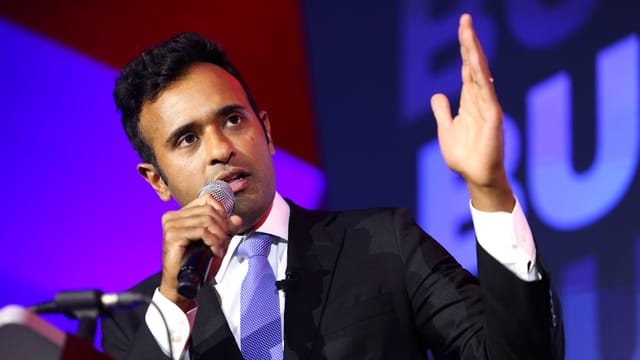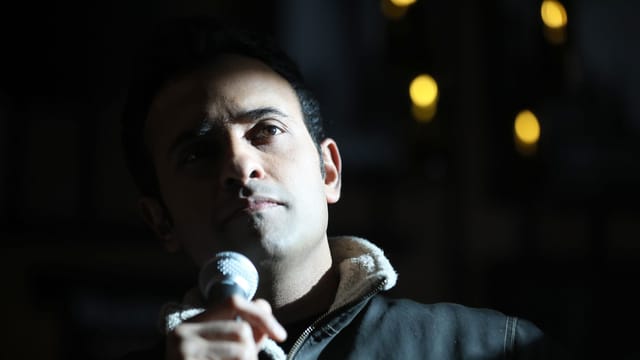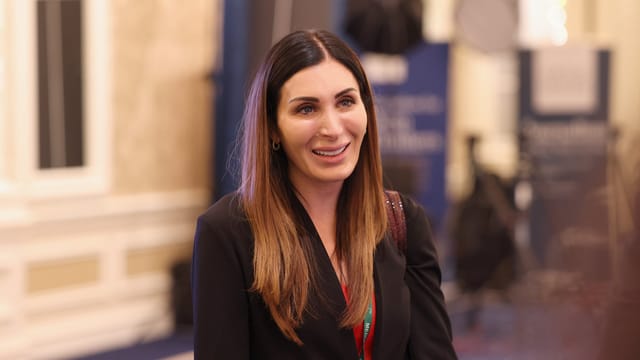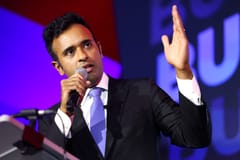
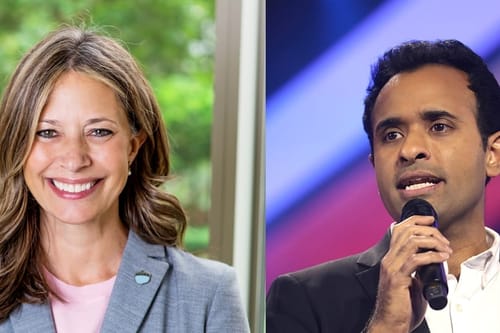

The super PAC bankrolling Republican Vivek Ramaswamy is back on Ohio airwaves with a television ad built around Dr. Amy Acton’s 1994 medical licensure application — the form on which she disclosed that she had sought therapy after being sexually abused as a child.
The spot began airing days after the Cook Political Report moved the governor’s race from Lean Republican to Toss Up on Friday, July 10. It is the second time this year that the Democratic nominee’s history as a survivor of childhood sexual abuse has been turned into material against her.
The ad misleadingly tells viewers that Acton’s medical knowledge was described as “insufficient” to Ohio’s medical board and that she “admitted to emotional or mental illness, drug addiction, or an alcohol problem.” It closes by telling voters they would not want Acton as their doctor and “definitely not as governor.”
Acton’s campaign responded on Wednesday, July 15, calling the claims false and the use of her abuse history a deliberate attempt to shame her. It is at least the second V-PAC spot this cycle that TiffinOhio.net has examined; an earlier ad blaming Acton for Ohio’s COVID-19 shutdowns rested on a premise Gov. Mike DeWine has repeatedly rejected, saying the closure decisions were his.
“Vivek Ramaswamy is once again spreading lies about Dr. Acton and shaming her for being a survivor of childhood sexual assault, all to distract from the fact that Ohioans can’t stand him,” campaign manager Phil Stein said in a release from the campaign.
Stein’s statement also faulted Ramaswamy for continuing to promote the endorsement of state Rep. Rodney Creech (R-West Alexandria). Creech was accused in state investigative records of climbing into bed with a minor female relative while wearing only his underwear. He denied the allegations, a special prosecutor declined to bring charges, and House Speaker Matt Huffman asked him to resign before later restoring his committee assignments. Creech remains the Republican nominee in House District 40, and Ramaswamy has not publicly addressed the allegations.
What the 1994 form actually was
Ohio’s medical licensure application at the time asked applicants whether they had been treated for emotional or mental illness. Acton answered yes and disclosed that she had sought outpatient therapy because of childhood sexual abuse, her campaign has said since the record first surfaced in April.
Ohio no longer asks the question. It was removed from the state’s medical license applications after regulators concluded it discouraged doctors from seeking treatment they needed — part of a national shift in how licensing boards handle physician mental health.
On the “insufficient” characterization, the campaign says the review in question covered a four-month internship program, and that three years later, when Acton completed her medical residency, her medical knowledge was rated “excellent.” Both ratings appear to come from evaluator reference forms submitted with the 1994 application rather than from any finding by the State Medical Board of Ohio.
Acton has been a licensed physician since 1994. She holds a medical degree from what is now Northeast Ohio Medical University and a master’s degree in public health from Ohio State, and she served as director of the Ohio Department of Health from February 2019 until June 2020.
The 2019 police report
The ad also tells viewers that Acton told the medical board she was clean, and that days later police came to her house and found she had combined alcohol with prescription drugs.
NBC News first reported the August 2019 incident in April. According to the police report, Acton pulled a mirror off a wall and shattered the glass after becoming upset with her husband, told officers she had been drinking and had taken an unknown amount of prescription medication, and was about to drive away before her husband talked her out of it. A medic recommended she go to the hospital and she refused. Police found no evidence of physical violence and classified the matter as a verbal argument over her long work hours. No one was arrested or charged.
Acton’s campaign has said she had one drink at dinner and was not intoxicated, and that the medications were migraine treatments she had been prescribed for two decades. Her husband, Eric Acton, took responsibility in a statement to NBC4.
“Seven years ago, I had too much to drink while Amy only had one drink. I started the verbal argument while she tried to de-escalate the situation, and eventually went to bed,” he said. Bexley police told NBC4 they had received two calls to the address in ten years: the 2019 dispute and a 2022 report of a suspicious person.
The April precedent
The 1994 disclosure entered the campaign in April, days after the police report became public. Donald Trump Jr. posted that Acton should be seeking help rather than running for governor, and Ramaswamy’s account reposted the message. Ramaswamy then posted a video saying his opponent had no vision “other than complain about what someone else did to her,” drawing bipartisan criticism across Ohio.
Who is paying for the ads
V-PAC: Victors, Not Victims, the super PAC that describes its sole mission as electing Ramaswamy governor, is overwhelmingly funded by a handful of people who do not live in Ohio.
Federal filings reported this week by the Ohio Capital Journal show five billionaires have given the committee $37 million — more than 88% of everything it has raised, out of a committee total of roughly $42 million. Pennsylvania investor Jeff Yass gave $20 million before the primary. Elon Musk gave $5 million in May. Ratmir Timashev gave $5 million, Ross Stevens $6 million across two contributions, and Bill Ackman $1 million. V-PAC reported $25.8 million on hand at the end of June and spent more than $8.1 million that month on a single 30-second ad against Acton.
Ramaswamy, whose net worth is estimated at roughly $1.8 billion, has loaned his own campaign $25 million. Between May 15 and the end of June, his campaign and V-PAC together spent about $9 million on advertising. Acton’s side spent roughly $100,000 over the same stretch.
Super PACs may raise and spend without limit but may not coordinate with a candidate’s campaign. V-PAC and the Ramaswamy campaign did not respond to multiple requests for comment from the Ohio Capital Journal for its report on the donations.
Why the timing matters
Cook Political Report analyst Jessica Taylor wrote on July 10 that the open Ohio contest was moving to Toss Up despite Ramaswamy’s significant spending edge, citing a favorable national climate for Democrats. It is the first time since 2018 the race has carried that rating.
A New York Times/Siena poll released shortly before the change showed the two candidates tied at 47%, with Acton leading among independents. A bipartisan AARP survey conducted by Impact Research and Fabrizio Ward put Acton ahead 47% to 44%.
The pattern is one Ohio voters will see more of. Both campaigns are expected to spend heavily through the fall, and this race is on track to be among the most expensive governor’s contests in state history. Election Day is Tuesday, November 3.
In Seneca and Sandusky counties, the governor’s race shares the November 3 ballot with the Ohio House District 88 contest, where Republican state Rep. Gary Click faces Democrat Aaron Jones. Click won his May primary by fewer than 600 votes and lost Seneca County.
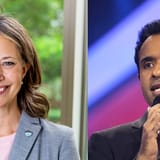
Acton and Ramaswamy are competing to succeed Gov. Mike DeWine, a Republican barred from running again by term limits.