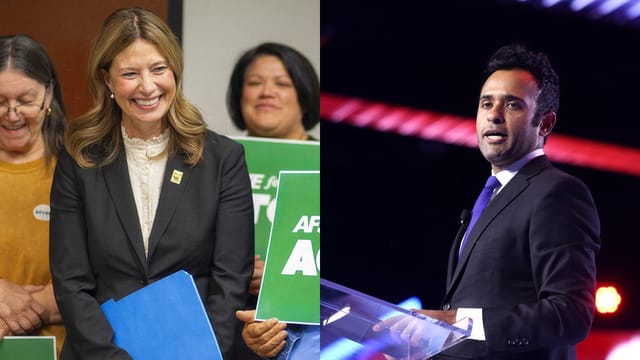

The super PAC bankrolling Vivek Ramaswamy has settled on a method, and it keeps working the same way. Start with something real — a 1994 licensure application, a 2019 police report, a recorded interview. Remove the part of the record that explains it. Let the viewer supply the worst available reading.
The newest television ad applies that method to a hip injury and a family joke about a television remote.
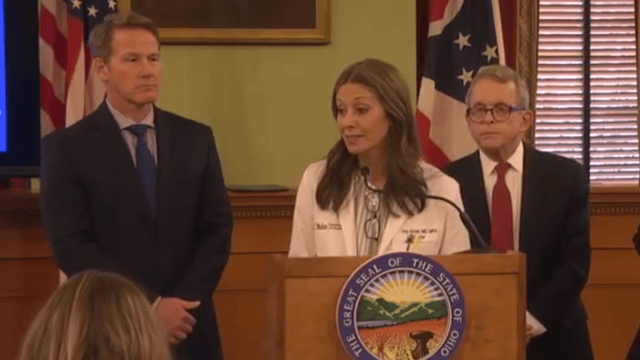
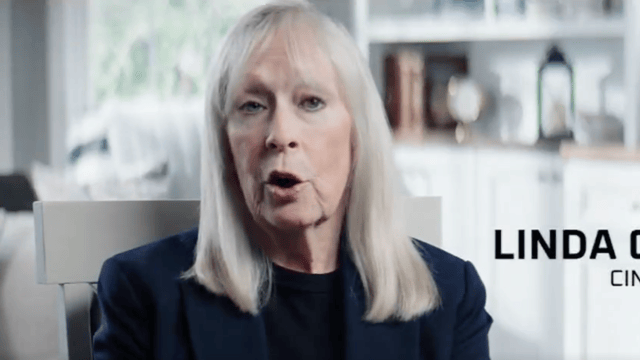
Acton’s campaign said Saturday that the spot recycles the medical-board and police-report material that has anchored three previous rounds of attacks, then adds two new items: a CDC communications training Acton missed, and a clip in which she says she cannot work her own TV remote. She missed the training, the campaign said, because she had fractured her hip and was in prescribed physical therapy. The remote-control line, it said, comes from a clip in which she describes being too consumed by the pandemic response to keep up with internet trends.
An operation with $25.8 million in the bank does not reach for a joke about a remote control because the joke is damaging.
“Vivek Ramaswamy and his allies are grasping at straws as they continue to spread desperate lies about Dr. Acton. No matter how hard he tries, Ramaswamy cannot escape the fact that his campaign is struggling under the weight of an unlikeable, billionaire scam artist who calls Ohioans ‘whiners,’ ‘lazy,’ and ‘mediocre,’ says Medicaid and Medicare are a ‘mistake,’ and proposes tax scams that would raise costs on working families,” said Acton campaign manager Philip Stein.
What the record actually holds
The load-bearing claim is the oldest one: that Acton shut Ohio’s schools and businesses during the pandemic. We examined that claim in June, when a V-PAC spot branded her “the liberal who shut down Ohio.”
Acton did sign the orders. She was director of the Ohio Department of Health from February 2019 to June 2020, and she signed under emergency authority the governor delegated to her. The person who held that authority has been unusually direct about who decided what.
“The decisions that were made during COVID, they were my decisions, so no one should blame someone else if they don’t like it. The buck stops with me,” Gov. Mike DeWine told NBC4 in December.
DeWine has since endorsed Ramaswamy. He has not withdrawn the statement. A super PAC supporting the candidate the governor endorsed is running ads that require the governor to be wrong about his own decisions.
The medical-board material has a similar shape. As we reported when the July spot went on the air, the “insufficient” characterization and the “excellent” one both appear to come from evaluator reference forms submitted with Acton’s 1994 licensure application — not from any finding by the State Medical Board of Ohio. Her campaign says the first covered a four-month partial internship and the second came three years later at the end of her residency. She has held an Ohio medical license since 1994.
The police-report material is real and it is also narrower than the ads suggest. Bexley officers responded to a reported domestic dispute at Acton’s home in August 2019. According to the report obtained by NBC News, Acton told officers she had been drinking and had taken prescription medication. Officers found no evidence of physical violence, classified the incident as a verbal argument, and made no arrest. No charges were filed. Her campaign says she had one drink and that the medications were long-prescribed.
None of the newer material touches her medical judgment or her conduct in office at all.
Who is paying, and what they get for it
V-PAC: Victors, Not Victims reported to the Federal Election Commission that it raised $41,774,674.63 for the 2026 cycle through June 30 and finished the quarter with $25,852,229.95 on hand.
Five donors account for $37 million of that — roughly 88 cents of every dollar. Pennsylvania investor Jeff Yass gave $20 million across three contributions. New York financier Ross Stevens gave $6 million. Ratmir Timashev, listing a Connecticut address, gave $5 million. Elon Musk, Ramaswamy’s former partner at the federal cost-cutting initiative, gave $5 million in May. William Ackman gave $1 million in June.
None of the five lists an Ohio address.
What they bought shows up in the same filings. V-PAC reported $8,211,114.50 in disbursements described as opposing Acton — every dollar of it inside June 2026, including a single $7,963,282 payment to Flexpoint Media on June 5. Over the same cycle it reported roughly $6 million in spending described as supporting Ramaswamy. The group has now spent more attacking his opponent in one month than it spent promoting him in the eighteen before it.
What Ohio’s own records don’t say
Here is the part that deserves more attention than it gets.
V-PAC is a federal committee spending on a state race. Ohio law permits that and attaches conditions. Under R.C. 3517.107, a federal political committee must register with the Secretary of State before it spends a dollar in an Ohio election, and must then file copies of the pages from its federal reports that itemize what it spent here.
Note what that captures and what it leaves out. The state gets the spending. It does not get the donors. An Ohioan who wants to know that a Pennsylvania investor supplied nearly half this operation’s money, or that Elon Musk wrote a $5 million check in May, will not find it in Ohio’s campaign finance system. That information lives in the federal filing only.
The statute contains one provision that would surface donor names at the state level, and it does not reach this case. It applies to contributors who are Ohio residents. None of the five men who supplied 88 cents of every V-PAC dollar lives in Ohio.
Then there is what the state record does with the spending it does capture. Ohio’s file on V-PAC lists $14,057,771.16 in Ohio-related expenditures across four reports. Just over $10 million of that — including the $7,963,282 Flexpoint Media payment on June 5, the largest single line in the file — appears with the purpose field blank. The federal version of that same transaction describes it plainly: media opposing Amy Acton.
The change is easy to date. Every Ohio entry through June 17, 2025 carries a stated purpose, most of them some variation of support for Ramaswamy. Every entry from July 17, 2025 forward is blank. The switch happened months before the anti-Acton buy, and it covers all of it.
Whether that reflects what the committee submitted or what the state’s system retains is not clear from the records themselves. What is clear is the result: a voter reading Ohio’s own database sees eight million dollars leaving a super PAC in June with nothing indicating it was spent attacking a candidate for governor.
The federal side offers no faster route. V-PAC has filed no independent expenditure reports with the FEC this cycle — the near-real-time disclosures that would apply if it were spending against a candidate for federal office. Because Ohio ties its deadline to the federal one, both records update on the same day: October 15, for the quarter covering July, August and September. Nineteen days before the election.
Ohio voters will watch two and a half more months of advertising before either filing shows what it cost.
Why northwest Ohio should care about a Columbus press release
Seneca County will not decide this race, but it will be counted in it. The Cook Political Report moved the governor’s contest from Lean Republican to Toss Up on Friday, July 10, and polling since has shown the two candidates within a point or two of each other. In a race that close, a few thousand votes across a handful of rural counties is the whole margin.
Those votes are being courted almost entirely through paid television, funded by five men who do not live here, in a race where the state’s own public record does not say what the ads were for.
Ramaswamy said of Acton in June, after the first V-PAC ad aired, that her handling of the pandemic “disqualifies her.” His allies have now spent $8.2 million making that argument, and the Republican governor who actually made the decisions has said, on the record and more than once, that they were his.
The ads do not have to be false to be misleading. They only have to leave things out. So far, that has been enough.