
This story was originally published by Signal Ohio. Sign up for their free newsletters at SignalOhio.org/subscribe.
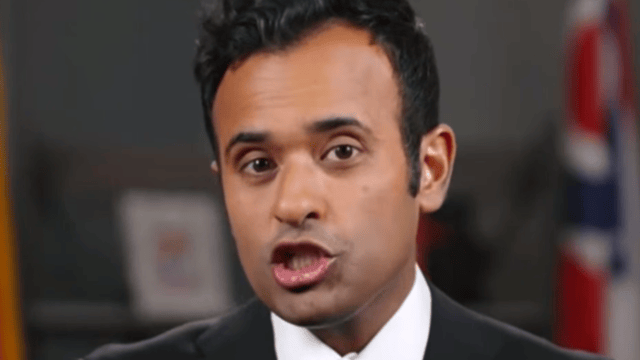
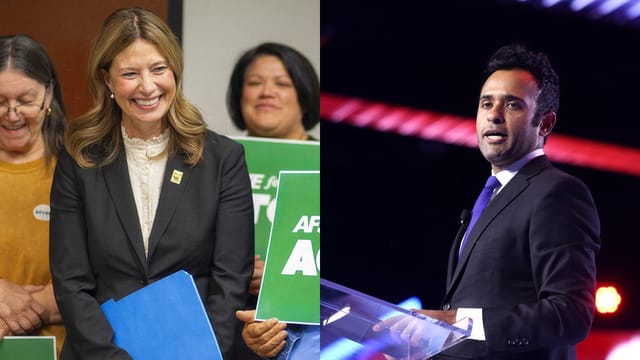
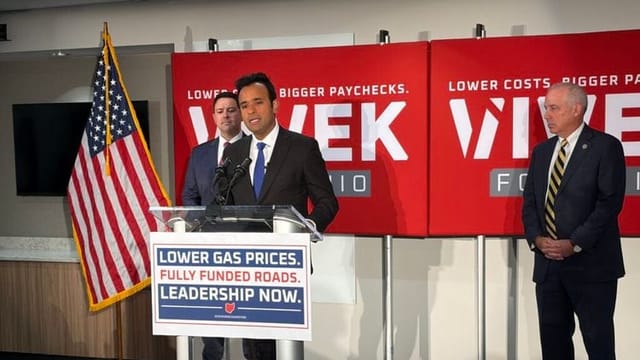
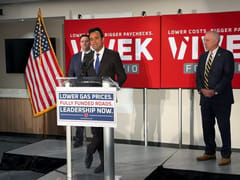
From the moment he claimed victory in the Ohio Republican gubernatorial primary, Vivek Ramaswamy has built a campaign in part around a critique of his opponent’s leadership of the state’s COVID-19 response.
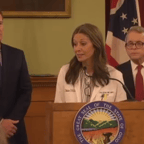
The case has mostly focused on Ohio’s decisions early in the pandemic – led by Republican Gov. Mike DeWine and Ohio Department of Health Director Dr. Amy Acton, a physician who’s now running for governor as a Democrat – to close schools and businesses in the spring of 2020.
Ramaswamy and the state Republican party have sought to ferry some of the lingering frustration and cynicism around COVID-19 into a race against an opponent they refer to as “Dr. Lockdown” or “Ohio’s Fauci,” a reference to longtime federal infectious disease expert Dr. Anthony Fauci, who advised President Donald Trump and President Joe Biden during the pandemic and is now a frequent punching bag and apparent criminal investigation subject of Republicans.
The state GOP has been more unsparing, accusing Acton of “recklessness dressed up in authority” and “a record marked by unconstitutional overreach, preventable suffering, and lasting damage” to Ohio families.
“Those kids in public schools will never get those two years of their education back. That’s unforgivable,” Ramaswamy said in a victory speech in May after a blowout primary victory.
“Businesses were shuttered, and we actually chased business and entrepreneurs to states like Florida or Texas.”
But a review of state health orders shows Ohio’s pandemic response wasn’t all that different from that of pandemic “freedom” states like Texas and Florida through the entirety of Acton’s leadership of the health department during the pandemic.
For instance, Ohio closed its K-12 schools in the Spring of 2020 on the same day as Florida. Also, while Texas and Florida were quicker to re-open restaurants, Ohio was quicker to re-open its first bars.
Acton led the Ohio Department of Health for the first 94 days of the pandemic before she resigned June 11, 2020. In that time, Ohio acted more or less with comparable timing with dozens of states, Democrat and Republican, largely adhering to CDC guidance under the Trump administration in responding to what was then an emerging and novel health crisis. Ultimately, millions of Ohioans were infected during the pandemic, and more than 42,000 died.
“All the states were doing this,” said Sharona Hoffman, a co-director at the law and medicine center at Case Western Reserve University’s law school. “We were not anomalous in any way. Texas and Florida were doing the same thing. … It had nothing to do with Amy Acton.”
Republicans have criticized Acton for taking comparatively common steps to respond to the pandemic, and glossing over their Republican backing. For instance, some have castigated Acton for issuing a late-breaking order delaying the March 2020 primary election. But Ohio was one of at least 16 states to delay its primaries. And the order only came after a lawsuit on behalf of immunocompromised voters seeking to do the same, organized by statewide Republicans including DeWine and Secretary of State Frank LaRose, failed.
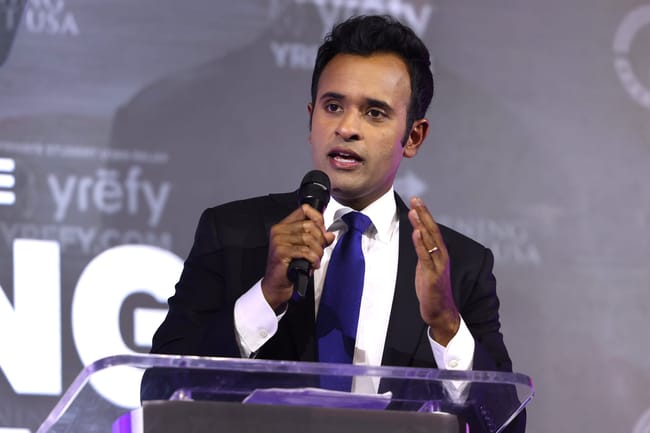
Like other Republicans, Ramaswamy has distanced himself from things like his personal decision to get vaccinated against COVID-19 or his self-identification as an “adviser” to the state’s pandemic response. As recently as Saturday, he referred to Acton as a “bureaucrat who shut down our economy [and] who will do it again” if given the chance.
The criticism comes despite insistence from DeWine, also a Republican, that the life-or-death policy choices of the day were his.
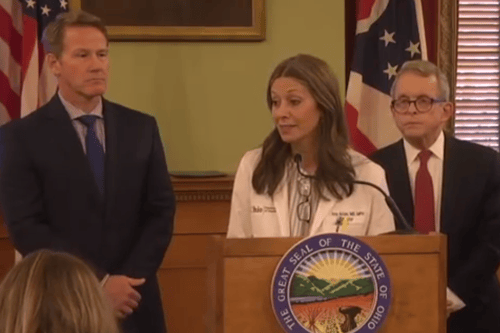
While most health orders were signed by Acton – state law vests power in the health department director – Acton and DeWine rolled them out jointly at the daily pandemic-era press conferences that vaulted Acton to prominence.
“The decisions that were made during COVID, they were my decisions, so no one should blame someone else if they don’t like it,” DeWine said recently. “The buck stops with me.”
Ramaswamy’s campaign declined to make the candidate available for an interview or answer questions on the subject of COVID-19.
Acton’s campaign also declined an interview, emphasizing that DeWine has taken ownership of pandemic-era decisions and that Ohio acted in similar fashion as most states.
“Dr. Acton is proud of the work she did alongside Governor Mike DeWine to put public health over politics, save lives, and keep Ohioans safe,” said Addie Bullock, an Acton spokeswoman. “Meanwhile, Vivek Ramaswamy made more than $2 billion from the COVID-19 vaccine, wanted to ‘segregate’ Ohioans based on their immunity status, and spent over $70,000 lobbying the federal government and White House on COVID drug approvals.”
Ohio, Florida and (most) California schools closed on the same day
On March 12, 2020, DeWine announced that Ohio would be the first state in the nation to close all public schools, effective March 16.
The decision proved to be a watershed moment. Within 24 hours, dozens of states followed. These included ruby red political grounds of Alabama, Florida, Louisiana, Utah and West Virginia.
While Ramaswamy’s campaign regularly and correctly points out that Ohio was the first to “announce” a statewide closure, most states closed schools around the same time.
Ohio and Florida both closed March 16, 2020, a Monday. California didn’t issue any statewide school closure at the time, but by that same day, districts enrolling 90% of California students had closed on their own accord. Texas schools were ordered to close that Friday.
When lawmakers convened for the first time during the pandemic later that month, the Ohio General Assembly didn’t at all reverse Acton’s decision. Instead, lawmakers voted to relieve schools of certain testing and reporting requirements given the shutdowns.
The bill passed unanimously, including with a vote from Sen. Rob McColley, a northwest Ohio Republican who is now Ramaswamy’s running mate.
States varied widely on contentious decisions around handling the 2020-2021 school year. In general terms, Republican states pushed more aggressively for open classrooms, while Democrats sought remote learning options. But these debates occurred well after Acton left and under a new state health director.
Ohio’s bar shutdown? Shorter than sunny Texas’
Ohio closed its bars and restaurants March 15, 2020, in one of the most visceral intrusions into adults’ lives during the pandemic at the time.
California, Florida and Texas’ bars and restaurants were all shuttered by March 20.
In the bitter decisions over re-opening the economy, Ohio sat reliably mid-pack throughout. Restaurants re-opened outdoors on May 15, 2020, with some bars almost immediately drawing dense crowds that stirred unease in state officials. Indoor dining resumed six days later. That’s 61 and 67 days, respectively.
Florida – its tourist towns in the midst of spring break – reopened its restaurants on May 1, 2020, and its bars June 5. That means its restaurants closed for 42 days and its bars for 81.
Texas reopened restaurants on May 4, 2020, at between 25% and 50% capacity, and opened bars on May 22 that year. So Texas restaurants were closed for 42 days and bars for 64.
The timeline is messier than partisan politics suggest. Florida and Texas were more aggressive opening restaurants than Ohio was, while more cautious with their bars.
Ohio declined a mask mandate under Acton
Conservatives have repeatedly sought to connect Acton with pandemic-era, robin’s egg-blue cloth masks – a visceral symbol of one of the most unpopular elements of the pandemic among conservatives.
But Ohio under Acton spurned a torrent of roughly two dozen progressive states that began imposing statewide mask mandates in April 2020.
On April 27, 2020, DeWine announced that Ohio would join a wave of more than a dozen states and impose a statewide mask mandate at open businesses to slow the spread of COVID-19.
But it never took effect, at least in the short run. The very next day, DeWine reversed himself, saying too many Ohioans found the notion of being forced to wear a mask “offensive.”
It wasn’t until July 2020, weeks after Acton resigned, that Ohio first required masks indoors, becoming roughly the 30th U.S. state to do so.
What about closing churches?
A perennial myth of pandemic lore is that Ohio ordered the closure of churches during the COVID-19 pandemic.
The Ohio Republican Party on Tuesday posted on social media an image of a man holding a sign – created by conservative organization Turning Point USA – that says “Don’t Let Dems Shut Down Our Churches.” He’s standing next to a cardboard cutout of Acton, wearing a blue cloth mask.
Rep. Adam Mathews, a Cincinnati Republican and attorney who serves in the General Assembly, in late July penned an op-ed with the headline “Amy Acton closed churches, kept abortions going. I am Catholic. That’s what matters.” (The headline was later corrected.)
However, Ohio never shut down churches during the pandemic. And Ohio’s Republican attorney general used the health department’s shutdown of “nonessential” medical procedures to include abortion clinics, an interpretation later overturned by federal courts. In other words, Acton’s health order was used as the legal basis to shutter abortion clinics until judges intervened. Mathews didn’t return a phone call.
DeWine, a religious conservative, asked that churches either refrain from convening in person or at least adopt social distancing measures, but he said it wouldn’t be enforced so as not to interfere with people’s constitutional rights to free exercise of religion. Acton’s health order was explicit on this point.
“This Order does not apply to and/or excludes religious gatherings, gatherings for the purpose of the expression of First Amendment protected speech,” it states.
Dan Tierney, a DeWine spokesman, said in an interview Tuesday he recalled the administration taking a lot of heat on the issue, but, he said, it’s simply incorrect to suggest any official action closed a church in Ohio.
He said some people perhaps mistook churches’ voluntary decision to close as the result of a health order. But on the other hand, the era was a hotbed of bad actors speaking untruths.
“During covid, there was a lot of misinformation on a lot of things from all ends of the political spectrum,” he said. “This is not the first time we had to answer that [church closure] question. We had to answer it back then too.”
California, for its part, took a more aggressive stance and closed churches. The U.S. Supreme Court overturned the order, deeming it a violation of the First Amendment.
A misleading nursing home ad
COVID-19 spread most efficiently in communal settings and hit older and infirmed populations the hardest. This combination left nursing homes uniquely vulnerable.
Every state struggled with the same problems – not enough testing to detect the virus or personal protective equipment to slow its spread. States tried increasing pay for the care workforce, surging protective equipment into the facilities, and restricting visitors.
Ohio, along with at least 30 other states, including Texas and Florida, banned nursing home visits in an effort to slow the spread of the virus, although research suggests the policy was ineffective. Other studies have found that no state emerged as a role model in their handling of nursing homes during the pandemic, where 39% of all COVID-19 deaths occurred.
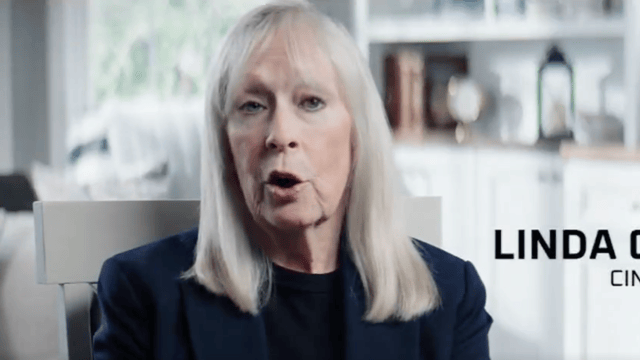
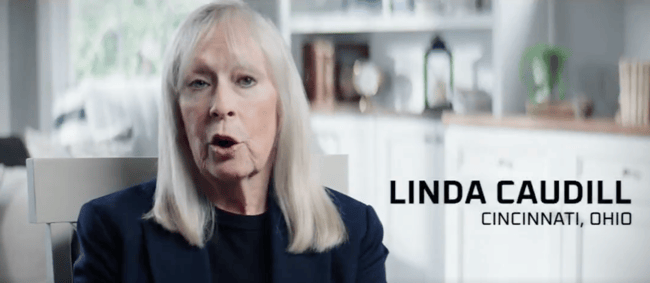
A recent ad from the Ramaswamy campaign invokes Acton’s decisions on the subject. In the ad, a Republican activist named Linda Caudill says her mother was in a nursing home when “Amy Acton shut down the state.” She said her mother was old and couldn’t comprehend why her family couldn’t visit.
“Amy Acton is to blame for this,” the ad states.
The ad criticizes Acton for the virus mitigation measures, while showing headlines about COVID-19-related deaths in Ohio nursing homes.
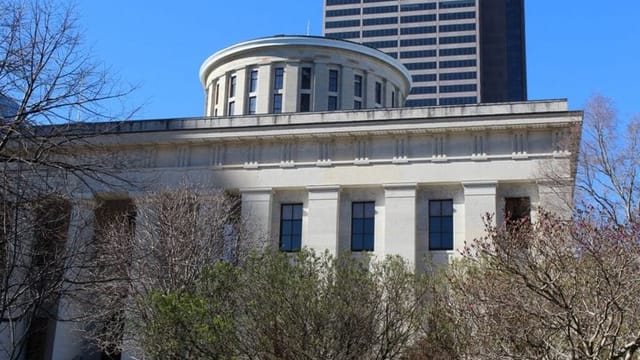
What’s more, some of the claims of Caudill – who is arguably best known for a Columbus Dispatch photograph that captured her angrily screaming outside the Ohio Statehouse in April 2020 while DeWine and Acton gave a press conference – don’t seem to hold up either. A Columbus Dispatch fact check found that Caudill’s mother lived in Kentucky and died after Ohio lifted its stay-at-home order.
Ohio Democrats called the ad a “scam,” and Democratic Party spokeswoman Katie Seewer accused Ramaswamy of resorting to “baseless and easily disproven lies because he’s desperate to salvage any thread of his failing campaign.”
Signal Statewide reached out to Caudill for comment.
Andrew Tobias contributed reporting.
Signal Ohio is a nonprofit news organization covering government, education, health, economy and public safety.