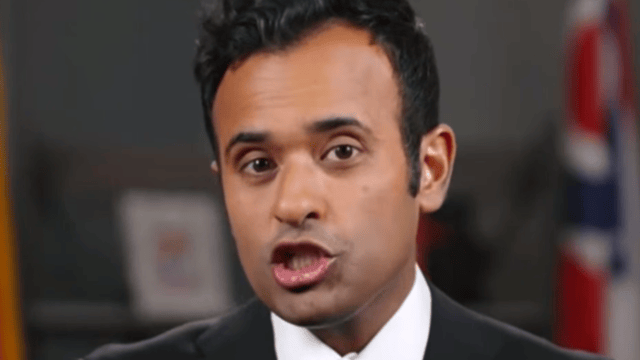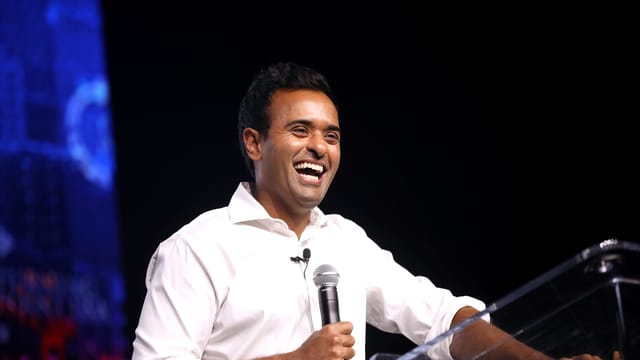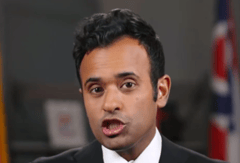
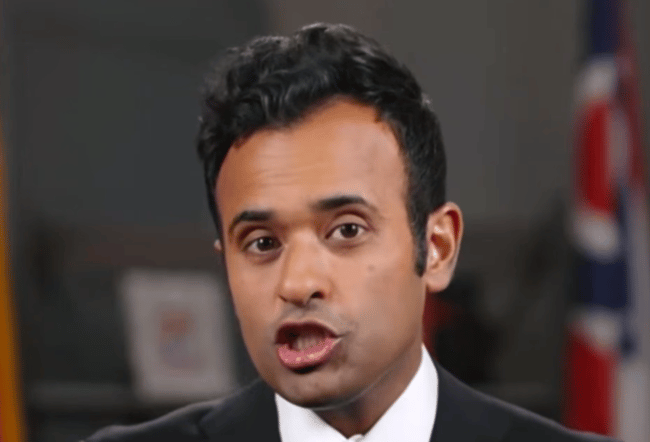
Vivek Ramaswamy’s newest television ad asks Ohio voters to blame Amy Acton for a woman’s isolation and death without telling them a central fact: the woman was a Kentucky resident who died in Kentucky.
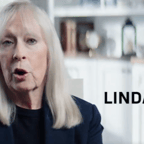
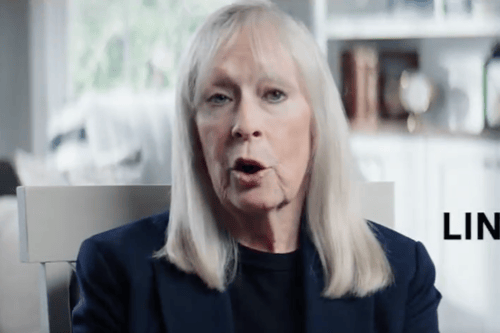
The spot, paid for by Vivek Ramaswamy and Rob McColley for Ohio and tracked by the ad-monitoring firm Medium Buying, features Delhi Township Republican activist Linda Caudill speaking directly to the camera about her mother.
“I had to put my mother in a nursing home because she had fallen,” Caudill says. “A few weeks after that is when Amy Acton shut down the state. My mother didn’t understand it. It traumatized her. She didn’t know why her family couldn’t come visit her. Two months later, she died. Amy Acton is to blame for this.”
What the ad never tells viewers is where Caudill’s mother lived or where she died.
Dorothy Farrell was 88 years old and a resident of Erlanger, Kentucky. She died on Saturday, July 25, 2020, at St. Elizabeth Hospice in Edgewood, Kentucky, according to her obituary from the Ronald B. Jones Funeral Home in Ludlow, Kentucky. Her funeral Mass was held at St. Henry Church in Elsmere, Kentucky. She was buried in Fort Thomas, Kentucky.
The same obituary that establishes those facts identifies one of Farrell’s surviving children as “daughter, Linda Caudill of Delhi, OH.”
Caudill did not learn where her mother lived and died from a news report. She buried her.
The timeline the ad leaves out
Ramaswamy’s campaign constructs a simple sequence for viewers: Acton “shut down the state,” Caudill’s mother could not see her family, and two months later she died.
The actual timeline is considerably different.
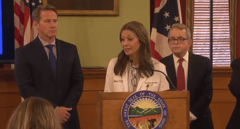
Gov. Mike DeWine lifted Ohio’s stay-at-home order on May 19, 2020, replacing it with an advisory containing strong recommendations and dropping travel restrictions. Farrell died more than two months later.
Acton resigned as Ohio health director on June 11, 2020. Farrell died six weeks later.
Kentucky allowed gatherings of up to 50 people to resume beginning June 29. Farrell died nearly a month after that.
And Kentucky’s own restrictions included an exception for people receiving end-of-life care from the beginning of the pandemic.
When Gov. Andy Beshear restricted visitation at Kentucky nursing homes in March 2020, patients receiving end-of-life care were the only group still permitted visitors, according to the National Governors Association’s record of Kentucky’s pandemic actions. Subsequent guidance told acute-care facilities to discourage visitors “except for visits in end-of-life circumstances” and similarly preserved end-of-life visitation at senior-care facilities.
None of those facts appear in Ramaswamy’s ad.
The strongest possible case for the ad still leaves a major hole
The ad does not identify the nursing home where Farrell stayed before entering hospice. That matters. Delhi Township sits across the Ohio River from Northern Kentucky, and without the facility’s name it cannot be established from the available records whether the nursing home was in Ohio or Kentucky.
Grant the campaign the possibility that it was in Ohio.
The ad still asks viewers to assign responsibility to Acton without giving them the information necessary to determine whether Acton’s rules actually governed the visitation Caudill describes. It never identifies the facility. It never identifies the specific order that prevented Caudill from visiting. It never mentions that Farrell lived in Kentucky. It never mentions that Farrell ultimately received hospice care and died in Kentucky. And it never mentions that Acton had been out of office for six weeks by the time Farrell died.
Instead, Caudill tells an Ohio audience that “Amy Acton shut down the state” and then says, “Amy Acton is to blame for this.”
The missing geography is not some incidental biographical detail. It is fundamental to determining whether the Ohio official being blamed actually controlled what happened.
DeWine has repeatedly said the COVID decisions were his
There is another problem with Ramaswamy’s effort to personally assign Ohio’s pandemic decisions to Acton: the governor who appointed her has repeatedly said otherwise.
DeWine, who has endorsed Ramaswamy, has publicly taken responsibility for the decisions his administration made during COVID-19.
“The decisions that were made during COVID, they were my decisions, so no one should blame someone else if they don’t like it. The buck stops with me,” DeWine told NBC4 in December.
Ramaswamy and groups supporting him have nevertheless spent much of the 2026 campaign making Acton personally synonymous with Ohio’s pandemic restrictions.
An earlier Ramaswamy ad blamed Acton for Ohio’s March 2020 primary election closure, a characterization DeWine himself contradicted and PolitiFact rated Mostly False. A Ramaswamy-aligned group has blamed her for Ohio’s pandemic shutdowns, used her history as a survivor of childhood sexual abuse in an attack ad and attacked her over a missed CDC training and an old joke about a television remote.
Ramaswamy, meanwhile, spent parts of 2020 advocating pandemic measures people close to the DeWine administration considered more aggressive than those Ohio ultimately adopted.
The latest ad takes that strategy somewhere new: it puts a grieving daughter on television to directly blame Acton for what happened to her mother.
Who Ramaswamy chose to put on television
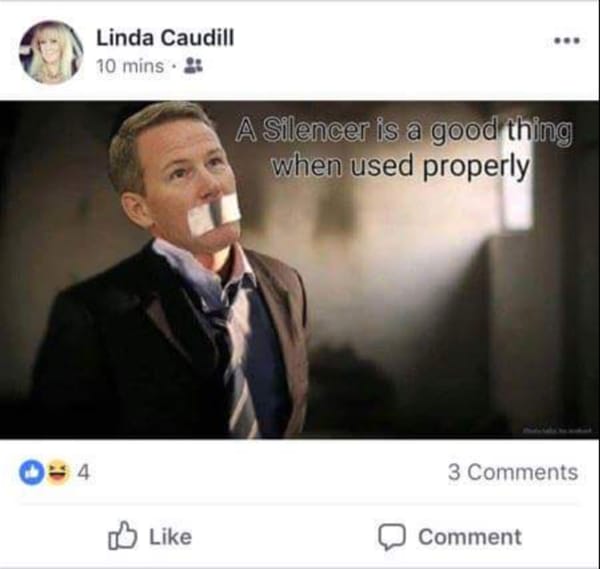
Caudill has been a known figure in Ohio Republican politics for nearly a decade.
In 2017, she served as a volunteer and county leader for Jim Renacci’s gubernatorial campaign.
That October, days after the mass shooting in Las Vegas, Caudill posted a meme to Facebook depicting a man bound to a chair with rope. Jon Husted’s face had been edited onto the man, with duct tape covering his mouth. The caption read: “A Silencer is a good thing when used properly.”
Cleveland.com reported at the time that the meme seemed to advocate Husted’s assassination. A Renacci spokesman said Caudill’s post did not reflect the campaign and that she had been asked to remove it.
A month earlier, according to the Cincinnati Enquirer, Caudill had entered the comments of a Facebook post written by a former Husted staffer as a tribute to her deceased grandmother and repeatedly attacked Husted there. She posted derogatory memes, including one comparing him to a portable toilet, and called him “disgusting.”
After the “silencer” post drew additional attention, Renacci’s campaign parted ways with Caudill.
The man depicted in that meme is now the Republican U.S. senator appearing on the same November 3 ballot as Ramaswamy.
Nine years after another Republican gubernatorial campaign cut Caudill loose over her conduct toward Husted, Ramaswamy’s campaign chose her as the face of a television attack on Acton.
And it put her on television to make an accusation that depends heavily on facts the ad never gives Ohio voters: her mother lived in Kentucky, died in Kentucky hospice care, and passed away weeks after Acton had already left the Ohio Department of Health.
Those facts were not difficult to find. They are in her mother’s obituary.
Caudill did not immediately respond to a request for comment for this story.