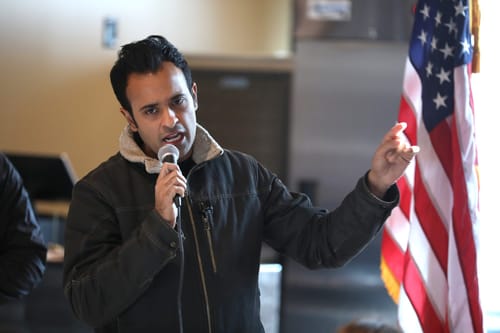
Vivek Ramaswamy has made Amy Acton’s pandemic record the centerpiece of his campaign for Ohio governor — accusing her of spreading “COVID ideology,” calling her shutdown role disqualifying, and now backed by a super PAC ad branding her “the liberal who shut down Ohio.”
But the public record shows Ramaswamy spent 2020 inside the same pandemic response he now campaigns against: advising the DeWine administration, backing mandatory antibody testing and stay-at-home orders for Ohioans without immunity, pitching a national registry to “segregate” Americans by biomarker — a registry his own company then worked to build — and founding the biotech firm whose subsidiary collected a $2.25 billion settlement over COVID-19 vaccines this spring.
Critics, NBC4 reported, call the contrast “hypocritical”: Ramaswamy attacks Acton over policies similar to ones he was advocating at the same time — in some cases, stricter versions of them.
He advised the response he now attacks
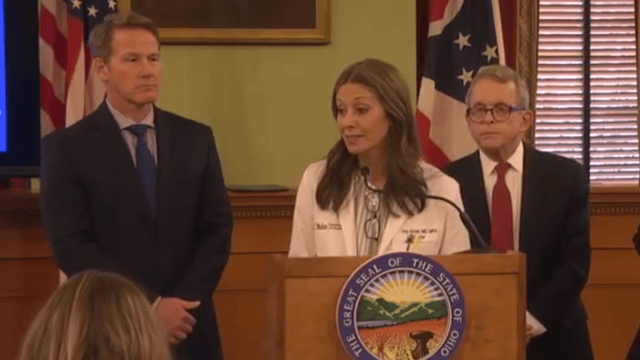
While Acton stood at the podium for Ohio’s daily briefings as state health director, Ramaswamy was advising the state’s pandemic response from the private sector. As CEO of Roivant Sciences, Ramaswamy “worked with the lieutenant governor as an adviser on COVID-19” during 2020, he wrote in a 2021 op-ed cited by the Associated Press. The lieutenant governor at the time was Republican Jon Husted, now a U.S. senator, who appeared alongside Acton and Gov. Mike DeWine at those same daily briefings.
He backed mandatory testing and stay-at-home orders
Ramaswamy’s 2020 positions went beyond advising. A recording from that year exclusively obtained by NBC4 shows Ramaswamy backed universal “mandatory” antibody testing and isolation — a system in which people with natural immunity could return to normal life while everyone else remained under lockdown in a mandatory stay-at-home order, with those locked down first in line for a vaccine.
“It would be a waste, arguably, to vaccinate somebody who already had immunity and I think the only way to ensure that we are sending the right people back to normal life now versus the people we keep in shelter at home mandates is on the basis of individual testing for immunity,” Ramaswamy said in the 2020 recording, according to NBC4.
Sources close to the DeWine administration in 2020 told NBC4 that implementing the system Ramaswamy suggested would have required a government registry of who had antibodies and who didn’t — and that mandated testing and isolation for select groups struck them as government overreach. Those are policies in the same family as the closures imposed by the DeWine administration and by states across the country — the very measures Ramaswamy’s campaign and running mate, then-state Sen. Rob McColley, have condemned as overreach.
In April 2020, on an episode of Rockefeller Capital Management’s client podcast, Ramaswamy laid out the concept in his own words, according to reporting by Contra that transcribed the interview. “Could we tolerate a national system in which certain people on the basis of a biomarker are segregated?” Ramaswamy asked. He answered his own question: “I personally think that it is better than the status quo if we can send 10 or 20 percent of the people back on the basis of having immunity.” He said he had discussed the idea with policymakers, including members of Congress and a U.S. senator.
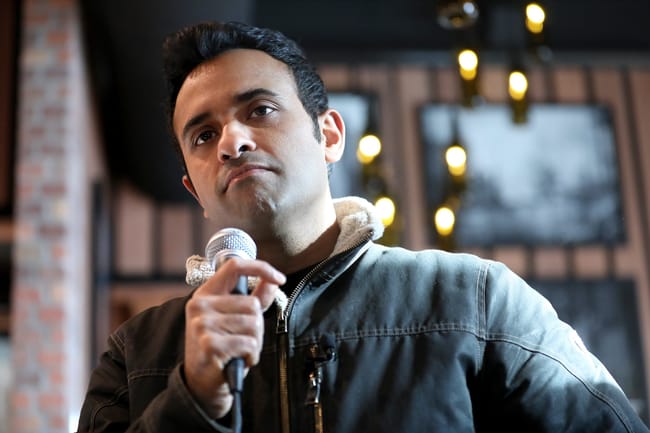
A discussion draft obtained by Contra shows Ramaswamy formally pitched the strategy, proposing a public-private partnership whose stakeholders would include an “Organization X” — a government division, private company or nonprofit — to maintain “the registry of individuals who are immune and individuals who should be prioritized for testing.”
During the pandemic, Ramaswamy supported vaccines and received one himself, and he advocated mask-wearing, the AP reported — though he has said he never supported governments mandating either.
His company tried to build the registry
The registry was more than talk. Datavant, a health-data company launched in 2017 under the Roivant umbrella, pushed for a national COVID-19 registry that would have allowed the small share of Americans gaining natural immunity to “get back to normal life” while the rest of the population continued to be “segregated,” the AP reported. The quoted language comes from the proposal itself.
Five days after Ramaswamy’s podcast appearance, The Wall Street Journal reported that Datavant was spearheading an effort to create a registry of COVID-19 patients by pooling medical records from across the country, according to Contra. By November 2020, Datavant announced a partnership supporting the National Institutes of Health’s National COVID Cohort Collaborative, a centralized platform built to store and study medical record data from people tested for the virus.
The pandemic paid — $2.25 billion from COVID-19 vaccines
The pandemic was also lucrative for the corporate empire Ramaswamy built. On March 3, Roivant announced that its subsidiary Genevant Sciences and partner Arbutus Biopharma had reached a $2.25 billion global settlement with Moderna over the pharmaceutical giant’s unauthorized use of their lipid nanoparticle delivery technology in its COVID-19 vaccines, including Spikevax. Moderna will pay $950 million upfront in July, with an additional $1.3 billion contingent on a federal appellate ruling. If the full amount is paid, the companies said, it would be the largest disclosed patent settlement in pharmaceutical industry history.
Genevant played a “fundamental role” in the global pandemic response, the companies’ announcement said. Ramaswamy founded Roivant in 2014 and served as its CEO until January 2021 and executive chairman until February 2023, when he stepped down to focus on his political career. TiffinOhio.net detailed that record in earlier reporting.
Then he paid to erase the record
As Ramaswamy entered politics ahead of his 2024 presidential run, he took steps to distance himself from his pandemic-era role. In early 2023, he paid an editor to remove a reference to his service on Ohio’s “COVID-19 Response Team” from his Wikipedia page, the AP reported. Ramaswamy called the edit a simple correction, saying the panel never met.
The attacks, and his explanation
Ramaswamy has kept Acton’s pandemic record at the center of his campaign. At rallies he accuses her of spreading dangerous “COVID ideology,” and supporters have dubbed her “Lockdown Amy.” The latest salvo is a 30-second TV ad from V-PAC: Victors Not Victims, the super PAC backing his campaign, which began airing Tuesday, June 9, branding Acton “the liberal who shut down Ohio, closing your child’s school and your friend’s business.”
Ramaswamy has said his talks with Husted and his support for the COVID registry were about “getting the economy going again,” and he describes his position on the virus as “nuanced.” He says the difference between his 2020 proposals and Acton’s orders is that Acton did not differentiate between people with natural immunity and people without it.
“She never engaged with those data points, and when the legislature required her to draw those distinctions, she did not do the hard work,” Ramaswamy said, according to NBC4. “She quit. It disqualifies her.” His campaign referred the AP’s questions about his time at Roivant to the company, which did not respond.
DeWine: ‘They were my decisions’
The premise of the attacks — that Acton shut down Ohio — is contradicted by the Republican governor who appointed her. Acton signed the closure orders as health director from February 2019 to June 2020 under emergency authority granted by DeWine, who has repeatedly said the decisions were his own — even after endorsing Ramaswamy.
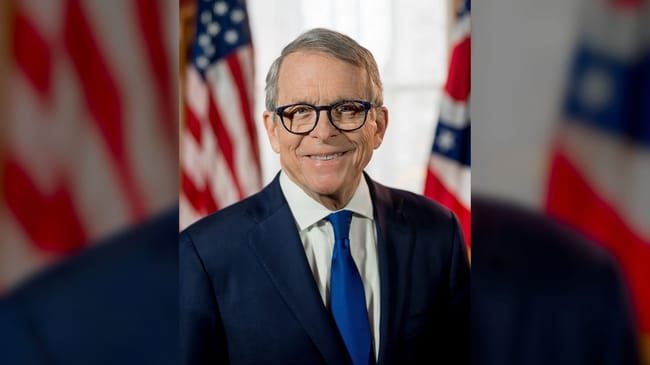
“I got advice from her. I got advice from people around the country,” DeWine said in December. “I was trying to get as much information as I could about something that we did not know much about, and I made decisions based upon that, but they were my decisions. They were not, they were not her decisions.”
Acton’s campaign has dismissed the COVID-19 attacks. “Dr. Acton is proud of the work she did alongside Governor DeWine to put public health over politics, save lives and keep Ohioans safe,” campaign spokesperson Addie Bullock said in a statement to the AP. “It is unfortunate that Vivek Ramaswamy wants to play politics on this issue.”
Ohio ranked 22nd among states in its per capita COVID-19 death rate during the pandemic’s first year, according to data from the U.S. Centers for Disease Control and Prevention cited by the AP.
Ramaswamy won the May 5 Republican primary and faces Acton in the general election on Tuesday, November 3.