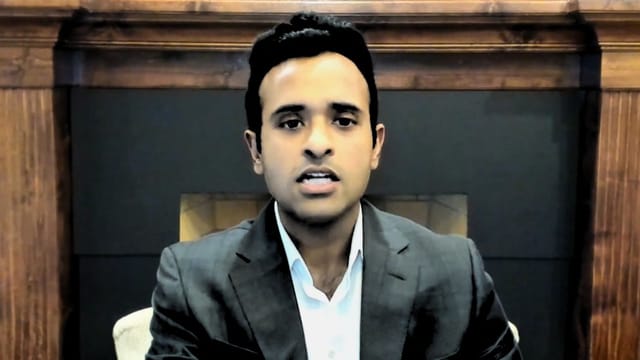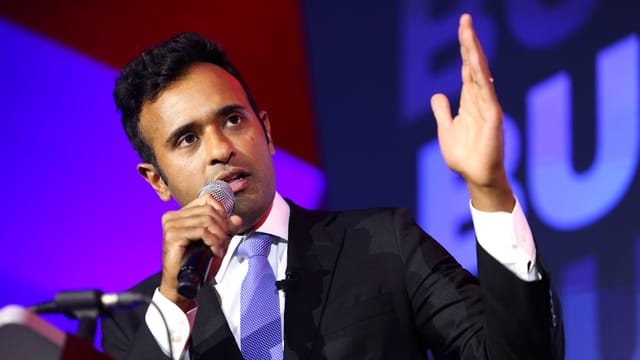
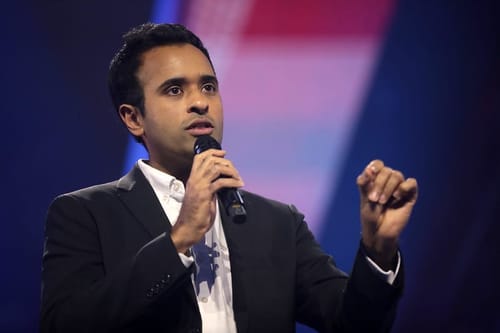
Vivek Ramaswamy, the biotech billionaire running for Ohio governor with Donald Trump’s endorsement, has a documented record of defending the practice of replacing American engineers with foreign visa workers — a position he articulated publicly just weeks before launching his gubernatorial campaign, and one his own company’s hiring history undercuts whatever reform rhetoric he has tried to attach to it.
On December 26, 2024 — while still serving as co-chair of Elon Musk’s Department of Government Efficiency — Ramaswamy posted a lengthy argument on X defending tech companies that hire foreign-born engineers instead of Americans. The reason, he argued, was cultural failure.
“The reason top tech companies often hire foreign-born and first-generation engineers over ‘native’ Americans isn’t because of an innate American IQ deficit,” Ramaswamy wrote. “A key part of it comes down to the c-word: culture. Our American culture has venerated mediocrity over excellence for way too long.”
He added: “A culture that celebrates the prom queen over the math olympiad champ, or the jock over the valedictorian, will not produce the best engineers.”
The post aligned him with Silicon Valley’s years-long push to expand the H-1B visa program, which allows U.S. employers to hire foreign nationals in specialty occupations — primarily technology and engineering. CNN reported that Ramaswamy and Musk used the moment to defend companies that depend on H-1B workers, arguing tech firms cannot operate without importing foreign labor.
His own company filed 29 H-1B applications
Ramaswamy’s defense of the practice was not abstract. According to federal records from the U.S. Citizenship and Immigration Services H-1B Employer Data Hub, Roivant Sciences — the pharmaceutical company Ramaswamy founded — had 29 H-1B visa applications approved between 2018 and 2023, as first reported by Politico. Ramaswamy stepped down as Roivant’s CEO in February 2021 but remained chair of its board of directors until February 2023.
When Politico asked his campaign about the gap between that record and his stated immigration policy positions, press secretary Tricia McLaughlin did not dispute the filings. “The system is broken and needs to be fixed,” she said in a statement, comparing it to using electricity while criticizing energy regulations. “Vivek believes that regulations overseeing the U.S. energy sector are badly broken, but he still uses water and electricity,” she said. “This is the same.”
‘Indentured servitude’ — but keep the pipeline open
Ramaswamy has publicly called the H-1B program “indentured servitude” and pledged to gut its lottery-based selection system. But he has never called for ending the importation of foreign tech workers. His stated goal is to replace the lottery with what he describes as a merit-based model — one that, under his own framing, would accelerate the flow of foreign engineers into American workplaces rather than stop it.
“The lottery system needs to be replaced by actual meritocratic admission,” he told Politico. “It’s a form of indentured servitude that only accrues to the benefit of the company that sponsored an H-1B immigrant. I’ll gut it.”
Critics from the left and right noted that his proposed solution addresses the mechanism of the H-1B program, not its core economic effect on American workers. A 2020 report by the Economic Policy Institute found that the structure of the H-1B program has allowed employers — including major tech firms — to pay visa workers at wage levels set below the local median for their occupation. A separate EPI analysis in 2023 found that the top 30 H-1B employers laid off at least 85,000 workers in 2022 and early 2023 while simultaneously filing for 34,000 new H-1B hires.
Bipartisan pushback
Ramaswamy’s December 2024 comments drew immediate backlash from across the political spectrum. Former South Carolina Gov. Nikki Haley, his onetime rival in the 2024 Republican primary, responded directly: “There is nothing wrong with American workers or American culture. All you have to do is look at the border and see how many want what we have. We should be investing and prioritizing in Americans, not foreign workers.”
Pro-Trump podcaster Brenden Dilley wrote on X: “I always love when these tech bros flat out tell you that they have zero understanding of American culture and then have the gall to tell you that YOU are the problem with America.” Steve Bannon, on his War Room podcast, called the pro-H-1B arguments a “total scam.”
The public blowup over the comments contributed to reported tensions between Ramaswamy and both Trump and Musk. Ramaswamy departed DOGE on January 20, 2025 — Inauguration Day — and formally launched his Ohio gubernatorial campaign the following month.
What it means for Ohio workers
H-1B is a federal visa program; Ohio’s governor has no direct authority over it. But Ramaswamy’s ideological alignment with the tech industry’s preferred approach to labor supply — importing credentialed foreign workers rather than investing in domestic workforce development — is a contrast that his opponents in the May 5 primary have already begun pressing.
Republican primary challenger Casey Putsch has made it a centerpiece of his campaign. “Our kids are denied high-paying jobs due to foreign H-1B visa labor,” Putsch’s campaign website states, positioning Ramaswamy implicitly as part of the problem he’s running against.
Ramaswamy has offered no state-level workforce or labor development policy addressing how Ohio workers — particularly in manufacturing communities already hammered by plant closures and job losses — would compete in the technology economy he describes as essential to the state’s future.
Attempts to reach Ramaswamy’s campaign for comment were unsuccessful.