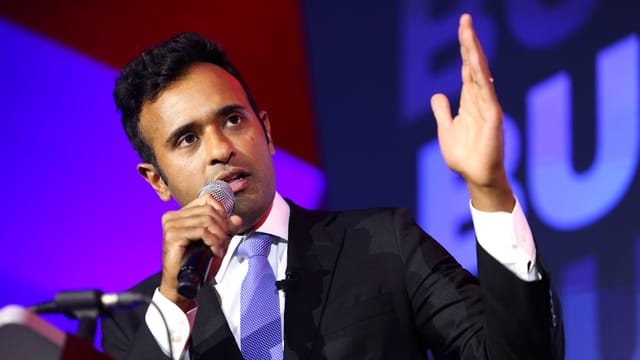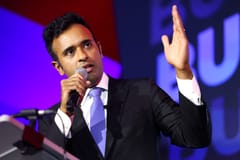
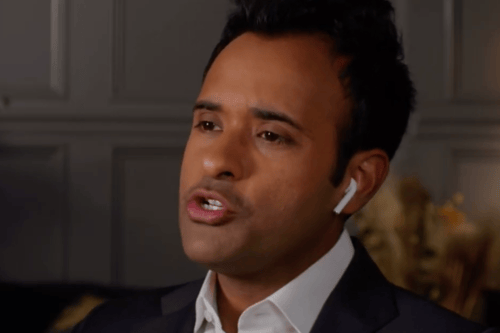

Vivek Ramaswamy made Ohioans a promise on Thursday. Build a data center in your community, he said, and your household electricity becomes free, your property taxes go down, and the facility meets every air and water standard without exception. If those conditions aren’t met, he wrote, the data center “won’t be built. Period.”
It is a large promise, and it rests entirely on one thing: a governor’s willingness to squeeze the industry on Ohioans’ behalf. There is no statute behind it. There is no rule. In an op-ed published the same week, Ramaswamy said delivering it takes “the acumen of a businessman, not a bureaucrat, at the top.” The mechanism is his own judgment.
Which makes it worth knowing who has been paying for access to that judgment.
Campaign finance reports filed with the Ohio Secretary of State show that political action committees tied to electric utilities, gas distributors, oil and gas producers, pipeline companies and solar developers gave Ramaswamy’s campaign $94,096.34 in cash during 2026, plus another $3,372.57 in-kind — food, beverages and facility rental provided by the Ohio Oil and Gas Producers Fund. Combined value: $97,468.91.
The money kept coming after it became a story
On Monday, May 18, the Energy and Policy Institute reported that six of Ohio’s largest investor-owned electric and gas utilities had sent more than $2 million to the Republican and Democratic governors associations, and that corporate PACs for five of the six had given more than $68,000 directly to Ramaswamy, his running mate Rob McColley, or both, going back to January 2025. Amy Acton’s campaign received nothing from those PACs.
That report is the reason this one exists. After it published, $65,603.24 more arrived from energy interests — nearly as much again as the watchdog group had found in the first place, from a broader set of companies, in the space of ten weeks.
The largest checks came last. On Friday, July 31 — the final day covered by the campaign’s most recent filing — three arrived at once:
-
$16,615.67 from the Utility Scale Solar Energy Coalition of Ohio PAC, the trade association for utility-scale solar developers. It is the only energy contribution in the file that matches Ohio’s per-election ceiling to the penny.
-
$16,615 from the employee PAC of Vistra Corp.
-
$10,000 from Diversified Gas & Oil Corporation’s PAC.
Two weeks earlier, on Wednesday, July 15, Energy Transfer’s PAC gave $5,000 in two installments. Apex Clean Energy’s PAC added $5,000 on July 31. NiSource, the parent of Columbia Gas of Ohio, gave $6,615.67 in February and $3,000 on May 29. Chesapeake Utilities gave $3,000. AES Ohio’s Dayton Power & Light fund gave $1,000 in April.
AEP’s Committee for Responsible Government gave $17,000 in two pieces — $16,000 on Tuesday, May 5, and $1,000 on Saturday, June 27. Ohio treats the primary and general as separate contribution periods, so those two are not additive against a single limit.
What a governor actually controls
The reason this matters is not that $97,000 buys anything in a race where Ramaswamy has loaned himself $25 million. It doesn’t. It is that every promise in his data center plan runs through agencies the governor staffs.
Under Ohio law, the governor appoints all five members of the Public Utilities Commission of Ohio, subject to Senate confirmation, choosing from lists produced by a nominating council. The governor also designates the chair, who serves in that role at the governor’s pleasure. PUCO decides rate cases. It decides how the cost of new transmission and generation gets divided between data centers and everyone else. It approved the data center tariff that AEP Ohio now operates under, and it would build the statewide data center rate class contemplated in pending legislation.
Free electricity for households near a data center is not something a governor can order. It is something a governor can push a commission and a utility toward — or not. The people who would be pushed have made themselves known to him.
The Ottawa County connection
Vistra’s check carries particular weight in northwest Ohio, because Vistra owns Davis-Besse.
The plant sits in Oak Harbor, about 45 minutes north of Tiffin. Along with the Perry plant in Lake County, it was the reason House Bill 6 existed — the 2019 law that charged Ohio ratepayers roughly $150 million a year to keep the two reactors running and that produced the largest corruption prosecution in state history.
Vistra is entitled to a distinction here, and it is a real one. Vistra did not receive the bailout. It was part of the coalition that fought HB 6. It acquired Davis-Besse and Perry from Energy Harbor in 2024, years after the subsidies were repealed and the indictments came down. Nothing about that history is Vistra’s conduct.
But Ohio’s experience with utility money in politics is not a matter of one company’s record. It is a matter of what the arrangement looks like from the outside — and Ohio has spent six years learning what it looks like when the companies that generate power and the officials who regulate it get comfortable with one another.
What Ohioans are paying while this happens
The bills are the part that isn’t complicated.
Ohio utilities disconnected service to roughly 345,000 customers in the year ending May 31, the highest rate in four reporting periods. AEP’s Ohio Power had the worst rate of any utility in the state at 15% — more than four times FirstEnergy’s 3.6%, according to reporting by Canary Media. Ohio electricity bills have climbed 53% since 2021.
Over the same stretch, the chief executives of Ohio’s four investor-owned electric utilities collectively took home $81 million in 2025. AEP’s Bill Fehrman accounted for $36.6 million of it. AEP has said generation costs, which Ohio law bars distribution utilities from controlling, are the primary driver of the increases, and that its average customer’s generation bill has risen 103% in five years.
Both things are true at once. The structural explanation for high bills is real. So is the fact that the industry offering it is funding the man who will appoint its regulators.
The case for the defense
Ramaswamy’s plan is not an industry wish list, and pretending otherwise would be dishonest. It would end future property tax abatements for data centers — a break that has cost Ohio billions and that developers have fought hard to keep. It would require full environmental compliance, closed-loop water recycling, and construction on brownfields rather than farmland. It includes a temporary pause on new approvals. Those are real commitments, and several of them cut directly against the interests of companies writing him checks.
The solar coalition’s contribution complicates the picture further. USSEC represents developers who are frequently on the opposite side of AEP and the gas producers in siting and rate fights, and whose projects Ohio regulators have repeatedly blocked. Calling this a single bloc would be wrong.
There is also no evidence — none — that any contribution was solicited in exchange for anything, or that Ramaswamy has taken any action for any donor. He holds no office. He has cast no vote. The campaign is entitled to say, accurately, that legal contributions from lawfully registered PACs are how American campaigns are funded, and that Acton’s donors have interests too.
What remains
The strongest argument against reading anything into this money is that it is small — a rounding error against $25 million of the candidate’s own cash and a super PAC that has raised $29.5 million.
That argument would be more persuasive if the money had stopped when it was noticed. It didn’t. It roughly doubled, broadened to companies outside the original six, and the biggest checks were written on the last day of the reporting period, seven weeks after Ohio’s utility spending in this race became a documented story.
Ramaswamy has investments across the data center supply chain and would appoint the boards that fund, site, tax and regulate it. He has now also accepted approaching $100,000 from the energy sector that powers it. He is asking Ohioans to trust that when he sits down across the table from these companies, he will squeeze them until residential electricity near their facilities is free.
Voters decide Tuesday, Nov. 3 whether that is a reasonable thing to take on faith.