
This story was originally published by Signal Ohio. Sign up for their free newsletters at SignalOhio.org/subscribe.
Electric bills will likely hit record highs for millions of Ohioans when July bills go out this month, driven by rising rates, new systemic demand and a heat dome that lingered over much of the Midwest.
New data from the Ohio Utility Rate Survey – a state publication based on cost data from utilities – shows the electric bill for a residential electric customer using an average amount of power hit record levels in Cleveland ($189), Dayton ($188) and Akron ($184) in July.
It’s not much better elsewhere. Columbus’ July ($198.53) is $1 from the high watermark in May 2024. Toledo ($175) was about $6 off from its June 2023 record. Cincinnati’s July bill ($171) is just $1 short of the local record set last June.
On a statewide basis, that means July bills are 12% higher than last year and a whopping 62% higher than they were a decade ago.
“Is this a new normal? Probably, at least for the near future,” said Tom Bullock, executive director of the Citizens Utility Board, a nonprofit that advocates for lower electric rates for residential customers.
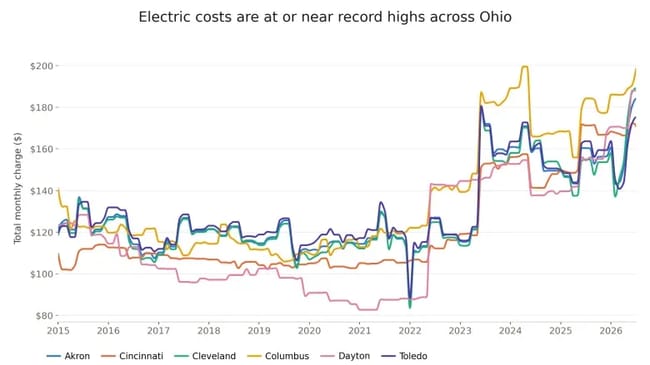
These figures assume what the federal government considers to be an average household’s use of 900 kilowatt-hours. Real consumption will vary based on different factors like efficiency and household size, but a stretch of intense heat early in the month spurred heavy demand on electricity-intensive air conditioners.
Experts said a complex mix of factors are pushing prices upward. Hot weather means more demand all at the same time. A development boom for data centers, the energy-intensive megafacilities serving the artificial intelligence sector, adds to that demand systemically. Coal-fired power plants have gone offline. Grid operators have been slow to allow new power producers into the system. And some have accused utilities of either inflating or at least relying on speculative assumptions of data center building to boost their own bottom lines.
Whatever the cause, the effect is palpable on the monthly bills. For a Columbus household, in American Electric Power Ohio’s service territory, 900 kilowatt-hours in July 2016 cost $118. Today, that’s about $199. That’s a difference of $81 more for the month. The 10-year spike is similarly seen across the state.
Three components drive electric bills: generation costs (the power you use), transmission costs (sending huge amounts of power across long distances from the power plant), and distribution costs (the last poles and wires before the end user). The data show that while transmission and distribution costs, both of which are set by regulators, have increased modestly, generation charges are behind most of the cost increase.
There are some limits to the data. It only goes back to 2015. And it doesn’t reflect rates paid by those who have chosen their own electricity supplier, or those on a municipal aggregation program.
Why are Ohio electric costs increasing?
Signal Statewide asked a variety of industry players the same basic question: why have electric bills gotten so out of control?
None offered simple answers. All blamed a mix of culprits.
Several singled out PJM, which operates the regional electric grid, spanning 13 states including Ohio. PJM hosts capacity auctions, where a price is set for a reserve of power to ensure reliability when demand hits its highest. Those auctions have seen massive price spikes year over year since 2024.
Among the biggest causes is the failure of PJM and state regulators to quickly let new electrons into the system, said Nolan Rutschilling, the managing director of energy policy at the Ohio Environmental Council.
Besides a queue backlog, he said natural gas has gotten preferential regulatory treatment in terms of navigating the permitting bureaucracy. But gas turbines are in short supply these days, meaning new plants can take five to seven years to get to the market. Renewable energy sources can be built much faster, but are subjected to far more regulatory scrutiny in Ohio.
This supply crunch, coupled with the new demand from more than 200 operational or planned data centers and huge industrial projects like Intel’s $28 billion chip fabrication plant or Anduril’s $1 billion advanced weapons factory in central Ohio, means higher costs.
“We’ve got really high prices because we aren’t bringing enough energy online,” Rutschilling said.
Bullock, from Citizens Utility Board, said President Donald Trump’s administration’s tariffs have worsened the effect, hiking the costs of steel that make up much of the physical power grid. And that grid, he said, has lacked proper maintenance, causing inefficient performance and likely warranting an expensive upgrade sometime in the future.
He lives in Lakewood, Ohio, and has personally seen the effects of an under-maintained electric grid and the unusually high rate and duration of the blackouts that come from it.
There’s also a U.S. war against Iran driving up the cost of raw fuels, an effect that tends to spill into electricity markets. And PJM, Bullock said, has been slow-footed allowing new generators – especially renewables – onto the grid.
That pressure is all mounting cumulatively, and there’s no obvious dynamic that would change things in the near term.
“You could easily see prices not letting up for the next five years,” he said.
There’s reason for more scrutiny, if not skepticism, around some of the finger pointing at data centers, said John Seryak, an engineer who works as a technical consultant to the Ohio Manufacturers’ Association. In an interview, he said utilities are making speculative and rosy assumptions about how likely a planned data center is to come to fruition. But they’re treating those assumptions as fact when making grid investment decisions.
And on the supply side, he said some technocratic changes have left PJM overestimating the impact of several coal-fired power plants during the 2010s. This would mean PJM is overestimating the drop in supply, which produces a price increase.
Ohio can make policy changes to mitigate the damage in the medium- to long term. But until then, he said people should expect higher bills, seek energy efficiencies where possible, and budget accordingly.
“I think right now, between transmission and capacity, I wouldn’t count on prices to come down between now and 2030,” he said.
Transmission costs are rising too, another trend driven by data centers, said Jon Blackwood, a spokesperson for the Ohio Consumers’ Counsel. And part of the problem is the murkiness around what costs can be shifted to customers.
“Forecasting issues include lack of transparency, potential double counting, and accuracy,” he said.
What do the utilities say?
Signal Statewide reached out to Ohio’s major, investor-owned electric utility companies that own utilities in Ohio: American Electric Power, FirstEnergy, AES, and Duke Energy.
By AEP’s own calculations, its distribution rates have increased 36%, the company said in a statement. Those increases are primarily tied to the increased cost for equipment, gas and labor flowing into the grid.
The company emphasized that the price hikes stem from the generation side of the ledger, and Ohio laws don’t allow distribution utilities like AEP Ohio to own power plants. And the company noted its recent regulatory effort to force data centers to absorb more risk in grid investments.
“Generation costs are the primary reason electric bills have increased in Ohio, and in Ohio, utilities like AEP Ohio are not permitted to own generation,” the company said.
“The average AEP Ohio customer’s generation bill has increased 103% in the last five years. That is material for Ohioans, and we are very concerned by it … In the PJM territory, there is an imbalance between the supply of electrons on the grid and demand for them. And since we cannot own generation, we are with our customers, waiting for the market to respond.”
FirstEnergy responded as well, noting – as have its competitors in the past – that utilities don’t set unit prices for electricity. However, utilities do set, pending regulatory approval, the transmission and distribution costs, which have increased over the decade.
Will Boye, a FirstEnergy spokesperson, said the company understands that even small cost increases can have big impacts in an inflationary economy.
“We must continue investing in our system in order to provide the safe, reliable service our customers count on,” he said. “We know that costs matter, which is why these investments are carefully planned and focused on delivering real, lasting value for the communities we serve.”
Signal Ohio is a nonprofit news organization covering government, education, health, economy and public safety.