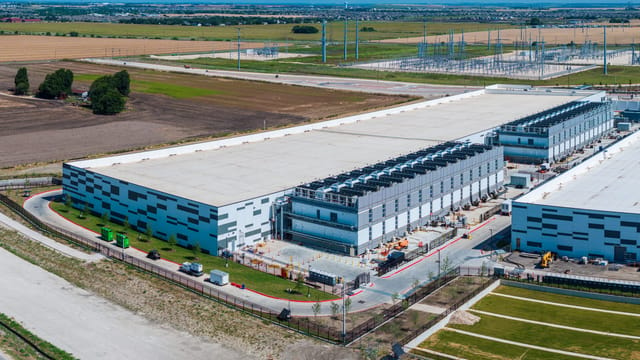


In a recent survey, most economists said Ohio’s tax abatements are an effective way to attract AI data centers to the Buckeye State, but many also questioned the desirability of doing so.
They were more split on the economic benefits of making data centers generate their own electricity.
There has been a swift, sharp backlash against data centers this year as projects have been rammed through without community input, electricity bills have shot up, and workers fear mass displacement by the technology. And there are worries about how artificial intelligence will reshape the jobs that remain.
As huge and growing numbers of Americans find it harder to simply pay their bills, the backlash has also been directed against a political system in which monied interests seem to have all the power.
In Ohio, anger against data centers built in June when the public learned that former Gov. John Kasich had granted some of the richest tech companies in the world billions in taxpayer incentives that would last 40 years.
Scioto Analysis surveyed 37 Ohio economists about data centers, including asking whether taxpayer incentives are an effective way to attract them. Twenty three said they were — although several expressed doubts about whether that’s a good thing.
“I think that (tax abatements) are effective for attracting the data centers,” Curtis Reynolds of Kent State University wrote in the comment section of the survey. “That does not mean that I think they are a good idea. Tax abatements become a race to the bottom and as communities fight for businesses. In the case of data centers, there will be little employment gains for the local community so the economic benefits of these tax abatements seem dodgy at best.”
Other economists questioned whether such incentives play much of a role in Big Tech’s decision making.
“Data centers locate where the power is, not where the abatement is,” wrote Roman Sheremeta of Case Western Reserve University. “The evidence on tax incentives shows most go to firms that would have come anyway — and hyperscalers are building everywhere they can. Ohio’s $2.3 billion mostly bought what it would have gotten for free.”
One economist said the unpopularity of data centers should make corporate handouts unnecessary.
“Because many communities across the country oppose data centers, Ohio may attract them without additional incentives,” wrote David Lindequist of Miami University. “Tax abatements seem to only provide marginal incentives at best.”
The economists split when asked whether making data centers produce their own electricity would lower Ohioans’ electricity bills. Sixteen said it would, 10 said it wouldn’t and 11 were uncertain.
Casey Boyd-Swan of Kent State University said such “behind-the-meter” generation might reduce electricity bills, but it could come with other costs.
“The idea behind this makes sense,” she wrote. “The biggest economic risk from data centers is cost-shifting, so requiring on-site generation keeps those costs with the data center. In practice, energy costs may not increase as much for Ohio residents, but most on-site generation will be natural gas turbines, which concentrate both air pollution and around-the-clock noise in the communities where data centers are located.”
For his part, Lucas Englehardt of Kent State University argued that on-site power generation might actually increase Ohioans’ power-bills. He said it would make electricity more expensive by adding to the scarcity of the fossil and renewable fuels needed to produce it — and through less-efficient generation.
“This just pushes the demand back a step,” he wrote. “Instead of competing for energy itself — driving energy prices up, they’ll be competing for the resources used to produce the energy — driving up the cost of those resources.”
He added, “In as far as data centers are below-average in energy-production efficiency, this will divert energy-production resources away from high-productivity uses to low-productivity uses, actually driving energy prices up for the end consumer compared to if we just allowed data centers to buy electricity from the grid, and allowed more efficient energy producers to expand production.”
This story is republished from the Ohio Capital Journal under a Creative Commons license. View the original article.