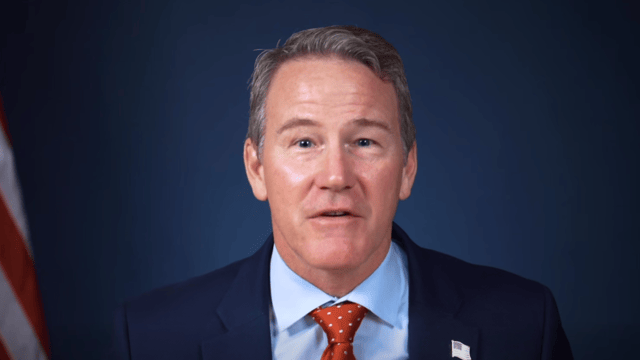

Derek Merrin voted to widen Ohio’s data center tax break in 2017. In the years that followed, the money came back to him from companies collecting it.
The vote came on Wednesday, June 28, 2017, when the Ohio House passed House Bill 49, the state’s two-year operating budget, by a margin of 59 to 40. Merrin, then a first-term Republican from Monclova Township, voted yes. Among the hundreds of statutes the bill amended was section 122.175, the provision that exempts data center equipment and construction materials from Ohio’s sales and use tax.
Four years later, in 2021, Merrin accepted $1,000 from the American Electric Power Ohio Committee for Responsible Government, according to Ohio Capital Journal’s review of state campaign finance records. As of September 2024, AEP had collected more than $6 million in Ohio data center tax breaks, per Policy Matters Ohio’s accounting of the exemption.
The next year, he accepted $500 from a Windstream Holdings PAC. Windstream that year advertised eight “key data center locations” in Ohio. Two of them, the Capital Journal reported, sat inside facilities operated by Cologix and CyrusOne — companies that had drawn more than $6 million and more than $5 million in the same state break.
The contributions total $1,500. They arrived four and five years after the vote, and nothing in the public record establishes that one had anything to do with the other. What the record shows is a lawmaker who helped widen a subsidy and then took money from the industry drawing it — a sequence voters in the 9th District are entitled to weigh as they decide whether to send him to Congress on Tuesday, Nov. 3.
What the break became
Ohio’s data centers collected $2.5 billion in state and local tax incentives between 2017 and 2024, according to a 2025 report by SRC EvalMetrics prepared for the Ohio Chamber of Commerce. Then the AI buildout arrived and the numbers stopped resembling anything the state had budgeted for.
Signal Ohio reported in May that the sales tax exemption alone cost Ohio about $1.6 billion in 2025 — roughly 11 times the state’s own forecast. Six days later, on Wednesday, May 27, Republican Gov. Mike DeWine directed the Ohio Tax Credit Authority to stop accepting new data center exemption requests. The authority met one last time on Monday, June 1, and approved a $42.3 million exemption for two Cologix projects in Delaware and Licking counties — a deal DeWine carved out of his own moratorium. That approval pushed the running total of exemptions issued since 2025 to nearly $2.17 billion.
The Cologix deal is a useful measure of what Ohio buys. In exchange for $42.3 million in forgone revenue, the company committed to create 90 full-time jobs. That works out to about $111,000 per job.
Merrin was not the only northwest Ohio Republican in the yes column in 2017. Bill Reineke, then the state representative for the 88th District covering all of Sandusky County and most of Seneca County, also voted for HB 49. Reineke is now Ohio Senate president pro tempore and sits on the joint legislative committee reviewing whether the exemption should survive at all.
The bill Ohioans are paying
The case against the exemption is no longer theoretical. Grid operator PJM’s capacity prices, driven primarily by data center growth, jumped from $28.92 per megawatt-day in 2024 to $329.17 — a 1,038% increase, Reuters reported in July. Average industrial electricity prices in Ohio rose 26% in the year ending December 2025, against a 7% national increase for industrial users. Residential customers absorbed 9%.
Ohio households were projected to spend about $745 on electricity this summer, up from $691 a year earlier, with the National Energy Assistance Directors Association pointing to data center demand as one driver.
AEP, which gave Merrin the larger of the two contributions, has been raising rates on Ohio customers through the same stretch.
His own township hit the brakes
The backlash in northwest Ohio has not come from the left. It has come from township trustees and small-city councils in some of the most Republican terrain in the state — including Merrin’s own.
On Tuesday, Feb. 17, 2026, the Monclova Township Board of Trustees voted unanimously — Barbara Lang, Deborah Stevens-Laux and Chuck Hoecherl, all yes — to impose a 12-month moratorium on the approval, establishment or construction of any data center in the township. Monclova Township is where Merrin lives.
Maumee City Council had passed its own 12-month moratorium on Feb. 2. Waterville Township trustees, next to the city Merrin served as mayor from 2008 to 2011, voted unanimously for one on Dec. 17, 2025. Richfield Township followed the same night as Monclova.
The same instinct reached Tiffin. On Monday, April 20, Tiffin City Council voted 6-0 to adopt Resolution 2026-42, freezing data center development inside city limits for up to a year. No data center had been proposed in Tiffin. Council wanted zoning tools in place first.
The position he holds now
At a VoteRPac debate in Toledo before the May 5 primary, the Capital Journal reported that Merrin said data centers do not need to be subsidized and don’t need tax breaks.
It is a defensible position. It is also the opposite of the policy his 2017 vote helped carry, and he has offered no account of the distance between the two — or of the contributions he accepted from the industry in between.
He has not been pressed on it. Merrin did not respond to the Capital Journal’s questions for its Aug. 10 story on the race. A local outlet covering his primary win noted he had not answered a single question or responded to a single inquiry during the campaign.
Silence may be a sound strategy in a district redrawn to favor him. The 9th was reconfigured in October 2025 into materially more Republican territory, though the Cook Political Report still rates the race a toss-up. Merrin took 44.1% in a five-way primary. He lost to U.S. Rep. Marcy Kaptur in 2024 by about 2,400 votes.
Kaptur has taken the opposite tack, and loudly. “How much more will our citizens be forced to pay for power and water?” she asked on the House floor late last year. “They have a right to know.” Her campaign told the Capital Journal that data center companies “should pay their fair share — not force hardworking people and local municipalities to subsidize billions in tax breaks for wealthy CEOs and shareholders who can easily afford to pay their own way.”
Voters in Lucas, Erie, Ottawa, Fulton and Defiance counties settle it in November. They will do it while their electric bills climb, their township trustees hold the line, and the man asking for their vote declines to say a word about the subsidy he helped widen or the money he took from the companies collecting it.