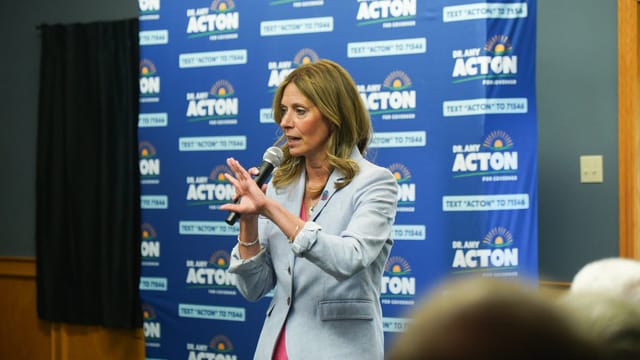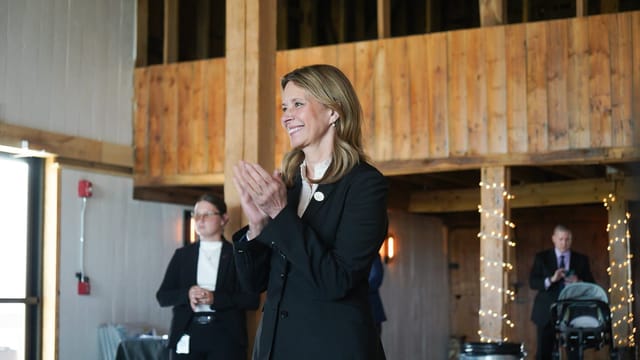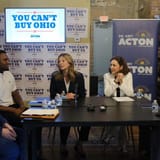
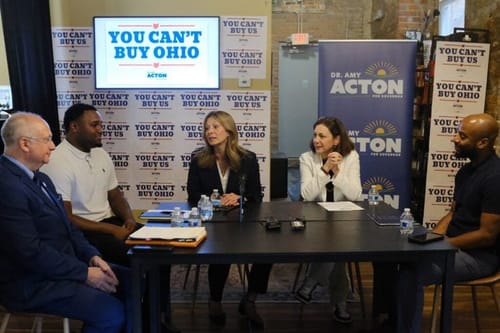

Democratic candidate for governor Dr. Amy Acton is promising to tackle corruption in Ohio if elected this November. On Wednesday, Acton shared a series of executive actions she’d take on day one through executive orders.
“We’ve got a lot of work to do,” Acton told reporters at a Columbus event. “But I think walking in the door and saying, ‘Look, there is a cost that we are all paying for corruption. We all know it. We’re famous for it.”
“We’re tired of watching (a) docuseries on it,” she went on, alluding to an HBO film about the House Bill 6 scandal. “And we know there’s more than enough good young public servants, older public servants, who want to do this work.”
Acton’s plan
Acton’s central argument is that corruption carries a cost borne by every Ohioan.
“I don’t know about everyone else here, but my electric bill went up 140 bucks this summer,” she offered as an example.
Her agenda includes three planks. First, she intends to create a task force to review state government and make recommendations within her first hundred days in office. That group will identify fraud and abuse, as well as opportunities to stricter oversight.
Acton also wants to eliminate the revolving door between state regulators and the industries they oversee. As governor, she won’t appoint people how have lobbied or worked in a given industry in the past three years, and she’ll require applicants disclose industry relationships and payments. Acton will also demand her appointees sign an ethics pledge committing to a three-year cooling off period before taking a job in the industry they previously regulated.
To limit the influence of dark money in politics, Acton would require state contractors spending money in political campaigns to disclose their donors. She’d also require companies bidding on lucrative contracts to disclose their ownership and political contributions.
In addition, Acton promised a state database detailing information about companies bidding for state contracts.
She spoke alongside Tiffany Muller from group End Citizens United Wednesday in Columbus. And Muller thinks Acton’s disclosure requirements could make a difference in the Ohio.
“This is something we’ve seen enacted in other states,” she said. “And what we have seen is that it works, right? It actually starts to get some of that dark money, that big special interest money, out of our system.”
A few grains of salt
While governors have substantial tools at their disposal to set state policy, their powers aren’t unlimited. Catherine Turcer from the government watchdog group Common Cause Ohio gave Acton credit for identifying and prioritizing a serious problem.
“One of the things that is really clear is that we have a corruption problem in Ohio,” Turcer said, “and that the state legislature has not taken the appropriate steps to create greater accountability (and) transparency.”
“I can’t imagine applying for the job of governor and not thinking about ways to improve the system,” she added.
But she warned Acton’s executive actions alone won’t be enough to fix the problem. Committing to appoint regulators who aren’t coming directly from a post in the industry they’re regulating is a good idea, but there’s little Acton can do on her own to restrict where her appointees go when they step down.
“When the state establishes good laws, there’s an enforcement mechanism,” Turcer said. “There’s not an enforcement mechanism in in this executive order.”
“For some people shame is really effective,” she added about Acton’s proposed ethics pledge. “But for others, it has no meaning whatsoever.”
Similarly, Turcer said Acton’s campaign finance disclosures for state contractors is a good first step, but not a panacea.
In an email, End Citizens United defended the disclosure requirements. The restrictions might only apply to contractors, but leveraging their interest in state money to get the full picture of their political spending, is a big deal.
Spokesperson Alysa James insisted “Dr. Acton’s plan is a real set of policies to turn this ship around and a pragmatic way to start fighting the pay-to-play culture that has taken over Columbus. Dr. Acton is the only candidate in this race we trust to ensure Ohioans are not paying for the cost of corruption.”
Turcer allowed that “reining in the folks that have contracts with the state of Ohio reins in corruption.
“But there are all sorts of other ways that the very wealthy and corporations influence the process,” she went on, “and it doesn’t address that,”
Hanging over any conversation of Ohio corruption is the House Bill 6 scandal, in which energy companies bribed the future PUCO chairman and funneled millions to political groups that don’t have to disclose their donors. That dark money helped get the law over the finish line and then beat back a referendum effort. But those companies weren’t state contractors. Acton’s disclosure proposals wouldn’t touch those transactions.
Still, Turcer said Acton’s appointment power could make a significant difference in Ohioans’ lives.
“These proposals do not get at the core of what went wrong with the House Bill 6 scandal. You can’t get there without the legislature,” Turcer said. “But she can appoint a more consumer-friendly person to the Public Utilities Commission. That is a very concrete thing that she could do that could change things.”
Follow Ohio Capital Journal Reporter Nick Evans on X or on Bluesky.
This story is republished from the Ohio Capital Journal under a Creative Commons license. View the original article.