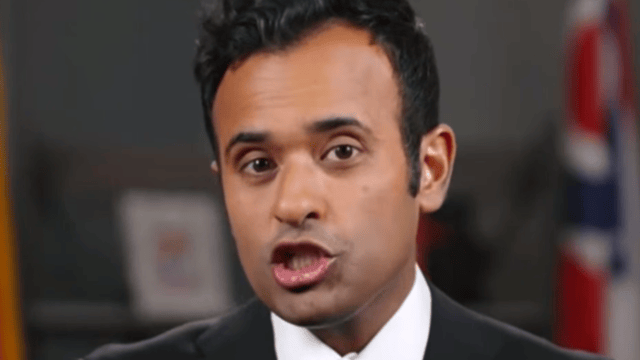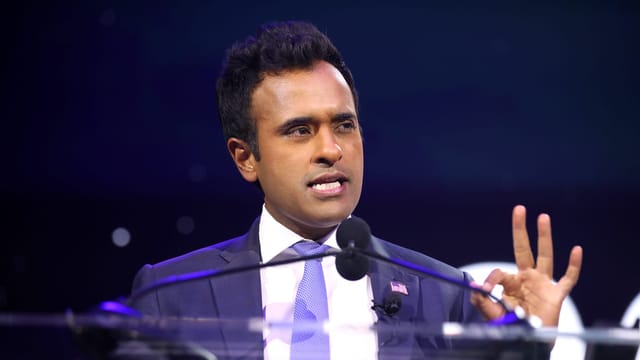
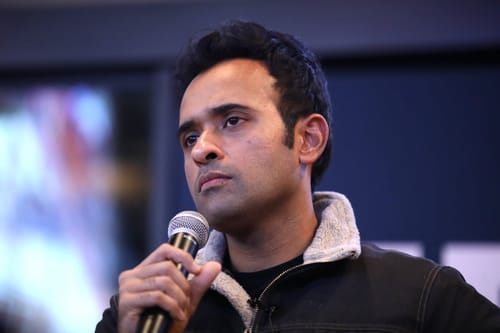
There is a simple question hanging over Vivek Ramaswamy’s campaign for Ohio governor: Why are some of the richest men in America spending tens of millions of dollars to put him in office?
Through June 30, Federal Election Commission records show V-PAC: Victors, Not Victims — the super PAC devoted to electing Ramaswamy — raised $41,774,674.63. Five billionaires supplied $37 million of that amount, or roughly 88 cents of every dollar the group raised.
Pennsylvania trading billionaire Jeff Yass gave $20 million. New York financier Ross Stevens gave $6 million, while Elon Musk and software billionaire Ratmir Timashev each gave $5 million. Hedge-fund billionaire Bill Ackman gave another $1 million. None listed an Ohio residence in the filings.
And the money has apparently continued pouring in. Signal Ohio reported Aug. 27 that Yass had made another contribution of at least $10 million to V-PAC, citing Politico and a source familiar with the group. If confirmed in the committee’s next federal filing, that would put Yass alone at at least $30 million behind the effort to elect Ohio’s next governor.
There is no public evidence that Ramaswamy has promised any of the donors official action in exchange for their money. V-PAC is an independent-expenditure super PAC, meaning it can accept unlimited contributions but is legally prohibited from coordinating its spending with Ramaswamy’s campaign.
Still, the concentration of the money raises questions because several of the billionaires underwriting Ramaswamy’s election have political or financial interests touching two major policy fights Ohio’s next governor will help shape: taxpayer-funded private education and the explosive growth of artificial intelligence and hyperscale data centers. Ramaswamy has made both issues significant parts of his political agenda.
Ramaswamy’s biggest donor has made school choice a political mission
Jeff Yass is not simply a Republican billionaire who occasionally writes campaign checks. Taxpayer-funded school choice has become one of his defining political causes, and The Washington Post has reported that he has spent hundreds of millions of dollars on political causes since 2015, with school vouchers and other school-choice programs at the center of much of that activity.
Yass has intervened in state political contests around the country to help candidates who support expanding alternatives to traditional public schools. Ohio is not new territory: Signal Ohio previously reported that Yass and his wife helped finance Ohio Republican legislative candidates during the 2024 fight that ultimately pushed then-House Speaker Jason Stephens from power.
Now Yass has committed at least $20 million in publicly filed contributions — and reportedly at least $10 million more — to the outside group working to make Ramaswamy governor. Ramaswamy, meanwhile, has explicitly called for “universal school choice” and has argued for expanding families’ ability to use public funding outside traditional public schools.
Ohio already allows families across the income spectrum to receive taxpayer-funded EdChoice scholarships toward private-school tuition. When News 5 Cleveland asked Ramaswamy whether millionaires should receive taxpayer-funded private-school vouchers, he did not directly answer the question, instead defending educational choice and dismissing the question as a “slapstick” gotcha.
TiffinOhio.net has also previously reported that Ramaswamy’s campaign biography emphasizes his public-school upbringing while omitting the name and private-school status of St. Xavier High School, where he spent all four years of high school. St. Xavier participates in Ohio’s EdChoice scholarship program.
Yass is not the only major V-PAC donor with a history involving privately operated education. Ackman, who gave V-PAC $1 million, previously invested $20 million through his charitable foundation in the Turner-Agassi Charter School Facilities Fund. Forbes reported that the fund financed dozens of charter-school facilities and produced financial returns for investors.
That investment dates back years and does not establish that Ackman is seeking any particular Ohio education policy today. But it adds another connection between a major Ramaswamy super PAC donor and the broader school-choice and charter-school movement.
Other megadonors are deeply involved in AI and computing infrastructure
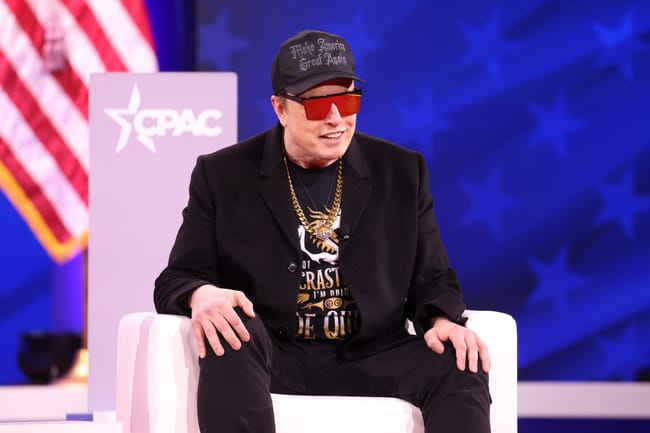
A second pattern runs through artificial intelligence, electricity and data centers. Ohio is in the middle of a major debate over hyperscale facilities — enormous computing campuses capable of consuming extraordinary amounts of electricity and requiring significant new energy infrastructure.
Ramaswamy spent months publicly welcoming that growth. As TiffinOhio.net previously documented, he repeatedly praised Ohio’s emerging AI data-center boom during public appearances in March and April 2025.
“We have an AI data center boom in the state of Ohio, which is great,” Ramaswamy said during one April appearance. “I’m all for it, I’m strongly in favor of it.”
His position became more conditional as public resistance to data centers grew. Ramaswamy later released an “Ohioans-First” proposal that would impose conditions on future developments, including requiring projects to generate enough value to provide nearby residents free electricity and lower property-tax burdens. The proposal does not call for ending data-center development; it establishes conditions under which Ramaswamy says the projects should proceed.
Several of the billionaires spending millions to elect him are directly involved in the AI economy or the enormous computing and energy infrastructure supporting it.
Elon Musk: $5 million
Musk gave V-PAC $5 million in May. His artificial-intelligence company xAI built Colossus in Memphis, one of the world’s largest AI computing installations, and xAI says the system has reached 200,000 interconnected GPUs with plans for substantially greater capacity.
Facilities of that scale are part of the reason utilities and state governments are confronting rapidly increasing electricity demand from artificial-intelligence computing. Musk also has an existing relationship with Ramaswamy: President Donald Trump initially selected the two men to lead the government-efficiency initiative that became known as DOGE before Ramaswamy departed and focused on his Ohio gubernatorial campaign.
Ross Stevens: $6 million
Stevens, who gave V-PAC $6 million, has an even more direct connection to the physical infrastructure behind AI. He founded Stone Ridge Holdings Group and NYDIG, which now describes itself as a vertically integrated power-and-compute operation involved in artificial intelligence, high-performance computing and bitcoin mining.
NYDIG’s website says the company develops, finances and operates “the power and compute behind frontier AI” and reports a power-and-compute development pipeline exceeding 3 gigawatts. One of Ramaswamy’s largest individual political benefactors therefore leads a company actively developing the type of industrial-scale power and computing infrastructure at the center of the national data-center expansion.
Ratmir Timashev: $5 million
Timashev’s connection to Ohio is different. Although his contribution records list an out-of-state residence, he attended Ohio State University, built software companies in Columbus and has donated heavily to the university.
His current business ambition is also closely tied to artificial intelligence. Forbes reported in June that Timashev plans to invest $100 million over five years through his Oh.io venture operation to attract 100 AI startups to Columbus. The publication also noted central Ohio’s existing concentration of data centers and companies supplying power and cooling equipment to the industry.
Timashev therefore has substantial and longstanding ties to Ohio, unlike some of V-PAC’s other major donors. But his $5 million contribution also means one of the people investing most heavily in making Ohio a national AI center is helping finance the outside effort to elect the state’s next governor.
Ohio’s next governor will help shape what happens next
Those overlaps matter because the next governor will have significant influence over both education and energy policy. The governor signs or vetoes state budgets that determine how billions of education dollars are distributed among traditional public schools, charter schools and private-school voucher programs, while executive agencies administer major portions of the state’s education and economic-development policies.
The governor also appoints members of the Public Utilities Commission of Ohio, which regulates the state’s investor-owned utilities and makes decisions affecting electricity rates and large power users. At the same time, state government will continue confronting questions involving data-center taxation, energy infrastructure, economic-development incentives and the effect massive new electricity loads could have on Ohio consumers.
TiffinOhio.net has previously reported that Ramaswamy’s personal financial holdings include investments in companies connected to the broader data-center economy. His latest proposal to require data-center developers to create enough economic value to provide nearby households free electricity has also drawn questions from energy experts about how the arrangement would work.
None of those facts establishes that V-PAC’s donors are seeking favorable government treatment. They do, however, make their extraordinary level of financial support relevant to voters trying to understand who is financing the race and what policy interests those donors have.
Ramaswamy’s campaign has been asked about the billionaire money before
Ramaswamy’s campaign has already had opportunities to explain the concentration of billionaire support. After Musk, Timashev, Ackman and Stevens contributed a combined $12 million to V-PAC during the second quarter, the Ohio Capital Journal reported that both V-PAC and Ramaswamy’s campaign committee failed to respond to multiple requests for comment.
Case Western Reserve University law professor Atiba Ellis told the Capital Journal that voters should examine the motives behind major contributions. Discussing Musk’s $5 million donation, Ellis said voters should “inquire about what his motives are in terms of influencing this election.”
There are also conventional explanations for much of the support. Yass is one of the country’s largest Republican political donors and regularly supports candidates who favor school choice. Musk previously worked alongside Ramaswamy, while Timashev has longstanding personal, philanthropic and business connections to Ohio. Wealthy donors may support Ramaswamy simply because they agree with his political and economic agenda.
Nor is outside political spending unique to Ramaswamy. National Democratic organizations are spending millions of dollars to support Democratic nominee Amy Acton. What distinguishes V-PAC is how concentrated its financing has been: through June, five billionaires supplied $37 million of the committee’s $41.77 million in receipts.
That leaves several questions the campaign could answer directly. Has Ramaswamy discussed Ohio’s voucher program or further school-choice expansion with Yass? Has he discussed data centers, artificial intelligence, electricity policy or state economic-development incentives with Musk, Stevens or Timashev? Have any of the donors or companies associated with them sought commitments from Ramaswamy involving taxes, regulation, energy infrastructure or state incentives?
And more broadly, why are a handful of billionaires willing to spend tens of millions of dollars helping determine who becomes Ohio’s next governor — and what policies do they hope a Ramaswamy administration would pursue?
Those questions do not presume an improper arrangement. But with five billionaires accounting for nearly nine out of every 10 dollars V-PAC raised through June, they are questions Ohio voters have reason to ask — and ones Ramaswamy and his campaign can answer.