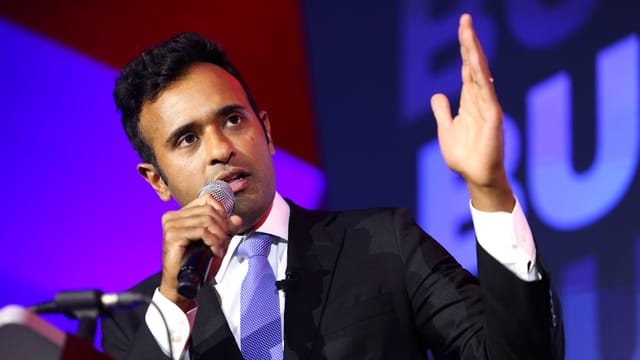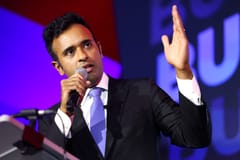
Vivek Ramaswamy won Ohio’s Republican nomination for governor by a wide margin in May, backed by President Donald Trump and much of the state’s Republican establishment.
Four months later, some of the opposition he encountered on his right flank has not gone away.
Casey Putsch, the Republican who challenged Ramaswamy in the primary, declared Monday that he still would not support his party’s nominee and suggested Republicans should consider an independent candidate instead.
“As a lifelong Republican, I said on the campaign — ‘I wouldn’t support Vivek Ramaswamy with a gun to my head,’” Putsch wrote on X. “Amy Acton is no leader, but the Republican Party needs knocked down for 100% selling us out.”
“How about an independent?”
Then on Tuesday, Putsch escalated his criticism while responding to TiffinOhio.net’s reporting on the extraordinary concentration of billionaire money behind the main super PAC supporting Ramaswamy.
Federal campaign-finance records show V-PAC: Victors, Not Victims raised nearly $41.8 million through June 30. Five billionaires supplied about $37 million of it — roughly 88% of everything the group raised during that period.
“Because they want an ROI,” Putsch wrote. “Vivek is here to SELL US OUT.”
Putsch did not provide evidence in the post that the donors had been promised anything in return or that Ramaswamy had agreed to advance their interests. But the comments represent another escalation from a former Republican rival who has continued attacking the GOP nominee months after the primary ended.
And the resistance to Ramaswamy from portions of the right extends beyond Putsch.
Even before Republicans voted in May, The Associated Press reported that Ramaswamy was encountering “growing headwinds” within parts of the GOP base, with conservative voters voicing frustration over issues including data centers, the Jeffrey Epstein files, the war with Iran and the rising cost of living.
The concern inside Ramaswamy’s campaign at the time was not necessarily that conservative voters would cross over and support Acton. It was whether enough dissatisfied Republicans might simply stay home.
Ramaswamy’s running mate, Ohio Senate President Rob McColley, warned Republicans before the primary that complacency could prove more dangerous than either Acton or the national political environment.
Conservative audiences have confronted Ramaswamy
The tensions have repeatedly surfaced in places where a Republican nominee would ordinarily expect a receptive audience.
At an April 21 Turning Point USA event at Ohio State University, WOSU reported that more than two dozen people lined up to question Ramaswamy on subjects including immigration, Israel and data centers.
One woman criticized the effect of data centers on farmland. After Ramaswamy defended the industry, she shouted, “Vote Casey Putsch” into the microphone.
“It’s a free country,” Ramaswamy responded.
The confrontation was mild compared with what happened three months later.
On July 29, Ramaswamy appeared at the Young Americans for Liberty national convention at Xavier University in Cincinnati. Video from the event showed attendees loudly booing as he took the stage.
The heckling continued during the appearance as audience members challenged him on issues including Israel and immigration. Ramaswamy ultimately left the stage about 14 minutes into what had been scheduled as a 30-minute appearance, according to contemporaneous reports.
The episode was striking not because Ramaswamy encountered protesters from the left, but because the hostile reception came at the national convention of a conservative and libertarian youth organization.
Immigration, religion and identity have exposed another fault line
A report published Tuesday by Reason describes another source of tension between Ramaswamy and some conservative Ohio voters: immigration, religion and competing ideas about American identity.
The reporter described attending a January gathering of Republican activists in southwest Ohio where a discussion of H-1B visas and immigration became contentious. Attendees challenged Ramaswamy over his support for an immigration system more favorable to highly skilled workers and over his rejection of the idea that Americans with deeper ancestral roots in the country should hold a more privileged place in American identity.
Ramaswamy, the Cincinnati-born son of Indian immigrants, has repeatedly rejected that conception of American identity, arguing instead that being American is rooted in allegiance to the country’s founding principles rather than ancestry.
The same reporter attended an Ohio Faith & Freedom Forum in Middletown on Aug. 17, where Ramaswamy addressed Christian conservatives as a Hindu candidate running against Acton, who is Jewish. Unlike the earlier gathering, the August audience appeared largely receptive to his argument that voters should focus on shared political values rather than a candidate’s personal religion.
That distinction matters: the evidence does not show that Republican voters have rejected Ramaswamy wholesale. He won the Republican nomination decisively, maintains the support of the state party and prominent conservative leaders, and has drawn large crowds at campaign events around Ohio.
But it also shows that winning the nomination did not eliminate the ideological and cultural disputes that surfaced during the primary.
Putsch is not a neutral messenger
Putsch’s continued attacks also come with important context.
His primary campaign drew condemnation for rhetoric targeting Ramaswamy’s Indian heritage and Hindu faith. The Associated Press documented several examples, including Putsch depicting Ramaswamy as an insect being sprayed with pesticide and challenging him to play “cowboys and Indians.”
Ramaswamy responded during the primary by publicly condemning racial and religious identity politics on the right, arguing that American citizenship and commitment to the nation’s founding ideals — not race, ancestry or religion — should determine who belongs in the country.
But Putsch is also no longer the only evidence of discontent on Ramaswamy’s right.
The former primary challenger remains openly opposed to him. Conservative voters have confronted him over immigration and data centers. A Turning Point USA audience member used her question to promote his Republican rival. And months after the primary, attendees at a Young Americans for Liberty convention greeted the Republican nominee with sustained boos and heckling.
At the same time, Ramaswamy has retained significant institutional conservative support. Ohio Republican Party Chairman Alex Triantafilou dismissed the online backlash during the primary, while prominent conservative organizations and Republican officials have continued supporting Ramaswamy’s campaign.
The result is a Republican nominee who decisively captured his party’s nomination but enters the final stretch of the general election with some of the fractures exposed during that contest still visible.
Putsch’s message this week made clear that, at least for one of Ramaswamy’s former Republican opponents, the primary did not settle the matter.