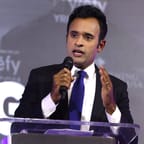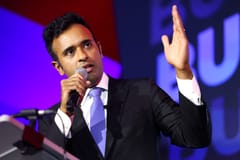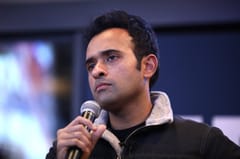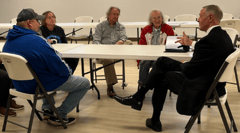
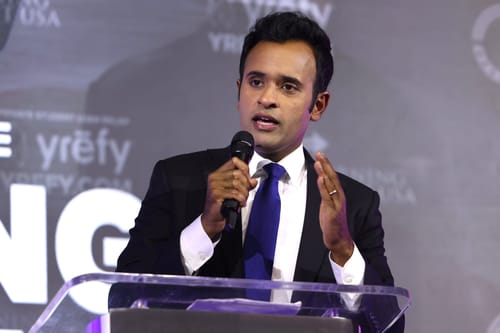

Vivek Ramaswamy built a national brand attacking identity politics. As the Republican nominee for Ohio governor, he is now facing a version of it from inside his own party.
The sharpest attacks on Ramaswamy’s identity have not come from Democrat Amy Acton’s campaign. They have come from far-right activists, conservative event audiences, online commentators and, during the Republican primary, one of his own GOP opponents — questioning his Hindu faith, his vegetarian diet, his Indian heritage and, in some corners, whether the Cincinnati-born candidate is truly American.
The facts of Ramaswamy’s biography are not in serious dispute. A biotech entrepreneur and 2024 Republican presidential candidate, he was born in Cincinnati to parents who immigrated legally from India, was raised Hindu, and went on to Harvard and Yale before winning the 2026 Republican nomination for governor. He faces Acton, the state’s former health director, in the Nov. 3 general election.
A primary rival questioned his citizenship
The most direct Ohio example came from Casey Putsch, a Perrysburg automotive entrepreneur and Tiffin native who challenged Ramaswamy in the GOP primary. In April, Putsch posted a video firing a rifle and inviting Ramaswamy to play “Cowboys versus Indians,” then adding, “Don’t worry, it’s feather, not dot” — a racialized reference distinguishing Indigenous people from people of Indian descent. Dr. Deepak Sarma, a Case Western Reserve University professor of Indian religions, called the video “one hundred percent” a threat. Putsch denied it was racist or threatening, describing it as a joke protected by the First and Second Amendments.
Putsch’s attacks extended to Ramaswamy’s gun credentials. In a separate video, he canceled his NRA membership on camera after the group’s political arm endorsed Ramaswamy, replaying clips from Ramaswamy’s 2023 NRA speech in which the candidate acknowledged growing up in an “anti-gun household” and having visited a shooting range “probably less than I can count on two hands.” Putsch told an NRA representative there was “nothing remotely American about” Ramaswamy.
Putsch also repeatedly questioned Ramaswamy’s citizenship. Told by a reporter that Ramaswamy was born in Cincinnati, Putsch responded that he was “born to Indian foreign nationals who came here just to have an anchor baby,” and in the same interview called him “questionably American.” NBC News has reported that Putsch routinely refers to Ramaswamy as an “Indian anchor baby,” a term that undermines the citizenship guaranteed to U.S.-born children of immigrants under the 14th Amendment.
Turning Point USA crowds questioned his faith
The theme has surfaced nationally. At a Turning Point USA forum at Montana State University in October 2025, Ramaswamy’s Hindu identity was challenged by several students. “Jesus Christ is God, and there is no other God,” one said. “How can you represent the constituents of Ohio who are 64% Christian if you are not a part of that faith?” Another asked why he would have “Christian values.” Ramaswamy responded by citing the U.S. Constitution’s ban on religious tests for public office, according to Religion News Service.
When Ramaswamy headlined another Turning Point USA event at Ohio State University on April 21, 2026, audience members pressed him on immigration and Israel. That event, WOSU reported, did not veer into the attacks on his religion seen in Montana, where some questioned whether a practicing Hindu could lead Ohio.
A fight rooted in the H-1B backlash
The tension predates the governor’s race. In late 2024, Ramaswamy and Elon Musk set off a backlash among Trump supporters by defending the H-1B visa program and high-skilled immigration. CBS News reported that their stance split Republicans, and Axios described the dispute as a “MAGA-world civil war” over race, immigration and American identity. The conflict intensified after Trump named Indian-born venture capitalist Sriram Krishnan as an AI adviser, and after Ramaswamy argued in a widely shared post that American culture had “venerated mediocrity over excellence.”
‘Anchor baby’ attacks go national
Far-right commentator Nick Fuentes has targeted Ramaswamy directly. After Ramaswamy argued in a New York Times essay that American identity is rooted in civic ideals rather than ancestry — writing that “no matter your ancestry,” a naturalized citizen is “every bit as American as a Mayflower descendant” — Fuentes wrote that Ramaswamy was “an actual anchor baby” and that “foreigners who have no right to be here don’t get to lecture me about what it is to be American.”
That framing has blended with a renewed national fight over birthright citizenship. On June 30, 2026, the Supreme Court reaffirmed birthright citizenship, rejecting President Donald Trump’s executive order seeking to restrict it. Hours later, the Justice Department directed prosecutors to prioritize investigations of “birth tourism schemes,” keeping the issue alive on the right even after the court upheld broad citizenship protections for people born on U.S. soil.
An outsider in the movement he champions
Ramaswamy’s case is striking because he rose to prominence attacking corporate diversity programs and liberal identity politics. Yet in the Ohio race, much of the pressure he has faced from his right has been explicitly identity-based. The Washington Post reported in May that Ramaswamy, after building a career denouncing “wokeness,” was confronting racist and nativist attacks in his run for governor, including from Putsch, who the paper said called him “not a real American.”
Ramaswamy remains backed by prominent Republicans, including Trump, and won the primary easily. But the attacks from the far right underscore a divide in the party: a candidate can champion “America First” politics and still be treated by some in that movement as an outsider — and, for a Hindu son of Indian immigrants born in Ohio, face questions from within his own coalition about whether being born here is enough.