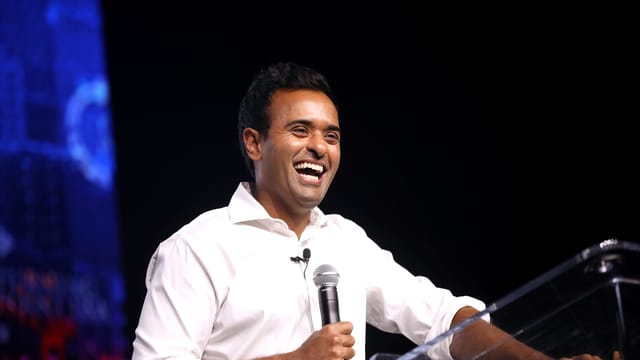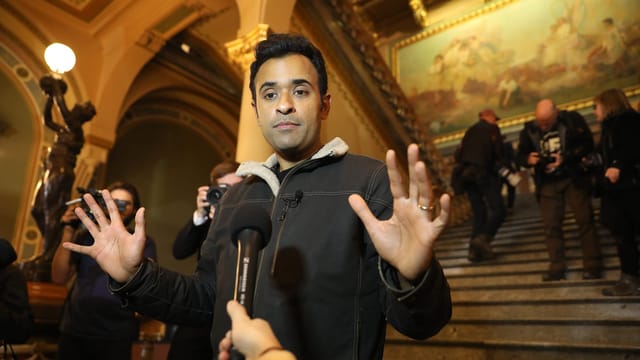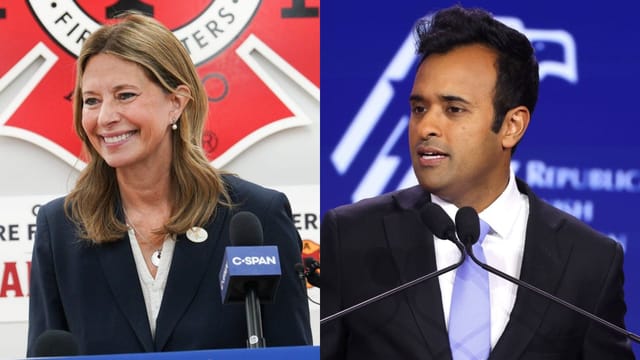
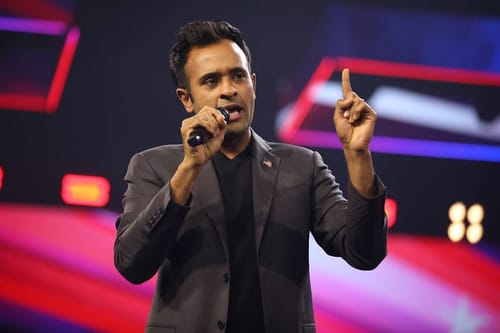
A New York Times feature this week added Vivek Ramaswamy to its list of potential 2028 presidential candidates — 15 months after the Ohio Republican nominee for governor publicly pledged to serve a full four-year term and rule out a 2028 White House bid.
The Times piece, published Wednesday by political reporter Reid J. Epstein, grouped Ramaswamy with Florida Rep. Byron Donalds in a category labeled “The Politicians Who Could Make a Quick Leap.” The Times wrote that the two Republicans “could bounce from running for governor to national campaigns” and noted that Ramaswamy “already ran for president in 2024.”
That framing arrives as Ramaswamy continues to dominate the Ohio race financially, largely on his own dime. He has loaned his gubernatorial campaign $25 million of his own money so far this year, a sum that accounts for roughly 83% of all the money his campaign raised in 2026, according to a fundraising report filed ahead of the May 5 primary. A federal super PAC supporting his bid, V-PAC: Victors, not Victims, has reported $29.5 million in fundraising this cycle, bringing the combined total behind his candidacy to roughly $80 million.
The four-year-term pledge
When Ramaswamy launched his campaign in February 2025, he told NBC News in a pre-launch interview that he was “fully committed to serving a full term” and said it was his “expectation that an agenda as ambitious as the one we’re pursuing will likely take two terms to fully implement.” NBC reported at the time that the pledge “would take a run in 2028 — and a potential primary clash with [Vice President JD] Vance — off the table.”
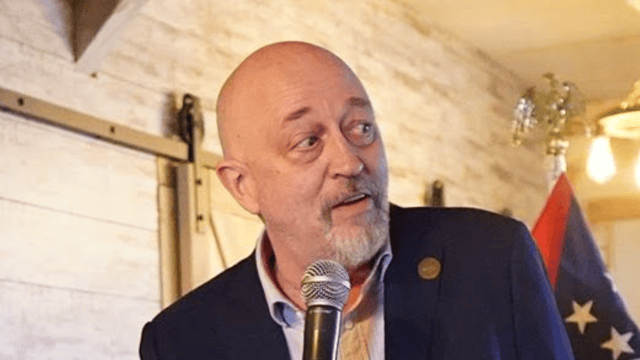
Ramaswamy has not publicly addressed the 2028 question since winning the May 5 Republican primary, in which he defeated political novice Casey Putsch 82.5% to 17.5%.
‘Not a consolation prize’
Even before Ramaswamy launched his campaign, members of his own party were warning that his ambitions extended beyond Columbus. Ohio Attorney General Dave Yost, who initially ran for the gubernatorial nomination before dropping out, told NBC News in February 2025 that Ramaswamy had spent the previous year cycling through bigger ambitions.
“He has wanted, over the last year, to be president, to have a Cabinet spot, to be co-leader of DOGE,” Yost said. “The governor of Ohio is not a consolation prize. … My concern is that what he seems to do best is to quit.”
Robert Alexander, a political science professor at Bowling Green State University, made a similar observation last month. Alexander told Newsweek that some voters may see Ramaswamy “as an opportunist who is settling for the Ohio governorship as a consolation prize, who may jump ship to run for president again in 2028.”
A national-tier campaign in a state race
The scale of Ramaswamy’s personal spending stands out even by the standards of expensive gubernatorial races. In July 2025, he told Fox News Digital that he was “prepared to invest at the same scale or greater” as the more than $30 million he poured into his 2024 presidential bid.
The campaign has spent more than $500,000 leasing a private jet since launching, with the aircraft leased through V Leasing LLC — a company Ramaswamy himself owns, according to filings reviewed by the Ohio Capital Journal. The campaign did not respond to the Capital Journal’s questions about whether V Leasing earns a return on the arrangement.
Acton’s campaign has leaned into the contrast. The Democratic nominee raised more than $10 million from roughly 76,000 first-quarter donors in 2026, with an average grassroots contribution of $29 and 95% of donations of $100 or less.
“He can continue throwing money at his campaign from the seat of his private jet, but Ohioans see right through his false promises,” Acton campaign manager Philip Stein said in a statement responding to Ramaswamy’s first-quarter figures.
What’s on the ballot in November
Recent polling has pointed to a close general election. A Bowling Green State University poll released in late April found Ramaswamy with a statistically insignificant 1-point lead over Acton. An Emerson College poll in December and a Quantus Insights poll in March both showed the candidates within a single percentage point of one another, while an EMC Research poll in February gave Acton a 10-point lead.
The general election is set for Nov. 3. Ramaswamy has not publicly addressed the 2028 question since the New York Times feature was published.