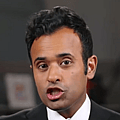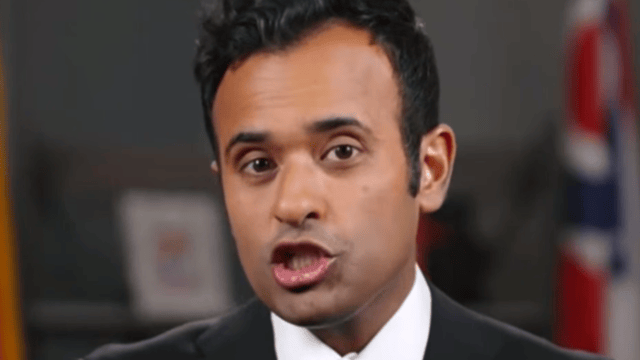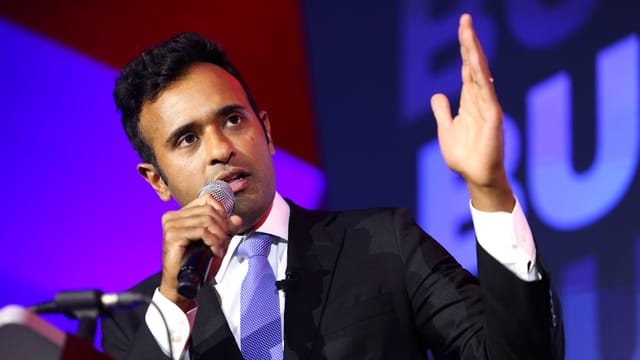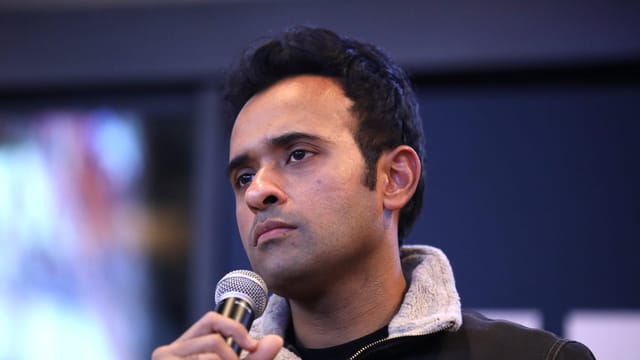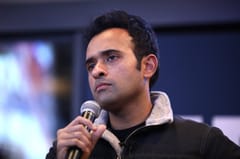
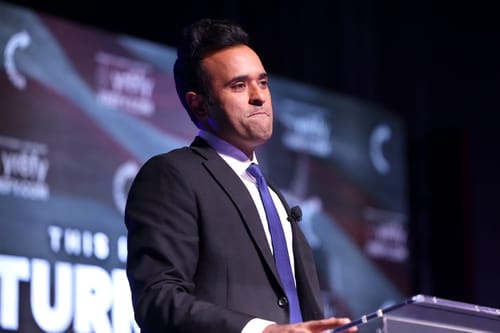

Republican gubernatorial nominee Vivek Ramaswamy told a town hall crowd in Strongsville on Friday that it is “incorrect” to say he wants to shut down Ohio public universities — four months after he posted a video saying the state has “too many of them” and three months after he told a college audience that Ohio should not be funding “subpar universities.”
An attendee asked Ramaswamy whether it was true he wanted to shut some schools, according to reporting by WEWS statehouse reporter Morgan Trau. He denied it repeatedly, saying his target was duplicated academic programs rather than the institutions themselves.
“I think that we have too many duplicative programs in our universities,” Ramaswamy said. “When I look at a region, I want to look at Ohio in terms of regions like regional governance; I want every region to have the best higher education institutions available for people in that region. But not every university needs to offer every program.”
He said he wants Ohio to have the country’s best nursing, computer science, civil engineering and humanities programs. “They just don’t have to be under the same exact roof in the same college,” he said.
What he said in March and April
The reversal is measurable against Ramaswamy’s own record over the spring.
In a video posted to his Threads account on March 13, Ramaswamy was answering a question about whether Ohio’s income tax could be eliminated when he turned to higher education.
“Look at the number of universities in our state. I love universities in Ohio. I want us to have the best universities. But we have too many of them. They need to be consolidated,” he said in the video, according to the Statehouse News Bureau. “And when you consolidate them, they can actually be centers of excellence who [are] actually the best in their respective domains instead of trying to create replicas and clones of one another throughout the state.”
Two weeks later, on March 27, he published an opinion column on his campaign site and in the Columbus Dispatch and other Gannett papers. The column proposed that state-funded universities with lower enrollment become specialized “centers of excellence,” and said his first budget would give the chancellor of higher education authority to review publicly funded institutions.
“It will identify where missions overlap, where enrollment collapse has made independence untenable, and where administrative functions can be unified without harming students,” Ramaswamy wrote, according to the Statehouse News Bureau’s account of the column. “The chancellor will then return to the General Assembly with a concrete plan on a fixed timeline.”
The column named Cleveland State University, the University of Akron, Kent State University and Central State University as institutions facing problems.
In April, at a Turning Point USA event at Ohio State University, a student asked Ramaswamy about the idea. “I don’t think you should be funding subpar universities,” he answered.
Asked in Strongsville about the column, Ramaswamy said the universities he named were “examples of where tuition was going up.”
“It’s a big leap from that to say if you should shut down a university,” he said. “But are there individual programs that we might say, ‘OK, this one belongs to this university and this one belongs to this university within a given region — that I do favor.”
Republicans pushed back first
The first significant objections came from inside Ramaswamy’s own party.
Gov. Mike DeWine, whom Ramaswamy is running to succeed, told reporters on March 30 that he supported some of the ideas in the column but not consolidation.
“I’m not in favor of consolidating our colleges or doing away with any of our 14 public universities,” DeWine said. “It’s important to have them all over the state so frankly, people who can’t afford to live at the college and pay room and board, they can commute. We still have commuters.”
State Sen. Jerry Cirino, a Kirtland Republican who chairs the Senate Finance Committee and has led the legislature’s higher education overhaul, was blunter when WEWS asked him about it in late June.
“I don’t know how much he knows about how higher ed works in the state of Ohio,” Cirino said.
Cirino said he would welcome a conversation with Ramaswamy and that consolidation could be discussed — but for branch campuses rather than main campuses. He said he has favored eliminating majors with low enrollment, and that a genuine consolidation plan, as opposed to defunding institutions labeled subpar, would be received differently.
Two university presidents also objected. Cleveland State President Laura Bloomberg said in April that consolidation should not be the only option on the table.
“We need to honor the identity of our public universities, which were formed for specific purposes to meet the needs of their region,” Bloomberg said. “All options need to be discussed — there are many ways to think about programs and strategic partnerships that are far short of consolidation and achieve the goals of being more nimble, efficient institutions of higher education.”
Kent State President Todd Diacon responded with a written defense of the state’s public campuses. “In the decade of the 1960s, we built 60 new buildings. Those buildings were filled with the sons and daughters of the Greatest Generation, ready to build Ohio’s future,” Diacon wrote in part. “This was not a waste. This was Ohio investing in itself.”
The tax connection
Ramaswamy first raised university consolidation while discussing his plan to eliminate Ohio’s personal income tax, and his opponents have tied the two together ever since.
David Pepper, the running mate of Democratic nominee Amy Acton, said the proposal shows how far Ramaswamy is from the everyday cost calculations Ohio families make.
“A tax break that helps everyone at the top, and students, particularly in poor communities, are told by Vivek Ramaswamy, ‘Get in the car, go pay room and board hundreds of miles away, because I’m gonna deprive you of the local opportunity you have to get a degree,’” Pepper said.
The income tax raises roughly $10 billion a year, about a quarter of Ohio’s operating budget, and helps fund K–12 schools, Medicaid, public universities, prisons and services for seniors, veterans and people with disabilities. TiffinOhio.net has previously reported on analyses projecting that eliminating the tax would open a $9.8 billion annual budget gap and that replacing that revenue through property taxes would require an increase of roughly 20% statewide. Ramaswamy has argued the gap can be closed through economic growth and spending discipline rather than service cuts.
What it means locally
Seneca County’s two universities, Heidelberg University and Tiffin University, are private institutions and sit outside the state system Ramaswamy has been describing. The closest public campus is Terra State Community College in Fremont.
Terra State has been under state fiscal watch since March 23, when the Ohio Department of Higher Education applied the designation following a March 17 recommendation from the state auditor. The college has up to three years to resolve the problems and must submit a financial recovery plan to the state. It has had two interim presidents since April; Chad Breeden took over on Monday.
Ramaswamy has not named Terra State in any of his public comments on higher education, and community colleges were not part of his column. But the debate he opened — over what the state owes public institutions that are struggling financially — now runs directly through Sandusky County.
DeWine’s objection turned on the same point. Students who cannot afford room and board depend on a campus close enough to drive to. In this part of northwest Ohio, that is a short list.
Ramaswamy faces Acton in the general election on Tuesday, Nov. 3.