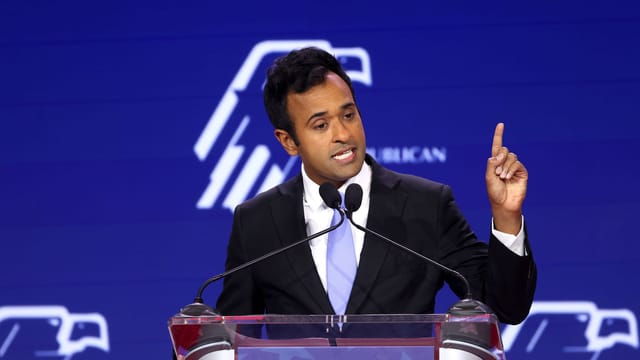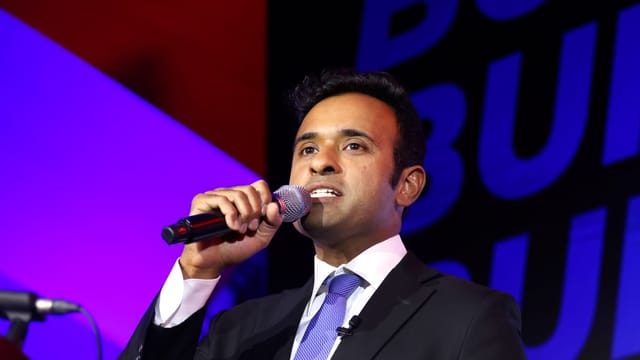

Vivek Ramaswamy has built his campaign for Ohio governor around a sweeping promise: lower taxes, smaller government and more money in Ohioans’ pockets.
But one analysis of his plan to eliminate Ohio’s income tax reaches a stark conclusion for homeowners: replacing the lost school funding locally could require property taxes to rise by about 20% statewide.
The finding comes from Innovation Ohio, a progressive policy group that analyzed Ramaswamy’s proposal to eliminate the state income tax. The group argues the plan would create a roughly $10 billion annual budget gap and shift pressure onto public schools, Medicaid, local governments and taxpayers.
Ramaswamy is not campaigning on raising property taxes. He is campaigning on the opposite. His campaign platform says he would “slash property taxes immediately” and “phase out the state income tax — starting with eliminating capital gains taxes.” A separate property-tax plan says he would roll back property taxes to where they were before the end of the COVID pandemic, which his campaign calls “the largest property tax rollback in Ohio history.”
The conflict is not over whether lower taxes are politically popular. It is over whether the math works.
Ohio’s personal income tax is one of the state’s largest revenue sources. The nonpartisan Legislative Service Commission estimated that the tax is expected to raise nearly $10.34 billion in fiscal year 2027, the first full year Ohio’s new 2.75% flat tax on nonbusiness income will be in effect.
That money helps fund the General Revenue Fund, which pays for core state services including K-12 education, Medicaid, public universities, prisons and other state programs.
K-12 education alone represents one of the largest claims on the state budget. The Ohio Department of Education and Workforce says state funding for primary and secondary education is estimated at $14.09 billion in fiscal year 2027, including $11.65 billion from the General Revenue Fund.
Ohio’s school-funding system is built as a state-local partnership. Public school districts rely on a mix of state aid, local property taxes, some school district income taxes and federal funds. If state aid falls, districts typically face three choices: cut services, ask voters for new local levies or find another way to raise revenue.
Innovation Ohio’s analysis says that if the lost income-tax revenue led to proportional cuts in K-12 education, schools would face a multibillion-dollar hit. To replace that money through local property taxes alone, the group says property taxes would need to rise by about 20% statewide.
That does not mean every homeowner’s bill would automatically increase by exactly 20%. Ohio property taxes are local, vary by school district and are often tied to voter-approved levies. But the estimate captures the pressure that could move from the state budget to local tax bills if the income tax is eliminated without an equivalent replacement.
TiffinOhio.net previously reported that Innovation Ohio estimated Ramaswamy’s income-tax repeal would create a $9.8 billion annual budget shortfall, threatening public school funding, Medicaid and local government services. The same report said replacing the lost revenue through property taxes would require an increase of approximately 20% statewide.
A tax cut with an unanswered funding question
Ramaswamy has argued that eliminating the income tax would make Ohio more competitive, attract residents and investment, and allow Ohioans to keep more of what they earn.
“We need to bring down the income tax eventually down to zero, because you deserve to keep what you earn,” Ramaswamy said at his campaign launch, according to the Statehouse News Bureau. “It is your money, not the government’s. We need to bring down property taxes in this state immediately, eventually down to zero.”
The Statehouse News Bureau reported in February that both Ramaswamy and Democratic candidate Amy Acton were talking about tax cuts but had offered few details on how they would pay for them. The bureau noted that Ramaswamy had been more direct than Acton in saying he wanted to bring income taxes down to zero.
Ramaswamy’s current campaign materials say local governments would continue operating “with greater discipline” under his property-tax rollback plan. The campaign says new construction would not be affected and existing debt obligations would be honored.
But his published plans do not identify a dollar-for-dollar replacement for the income-tax revenue he wants to phase out.
That omission is central because Ohio’s income tax is not a marginal revenue source. Eliminating it would require either historic economic growth, deep cuts, replacement taxes or some combination of all three.
TiffinOhio.net previously examined Ramaswamy’s broader tax agenda, including the combined effect of eliminating the income tax, repealing taxes on capital gains and rolling back property taxes. The pattern in outside analyses was consistent: the benefits would flow most heavily to wealthy Ohioans and corporations, while the cost of replacing revenue would fall more heavily on working and low-income families.
Why schools are at the center of the debate
For most Ohio communities, schools are the largest local public expense and property taxes are the primary local funding tool.
The Ohio Department of Education and Workforce says school funding is distributed through a formula that considers student needs, district costs, assessed property values and income. The formula is designed to equalize funding by sending more state money to districts with less capacity to raise revenue locally.
That structure means state cuts do not land evenly.
Wealthier districts may be able to ask local voters for more money, though even there higher property-tax bills can strain homeowners. Poorer and rural districts may have less property wealth to tax in the first place, making state aid more important.
If state funding falls and districts try to replace it locally, the result can be repeated levy campaigns, higher bills for homeowners, or cuts to staff, transportation, special education support, career programs, arts, music and other services.
Innovation Ohio’s analysis warns that schools would not be able to absorb cuts of that size without visible consequences. The group said districts could face larger class sizes, fewer teachers and support staff, fewer bus routes, reduced meal programs and less support for students with disabilities.
The Ramaswamy campaign has framed the issue differently, arguing that taxpayers are paying more while schools are not delivering better results. His property-tax plan says property taxes on homes and farmland have jumped nearly 45% since 2020, while local governments and schools received federal pandemic aid and academic outcomes declined.
That message is likely to resonate with homeowners who have seen sharp increases in tax bills after property reappraisals. But the policy question remains: if the state cuts income taxes and local property taxes at the same time, what fills the gap?
Property-tax relief, or property-tax pressure?
Ramaswamy’s tax pitch rests on two promises that are difficult to reconcile: cut the state income tax to zero and also cut property taxes.
If economic growth is large enough, the campaign’s argument is that Ohio can grow its way out of the revenue loss. If spending cuts are large enough, the state can reduce the need for replacement revenue. If neither happens at the scale required, the pressure moves elsewhere.
One option would be the sales tax. Innovation Ohio has argued that replacing the full income-tax loss through sales taxes would require a major increase, a shift that would generally hit lower-income households harder because they spend a larger share of their income on taxable goods.
Another option would be deeper cuts to state services. That could affect schools, Medicaid, higher education, prisons, local government support and services for seniors, veterans and people with disabilities.
A third option would be local property taxes. That is the path behind the 20% figure.
The Legislative Service Commission’s revenue estimate shows the scale of the income tax in the state budget. The state education department’s funding overview shows how deeply schools depend on state aid and local property taxes. Innovation Ohio’s analysis connects those two facts and argues that eliminating the income tax would eventually push costs onto local taxpayers.
Ramaswamy’s campaign would likely reject that conclusion, arguing that it assumes government spending should stay on its current path and does not account for future growth, efficiency or budget cuts.
But unless the campaign identifies specific cuts or replacement revenue, voters are left with competing claims: Ramaswamy’s promise that Ohio can eliminate income taxes and cut property taxes, and analysts’ warning that the plan could force schools and local governments to make up the difference.
The bottom line for Ohio homeowners
The 20% figure is not a property-tax increase Ramaswamy has endorsed. It is an estimate of what could be required if local taxpayers had to replace school funding lost under his income-tax repeal plan.
That distinction matters. So does the underlying budget math.
Ramaswamy is promising one of the most aggressive tax-cut agendas Ohio has seen in decades. His campaign says the plan would make the state more affordable and more competitive. Critics say it would hollow out the state budget, threaten schools and Medicaid, and shift costs onto homeowners and consumers.
For Ohio voters, the question is not whether lower taxes sound appealing. It is whether Ramaswamy can eliminate a tax that raises about $10 billion a year, reduce property taxes at the same time, and avoid forcing schools or local governments to come back to taxpayers for the money.
So far, his campaign has not shown how that equation balances.