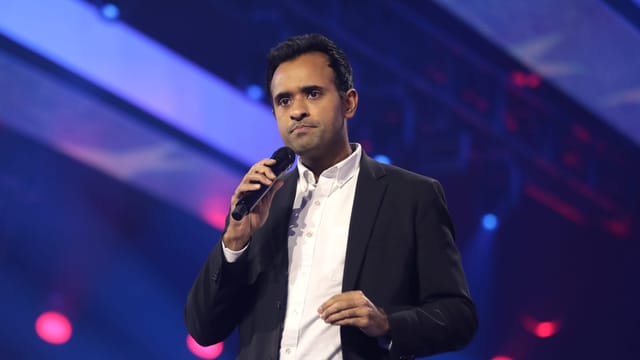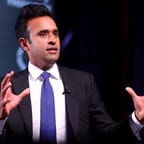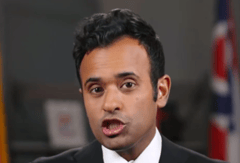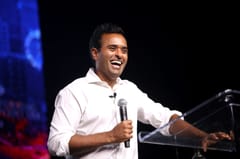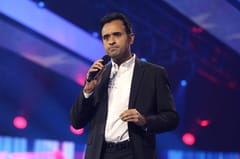
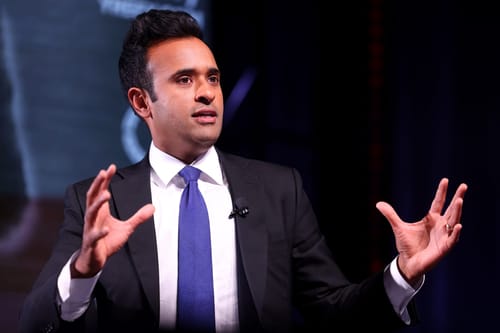
The biotechnology company Vivek Ramaswamy founded, and still partly owns, is collecting one of the largest patent settlements in pharmaceutical history — a payout for the same COVID-19 vaccine technology the Republican gubernatorial nominee has built much of his campaign attacking.
Under a deal reached March 3, Moderna agreed to pay Genevant Sciences, a subsidiary of Ramaswamy’s Roivant Sciences, and its partner Arbutus Biopharma a settlement worth up to $2.25 billion to resolve patent litigation over the lipid nanoparticle technology used to deliver Moderna’s COVID-19 vaccines, including Spikevax. A $950 million upfront payment was due on or before Wednesday, July 8, according to securities filings by both companies. A further $1.3 billion is contingent on the outcome of a federal appeal.
Ramaswamy spent the days before that deadline abroad. Hours after marking the Fourth of July at events in Lancaster and Upper Arlington, he flew by private jet from Columbus to Paris on the night of July 4 — his fifth international trip of the year, according to flight-tracking data cited by the Columbus newsletter The Rooster.
A shareholder, not a bystander
Ramaswamy founded Roivant in 2014 and served as its chief executive until 2021, stepping down from the company’s board in early 2023 to run for president. He holds no current role at the company and is not a party to the Moderna case; the settlement money is paid to the companies, not to him. But he remains one of Roivant’s largest shareholders, holding roughly 7 percent of the firm — a stake that stands to benefit from a deal that has strengthened the company’s balance sheet and its stock.
Roivant recorded a $770.2 million gain tied to the settlement in its most recent earnings. Its shares rose about 6 percent the day the deal was announced — Arbutus jumped roughly 24 percent — and Roivant’s board authorized a $1 billion share repurchase program that returns cash to shareholders.
A campaign built on the pandemic
Ramaswamy faces Democrat Amy Acton, the former state health director who led Ohio’s early COVID-19 response, in the general election on Tuesday, November 3. He has made Acton’s 2020 record a centerpiece of his campaign, accusing her at rallies of spreading dangerous “COVID ideology,” and a super PAC backing him has aired ads that TiffinOhio.net has reported to contain false claims about her role in the shutdowns.
He has also distanced himself from the vaccine his former company’s technology helped make possible. On a July 2023 podcast appearance during his presidential run, Ramaswamy said he was vaccinated but regretted it: “Had I had the facts that I do now, as a young, thankfully healthy male, I would not have chosen to get vaccinated,” he said at the time.
His own pandemic ghosts
Ramaswamy’s public posture as a COVID skeptic sits alongside a 2020 record that ran the other way. As Roivant’s CEO, he served as an adviser on COVID-19 to then-Lt. Gov. Jon Husted — now a U.S. senator — a role he described in a 2021 op-ed. During that period, the Associated Press reported, Ramaswamy supported vaccines, received one himself and advocated mask-wearing, though he said he never backed government mandates for either. A Roivant company, Datavant, pushed for a national registry that would sort Americans by immunity status, allowing those with natural immunity to “get back to normal life.” Roivant also spent $70,000 lobbying the federal government on COVID-19 drug issues in 2020 and 2021.
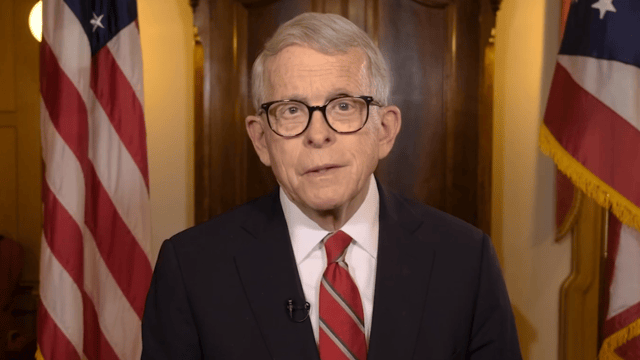
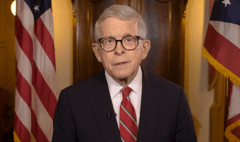
The central premise of his attacks on Acton has been contested by the Republican who appointed her. Gov. Mike DeWine, who has endorsed Ramaswamy, has repeatedly said the decisions to close businesses and schools and to postpone Ohio’s 2020 primary were his own. “I told her to issue the health order,” DeWine has said of the primary postponement. “The decision was mine.” Acton’s campaign has said she is “proud of the work she did alongside Governor DeWine to put public health over politics, save lives and keep Ohioans safe.”
After entering politics, Ramaswamy moved to strip part of that history from public view. In early 2023, a Wikipedia editor who disclosed being paid by Ramaswamy removed a reference to his service on Ohio’s “COVID-19 Response Team.” Ramaswamy has called the edit a simple correction, saying the panel never met. His campaign has acknowledged paying an editor but denied the change was politically motivated.
Ramaswamy has defended his record as consistent. In an interview with the AP, he said both his support for the registry and his talks with Husted were about “getting the economy going again,” and described his overall position on the virus as “nuanced.” “As a decision maker, you have to weigh the costs and benefits of your actions,” he said. “You can’t be unmoored from the data.” His campaign referred questions about his time at Roivant to the company, which did not respond to the AP.
Critics see a contradiction
Innovation Ohio, a progressive research and communications group, has seized on the settlement. “This sums up exactly who Vivek Ramaswamy is: someone who did everything he could to get rich off of the COVID pandemic,” said the group’s president, Michael McGovern. “We can’t trust him to look out for Ohioans best interest because the only thing he seems to care about is looking out for himself and his own ambitions.”
“Vivek wants to have it both ways: attack Ohio’s COVID response in public, while quietly making millions,” McGovern said. “Vivek is a total fake, and Ohioans can see it.”
The settlement TiffinOhio.net first reported in the spring resolves only part of the litigation over the vaccine technology. Genevant and Arbutus are still pursuing a separate case against Pfizer and BioNTech, whose Comirnaty shot accounts for roughly two-thirds of global COVID-19 mRNA vaccine sales.