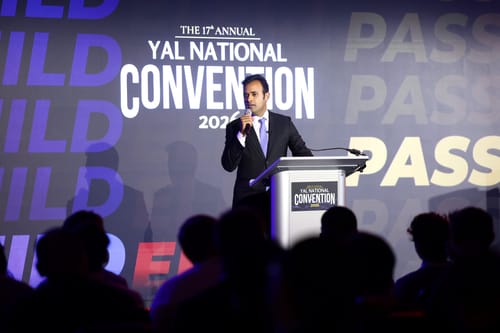

Vivek Ramaswamy got booed off a stage in the city where he was born, by a room that should have been the friendliest audience of his year. He lasted 14 minutes of a 30-minute slot. Somewhere in the middle, the Republican nominee for Ohio governor told a hall full of young conservatives and libertarians something a professional campaign would have spent a decade training him never to say out loud.
“The truth of the matter is, you know, no matter what happens in whichever direction we go, people in my generation have already made it,” he said. “We’re gonna be fine. It’s gonna be your generation…that pays the price.”
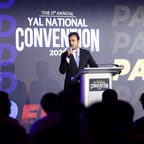
The room turned on him. He tried to push through, asked who still believed in capitalism, told the ones who clapped they would be carrying everyone else on their backs, said “Peace out, see you guys” and walked, roughly 16 minutes ahead of schedule, to another wave of boos. It happened July 29 at the Young Americans for Liberty national convention, held on Xavier University’s campus in Cincinnati. TiffinOhio.net covered the appearance and the week of backlash that followed it.
The consensus reading was that Ramaswamy misjudged the room. That is too generous. He did not misjudge the room. He described, in one sentence, the arrangement that made him a billionaire — and a room of 20-year-olds who have spent their lives on the wrong end of arrangements like it recognized the shape of it immediately.
The structure, not the gaffe
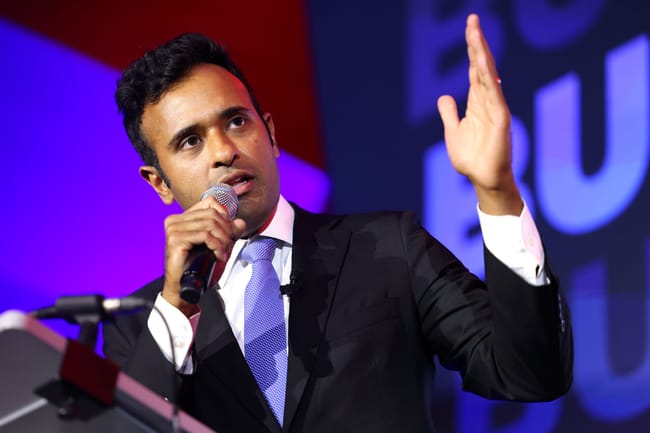
Two weeks after the boos, the investigative newsletter Oligarch Watch published the most detailed account yet of how Ramaswamy actually made his money. Caleb Ecarma’s Aug. 12 investigation is a case study in who absorbs a loss.
In December 2014, Axovant — a subsidiary of Ramaswamy’s Roivant Sciences — bought the rights to an experimental Alzheimer’s drug from GlaxoSmithKline for $5 million. Glaxo had already given up on it. The drug, later named intepirdine, had failed multiple Phase 2 trials, including two involving 576 and 684 patients.
Then, according to Oligarch Watch, the failed data got a second look. Axovant hired Ramaswamy’s mother, Geetha Ramaswamy, as vice president of medical and scientific strategy in 2015. Oligarch Watch reported that she had never conducted a clinical trial, and that within weeks of the company’s record-setting initial public offering she had co-published two reanalyses of Glaxo’s failed 684-patient study — one that sorted patients into pass-or-fail buckets rather than measuring cognitive performance, and one that simply dropped the more than 30% of patients who left the study before it ended. Both methods are long-criticized in the medical research literature for producing biased results. Both produced numbers Axovant could sell.
The IPO raised $315 million on a $1.4 billion valuation, with no revenue and, as the trade press noted at the time, not a single patient recruited for a future trial. Ramaswamy went on television and told investors the drug could help millions.
Oligarch Watch reported that when rival drugs in the same class began failing, Ramaswamy could not quietly dump 75 million Axovant shares on the open market without tanking the price and triggering disclosures. So Roivant’s position was monetized privately instead, through a $1.1 billion SoftBank transaction disclosed to the Securities and Exchange Commission in September 2017. Less than a month later, intepirdine failed its Phase 3 trial. The stock fell about 70% in a single day. The company was eventually renamed, lost nearly all its value and shut down.
Ramaswamy made an estimated $260 million from Roivant, per Forbes. The California State Teachers’ Retirement System — a pension fund for schoolteachers, in another state, whose members had no idea any of this was happening — watched its Axovant stake fall from about $1.2 million to about $68,000, according to SEC filings cited by Oligarch Watch.
David Niven, a political scientist at the University of Cincinnati, gave Oligarch Watch the cleanest description of the arrangement: it was, he said, “heads I win and tails I also win.” Ramaswamy has told BioPharma Dive there was “probably nothing in a meaningful way” the company could have done differently.
Writing for TiffinOhio.net in May, Randy Kemp argued that a business model that pays the founder whether or not the product works is a scam in every sense that matters to the people on the losing end, even when it is entirely legal. The new reporting on how the underlying data got massaged does not soften that judgment. It sharpens it.
The same arrangement, now on the ballot
The Xavier speech was not a one-off embarrassment. Every major plank of Ramaswamy’s campaign for governor has the identical structure: he names an upside, and someone else carries the risk. It is the Axovant arrangement, scaled to a state.
The tax plan. Ramaswamy has pledged to eliminate Ohio’s personal income tax, which raises roughly $10 billion a year — about a quarter of the state operating budget, funding K-12 schools, Medicaid, public universities, prisons and services for seniors, veterans and disabled Ohioans. He says growth and spending discipline will close the gap. He has not said which programs get cut. Outside analyses have been consistent: the benefits flow to wealthy Ohioans and corporations, and replacing the revenue through property taxes would require an increase of roughly 20% statewide. Heads he wins. Tails your school levy.
The data centers. Ramaswamy wants to accelerate Ohio’s data center buildout and has called the boom good on tape at least 10 times, with no conditions attached. What he offers the communities absorbing it is free electricity and lower property taxes for the people who live nearest the facilities. Call that what it is: a scam. A single hyperscale data center can draw as much power as 100,000 homes, according to the Ohio Consumers’ Counsel, and new baseload generation takes years to bring online. Ramaswamy has never said where the surplus that makes anybody’s power free is supposed to come from. Innovation Ohio President Michael McGovern called the plan unserious. Meanwhile a May report from the group found Ramaswamy’s personal holdings span every tier of the industry he would regulate — chip makers, cloud and data center operators, industrial real estate, crypto — and McGovern said he is too entangled with it “to make sure it does right by our communities.” As governor he would appoint all five members of the Public Utilities Commission, the body that sets the rates. He has also taken nearly $100,000 from energy interests while Ohioans’ electric bills climb.
The crypto push. Ramaswamy has praised House Bill 18, which would let the state treasurer and five public pension boards put money into bitcoin-tied funds. He holds a stake of roughly $69 million in Strive, a leveraged bitcoin treasury company that lost $257.6 million last quarter. He faces no legal requirement to divest. The people whose retirements would ride on that bill are teachers, firefighters and public employees — which is to say, the same category of person who held the Axovant shares.
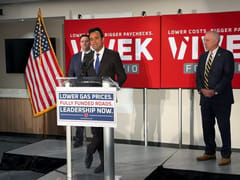
The campaign itself. Ramaswamy has put $25 million into his own campaign, about 83% of what it raised this year. It is structured as a loan, meaning donors’ money can be used to pay him back. The super PAC behind him has been financed overwhelmingly by a handful of out-of-state billionaires, including Elon Musk. Even the money is a downside-protected position.
‘Your generation’
The rest of the record fills in the line about generations.
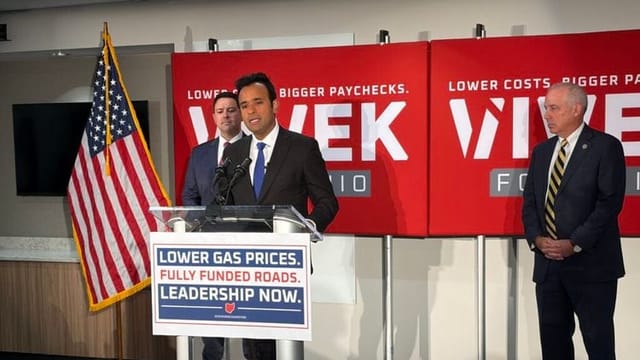
Ramaswamy told Ohio parents in November 2025 that the fix for child care costs was to keep kids in school year-round and until 4 p.m. Then the video came down, without explanation, and the proposal has not resurfaced. In December 2024 he argued that tech firms hire foreign-born engineers over Americans because American culture “has venerated mediocrity over excellence for way too long” — while the company he founded had filed for 29 H-1B visas. On July 4 this year he worked a parade in Lancaster, shook hands in Upper Arlington, and then boarded a private jet to Paris, his fifth international trip of the year on a plane he has flown more than 50 times during the campaign.
None of that is illegal. Little of it is even unusual for a very rich candidate. The Xavier crowd was not booing a policy disagreement. It was listening to a man explain, without apparent embarrassment, that he had already collected and they had not.
Why that room
Young Americans for Liberty grew out of Ron Paul’s presidential campaigns and organizes college students around limited government and free markets — the exact principles Ramaswamy built a national brand on. This was not a hostile crowd bused in by the opposition. It was his own coalition, in the city where he was born.
The complaints shouted from that floor were about bills. Attendees heckled him over data centers and energy prices — the same two complaints that moved Tiffin City Council to vote 6-0 on Monday, April 20, to freeze data center development inside city limits for a year. No data center had even been proposed here. Council wanted to know the cost first. That instinct — find out who pays before you say yes — is the same instinct that filled the Xavier hall with noise.
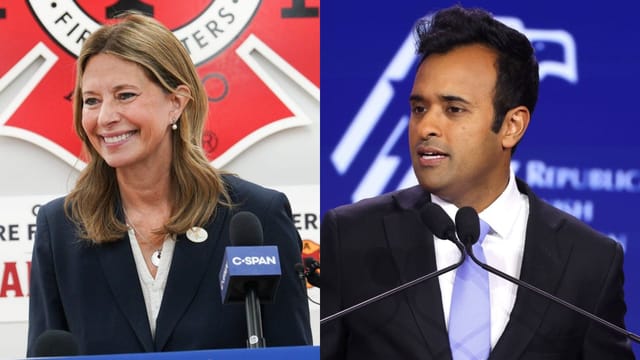
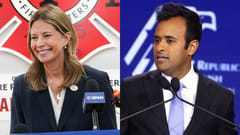
Democratic nominee Dr. Amy Acton has been making the out-of-touch-billionaire argument for months against his jet travel and his self-funding. What changed on July 29 is that a room full of Republicans and libertarians made it for her, louder.
The race remains close. A Fox News poll of 1,008 Ohio registered voters conducted Aug. 6 through 10 put Ramaswamy at 50% and Acton at 48%, a two-point margin inside the error bars, with the poll finding cost of living dominating voter concerns statewide.
Ohioans vote Tuesday, Nov. 3. When Ramaswamy says his generation has already made it, he is not speculating. He is reporting a result. The unsettled question is who holds the bag the next time one of his ventures does not work out, and whether Ohio wants to volunteer.