In September 2022, a sitting county elections-board member and his wife lent $150,000 to the media company run by Jack Windsor, a conservative Ohio talk-radio host who runs his own Statehouse news outlet. James F. Kerg Jr. — then a member of the Shelby County Board of Elections, and now a board member of the conservative advocacy group Ohio Value Voters — and his wife, Theresa, bought a convertible promissory note issued by Media Dynamics Group LLC. Windsor signed the note for the company and signed a separate guaranty the same day, personally promising to pay if the business did not.
The note came due Dec. 31, 2024. It was not paid. To collect, the Kergs sued twice, and when a magistrate ordered Windsor to appear and answer questions under oath about his property, Windsor filed for federal bankruptcy protection 24 days before the scheduled examination.
Under the repayment plan he has proposed, Kerg would recover about 5 cents on the dollar.
The case is a public accounting of one Ohio media venture — who financed it, the debt that followed, and what its owner reported owning once collection began. Windsor markets himself as an investigative reporter. His initial bankruptcy filing runs 94 pages.
Two lawsuits to collect one debt
The Kergs sued Windsor personally in Franklin County Common Pleas Court in September 2025, seeking $185,457.60. Certified mail sent to the address listed for him in that complaint came back in January marked not deliverable as addressed, and the case stalled.
Eight days later they filed again, this time against both Windsor and his company, and invoked a clause Windsor had signed in 2022. The note was a cognovit instrument — a commercial agreement in which the borrower waives the right to advance notice and a trial and consents in advance to judgment being entered against him. Ohio voids such clauses in consumer transactions. In commercial transactions they can be enforced if statutory requirements are met.
Judge Sheryl Munson entered judgment nine days after that second case was filed, finding that the requirements for a cognovit judgment were met and that the note did not arise from a consumer transaction. Windsor and Media Dynamics Group were held jointly and severally liable for $185,457.60, plus post-judgment interest and collection costs. The Kergs then dismissed their original lawsuit.
With judgment in hand, they moved to collect. In March, a magistrate ordered Windsor to appear at 9 a.m. on April 24 to answer under oath concerning his property.
On March 31, Windsor filed for Chapter 13 bankruptcy in Columbus. The automatic stay that accompanies a bankruptcy filing halted further collection activity before that examination could take place.
A company with $4 in the bank
Windsor’s petition identifies four business or trade names: Media Dynamics Group, Red Straw Marketing, Windsor Brands, and his own name. He reported that Media Dynamics Group — the company the Kergs financed — had taken in no income and paid no expenses over the previous six months. He valued his ownership interest in it at $1,750 and reported that its bank account held $4.
He scheduled more than $305,000 in debts. Beyond the Kergs, they include roughly $69,800 owed to the U.S. Department of Education, $30,000 to the Internal Revenue Service, and several thousand dollars across credit cards and collection accounts. He also listed $4,100 owed to Gongwer News Service, the subscription state-government news service that has covered the Ohio Statehouse since 1906. Windsor is a Statehouse correspondent for a Cleveland radio station.
It is his second known bankruptcy. A court-generated notice of prior filings shows he filed a Chapter 7 case in northern Ohio in October 2005 and received a discharge in February 2006 — far outside the four-year window that can bar a debtor from receiving a Chapter 13 discharge after a Chapter 7 discharge.
Five cents on the dollar
As of Aug. 3, five creditors had filed six claims totaling $216,037.05. Kerg’s claim, filed in his name alone for $189,197.41, is roughly 88 percent of that. Gongwer did not file. The Department of Education has not filed either, but as a federal agency it has until Sept. 28, the later deadline that applies to government creditors.
A creditor that neither files a claim nor has one filed on its behalf — the debtor or trustee may do so after the creditor’s deadline passes — generally receives nothing through the plan. But failing to file does not by itself erase a debt. Most federal student-loan debt survives a Chapter 13 discharge no matter what the lender collects, unless the borrower wins a separate court finding of undue hardship.
The plan Windsor filed in April proposes paying $890 a month for five years, with general unsecured creditors receiving 5 percent of their allowed claims. If Kerg’s $189,197.41 claim is allowed in full, the plan is approved on those terms and Windsor completes it, Kerg would collect about $9,460 — five cents for every dollar. The 5 percent applies only to general unsecured claims; the plan must separately provide for full payment of allowed priority debts, including allowed priority tax claims, unless those creditors agree otherwise, and must account for trustee compensation and any allowed attorney fees.
If Windsor finishes a confirmed plan, the unpaid portions of dischargeable debts covered by it could be wiped out. Statutory exceptions, including most student loans and certain taxes, can survive.
Nothing has been approved. Chapter 13 trustee Faye D. English objected to confirmation in May, seeking tax returns, profit-and-loss statements and business bank records, and asking the court to deny confirmation and dismiss or convert the case if the gaps were not filled. She filed a second objection in June challenging property Windsor claimed as exempt from creditors, including his interests in Media Dynamics Group and Red Straw Marketing. Windsor amended two schedules on July 17. No order resolving either objection appeared on the docket as of Aug. 3.
Confirmation hearings set for June and July were each continued. The matter now goes before Judge Tiffany Strelow Cobb on Aug. 18.
As of Aug. 3, no adversary complaint had been filed seeking to keep the Kerg debt out of a completed Chapter 13 discharge. The July 13 deadline for complaints under the potentially relevant fraud and fiduciary-misconduct provisions passed without a filing. The state pleadings alleged breach and default, not fraud. Whether Kerg ultimately collects 5 percent or something else depends on the confirmation ruling, the trustee’s objections, any amended plan, allowance of his claim and whether Windsor completes the case.
Windsor was sent 14 written questions about the note, the judgment and his bankruptcy filings, with a deadline of 5 p.m. Aug. 3. He responded twice without answering any of them — first asking to schedule a phone call, and then, on Monday at 4:59 p.m., one minute before the deadline, asking that it be extended and posing his own questions about TiffinOhio.net’s ownership, funding and staffing. Marczewski and Garvine did not respond to requests for comment.
The men involved
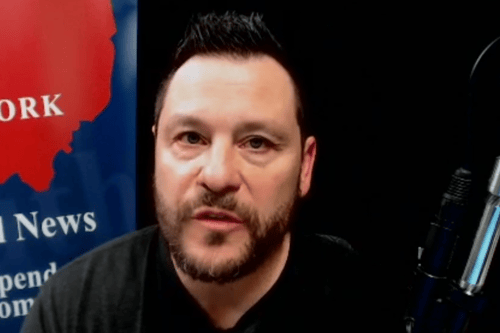
Windsor is the founder and editor-in-chief of the Ohio Press Network and hosts a weekday program on a Columbus talk radio station. He gained a following in conservative media during the COVID-19 pandemic, pressing Gov. Mike DeWine, then-Lt. Gov. Jon Husted and former state health director Dr. Amy Acton over the state’s response, and he previously served as managing editor of The Ohio Star. His Facebook page, titled “Jack Windsor – Investigative Reporter,” had more than 41,000 followers as of Aug. 2.
Media Bias/Fact Check, which rates news outlets for political lean and reliability, classifies the Ohio Press Network as right-biased with mixed factual reporting. In its March 2025 assessment, it noted the site disclosed neither its ownership nor its funding, which it said raised the possibility of “an undisclosed ideological affiliation or external funding influence.” The court records in Windsor’s bankruptcy identify one source of that financing. The Ohio Star, where Windsor was managing editor, carries the same right-biased, mixed rating; it is owned by Star News Digital Media, not by Windsor.
Kerg is a longtime Republican strategist and fundraiser. According to his biography on the Ohio Value Voters website, he has advised state legislative and congressional campaigns for more than three decades and has owned and run an Ohio aerospace-components manufacturer since 1990. He sits on the group’s board; Ohio Value Voters endorses candidates and campaigns on social-conservative issues. Kerg served on the Shelby County Board of Elections from 2019 until 2023, including a term as its chairman, and was a member of that board when he and his wife financed Windsor’s company.