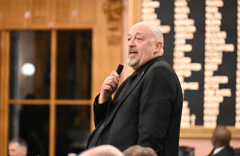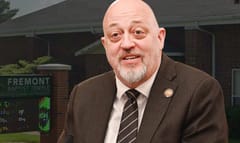
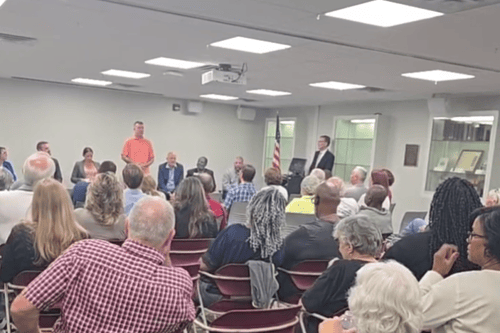
FREMONT, Ohio — Sandusky County’s projected $4.3 million budget shortfall, automated license plate readers, data centers and the fallout from former Judge Jon Ickes’ removal from the bench dominated a wide-ranging candidate forum Tuesday night in Fremont.
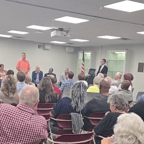
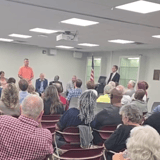
The Sept. 29 forum, hosted by Fremont NAACP Unit 3217B at Birchard Public Library, brought together eight candidates seeking county, judicial and state offices with five weeks remaining before the Nov. 3 general election.
Participating, from left to right, were Republican Sandusky County Commissioner Justin Smith; Democratic commissioner candidate Jill Simpson; Democratic commissioner candidate Kurtis Kuhl; independent Sandusky County Common Pleas Court candidate Kimberly Ontko; Republican commissioner candidate Rich Farmer; Republican state Rep. Gary Click; Democratic Sixth District Court of Appeals Judge Myron Duhart; and Democratic state representative candidate Aaron Jones.
The four commissioner candidates are competing in two separate races. Smith, who was appointed to the commission in April after Charlie Schwochow resigned, faces Simpson for the remainder of the unexpired term ending Jan. 2, 2029. Farmer faces Kuhl for the regular four-year term beginning Jan. 1, 2027, replacing Commissioner Russ Zimmerman.
County’s $4.3 million shortfall takes center stage
The county’s finances became one of the night’s central issues, little more than a week after TiffinOhio.net reported that Sandusky County had frozen nonessential spending and hiring while confronting a projected $4.3 million budget shortfall.
Smith emphasized that he joined the commission in April and was not in office when the 2026 budget was originally adopted.
“I did not cause the problem, but I am working to fix the problem,” Smith said.
Smith said county budget hearings had not been conducted since 2019 before commissioners resumed them this year. He said officials are now meeting with individual departments and reviewing their spending.
County records previously reviewed by TiffinOhio.net provide additional context to that defense. Smith was serving on the commission when county officials identified the projected $4.3 million gap and when the county’s spending and hiring freeze took effect Sept. 1. He also joined Commissioners Scott Miller and Russ Zimmerman in a Sept. 4 public statement announcing what the board called a spending “pause,” without disclosing either the projected $4.3 million shortfall or the hiring freeze.
Smith said Tuesday that officials are asking department heads to identify spending that can be trimmed while trying to preserve services.
Simpson said stabilizing county finances would be her top priority and called for closer examination of budgeting, forecasting, communication among county offices and oversight of taxpayer dollars.
She specifically questioned whether heavy overtime spending in some departments could be reduced by hiring part-time or additional employees.
Simpson also tied the financial problems to public confidence in county government.
“Their jobs are not to serve themselves or their individual offices,” Simpson said of county officials. “Their jobs are to serve the people of Sandusky County.”
Farmer said he requested several years of actual spending and budget information from Sandusky County and compared it with figures from Seneca and Huron counties.
He told the audience he warned commissioners in February that the county’s budget would not work and pointed to line items where, he said, budgeted amounts significantly exceeded recent actual spending.
Farmer also singled out overtime at Sandusky County EMS and questioned how the county accounted for costs associated with the new EMS facility.
“Obviously, as the county commissioner, your number one job is that budget,” Farmer said.
Kuhl said county finances should be substantially easier for the public to inspect.
“I think the budget needs to be something you don’t need to do a records request for,” Kuhl said.
He called for Sandusky County to publish accessible budget information online showing residents where money is going, what major projects cost and where spending is exceeding projections.
Candidates line up against Flock cameras, but differ on what to do
The candidates found substantial agreement when the discussion turned to Flock Safety cameras and other automated license plate reader systems, but their proposed responses differed.
Smith said the cameras currently being used in Sandusky County are funded through the drug task force rather than the county General Fund.
He said he would vote against using General Fund money for them.
“If it was under the General Fund right now, I would say no,” Smith said, adding that he was still examining the broader privacy and law-enforcement questions and was “leaning against” the cameras.
Simpson raised concerns about the collection and storage of information, who can access it, probable cause and the potential for misuse.
“I am in favor of putting a pause on that,” Simpson said. “I would not be disappointed if they went away at all.”
She said that if the technology remains in use, regulations would be needed to protect the public.
Kuhl took a firmer position, saying he does not support Flock cameras under the current system because of warrantless access, inadequate regulation and the potential for abuse.
He said he would vote against county funding for the cameras and supported an immediate moratorium or removing them until stronger protections are established.
Farmer was even more direct.
“You ever heard the term, ‘No is a complete sentence?’” Farmer asked. “No. I don’t support Flock cameras.”
Ontko declined to take a substantive position, noting that a dispute involving the technology could eventually come before her as a judge.
“I think it’s important that everybody’s rights are protected,” Ontko said, adding that courts have a responsibility to protect those rights.
Duhart similarly avoided addressing a specific controversy that could reach the appeals court, but framed the larger debate as a Fourth Amendment issue involving civil liberties, due process and the judiciary’s role as a check on the other branches of government.
“It is important that you all know and understand who your judges are,” Duhart said.
Click tells Jones to “do something” in a city with no government ALPR network
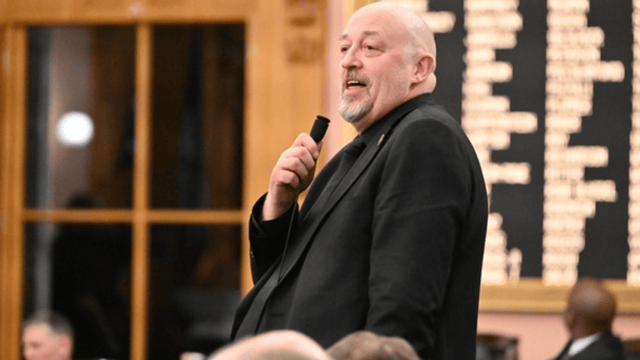
Click pointed to House Bill 1011, his recently introduced “1984 No More Act,” and used the issue to challenge Jones.
“I actually think Aaron agrees with me, but only one of us has taken action,” Click said.
Click told Jones, who represents Tiffin’s 1st Ward on City Council, that he should introduce a city ordinance banning or pausing automated license plate readers.
“If you agree, I would encourage you to just go ahead and take — don’t just talk about it,” Click said. “Just do something about it.”
Click did not mention that Tiffin currently has no city-operated Flock or other automated license plate reader network for Jones or City Council to shut down.
Tiffin had budgeted money for license plate readers, but the planned police deployment never occurred. In July, City Council voted 7-0 to place a $17,382.76 refund into the General Capital Improvement Fund for two license plate reader cameras that were not used. Jones joined the rest of council in that vote.
Privately operated readers are a separate matter. DeFlock, a volunteer-run and crowdsourced mapping project, lists privately operated Flock equipment in Tiffin, including cameras attributed to Lowe’s. The project cautions that its map can be incomplete or outdated. Those cameras are not operated by Tiffin city government or the Tiffin Police Department.
Jones responded at the forum by explaining that Tiffin had considered the technology but ultimately did not deploy it.
“We had them in our budget. We removed them from the budget,” Jones said.
Jones said Police Chief David Pauly determined the money could be better spent on officer safety, body cameras, bulletproof vests and other police equipment.
Jones also said he would go further than a temporary pause.
“I wouldn’t do a moratorium,” Jones said. “I’d just say, ‘Just don’t. Just don’t. Just get rid of them.’”
Click’s HB 1011 has not passed either chamber of the General Assembly. As of Tuesday, the official legislative record showed only one action: its Sept. 14 introduction. It had not yet advanced into a House committee.
The bill is also explicitly temporary. Its restrictions would disappear one year after taking effect.
The introduced proposal contains several exceptions to its restrictions, including uses connected to AMBER, SILVER, endangered-missing-child, endangered-missing-adult and BLUE alerts. It also contains an exception allowing use in connection with U.S. Immigration and Customs Enforcement’s enforcement of federal immigration law.
Click acknowledged at the forum that he deliberately included exceptions in an effort to remove potential objections to the temporary moratorium.
“The reason for the exceptions is not because I think they should continue,” Click said, “but it’s like, okay, let me remove the objections for the pause.”
Jones calls for halt to new data centers
When asked about the most pressing issues facing the office he is seeking, Jones identified data centers and property taxes.
Jones said he would pursue a moratorium on new data center construction while Ohio more closely examines the industry’s effects on electricity demand, natural resources and taxpayers.
“We need to investigate this a lot more than what we’re doing,” Jones said.
He said large data centers should not continue receiving favorable tax treatment while Ohio homeowners face rising property taxes and electric bills.
Jones also connected property taxes to public school funding, arguing that inadequate state funding leaves local districts more dependent on local levies.
“We have to fund our public education,” Jones said.
Click cites Christianity bill when asked about teacher academic freedom
After a break, moderators turned to written questions submitted by audience members.
One asked what could be done to ensure teachers have academic freedom in public high schools without fear of state or district restrictions.
Click responded by pointing to House Bill 486, legislation he introduced with Republican Rep. Michael Dovilla.
Click said teachers have faced restrictions when attempting to discuss the Christian influence on American history and cited figures including John Leland and Roger Williams.
HB 486, however, is not a general academic-freedom measure covering teachers broadly or subjects generally.
Officially titled the “Charlie Kirk American Heritage Act,” the bill would permit teachers in public schools and state institutions of higher education to provide instruction on what the legislation describes as the influence of Judeo-Christian values on history and culture.
The Ohio House passed the measure 62-27 in November 2025. It has since been referred to the Senate Education Committee but has not passed the Senate.
Ickes scandal hangs over judicial discussion
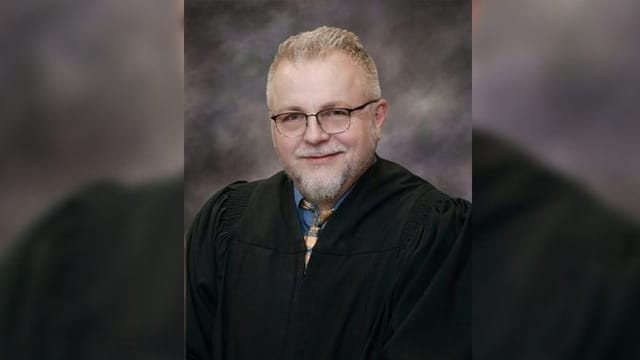
The fallout surrounding former Sandusky County Common Pleas Judge Jon Ickes remained another major subject.
In an Aug. 19 decision, the Ohio Supreme Court suspended Ickes from practicing law for two years and immediately removed him from the bench without pay after finding multiple violations of Ohio’s judicial conduct rules.
The court found misconduct including Ickes’ failure to recuse himself from criminal cases involving his stepson, a law-enforcement witness; vulgar and inappropriate workplace conduct; and use of a racial slur within earshot of a Black defendant.
Yet Ickes remains on the Nov. 3 ballot against Ontko.
In a Sept. 14 ruling, the Ohio Supreme Court said existing election law did not allow the court or the Sandusky County Board of Elections to remove Ickes after the applicable statutory deadlines had passed, even though his suspension prevents him from taking the office while it remains in effect.
Ontko said restoring public confidence is one of the most pressing challenges facing the Common Pleas Court.
She called for professionalism, integrity, impartiality, timely decisions and respect for people entering the courthouse.
Asked directly about Ickes remaining on the ballot, Ontko questioned how Ohio law permits voters to face a candidate who cannot presently assume the office.
“How do we end up in a situation where we have somebody on the ballot that cannot take the seat?” Ontko said.
She said voters could otherwise be left choosing without knowing who might ultimately fill the office if an ineligible candidate receives the most votes.
Click later said he called Ickes after the misconduct became public and told him he should resign.
“What he did was absolutely atrocious, it was horrible, it was very offensive,” Click said.
Click then invoked his pastoral background, saying, “As a pastor, I always believe in grace,” and adding that he does not believe anyone is irredeemable. He said he agreed with the Supreme Court’s decision to remove Ickes from the bench while believing Ickes was attempting to address his conduct personally.
Duhart said the broader episode illustrated how heavily courts depend on public confidence.
“The other two branches of government, they have the power of the purse and the power of the sword,” Duhart said. “Third branch of government, all we have is trust.”
“And when we lose the trust of folks, we don’t have much of anything left.”
Housing, wages and a shrinking county
The candidates were also asked how Sandusky County should confront long-term population decline.
Kuhl had already raised the issue earlier in the forum, saying studies indicate the county needs roughly 1,000 additional homes and arguing that housing shortages, wages and employment opportunities all affect whether younger residents stay.
He later suggested county leaders should directly survey young people about why they plan to leave and what could persuade them to return after college, military service or job training.
Simpson said population loss is connected to numerous factors including housing, schools, parks, jobs, wages and the overall quality of life available to families.
Farmer focused on income, arguing that Sandusky County’s wages trail those in surrounding counties and make both housing development and long-term retention more difficult.
“We gotta find a way to get the wage to a higher level to where the people that live in the county can afford to stay in the county,” Farmer said.
Smith also emphasized higher-paying employment, saying the county has built schools, parks and community amenities but needs stronger job opportunities.
Jones argued that state policy also plays a role, pointing to education, taxes and economic conditions that push younger residents toward opportunities elsewhere.
“We just keep doing the same thing, expecting different results,” Jones said. “At some point, we have to look at it and say, ‘What are we doing?’”
Duhart said rural population loss is also affecting the legal system, where counties are struggling to maintain enough qualified attorneys to represent defendants. He pointed to the Ohio Rural Lawyers Program as one effort aimed at attracting attorneys to underserved communities.
Five weeks to Election Day
The candidates used their closing remarks to make their final pitches with 35 days remaining before the election.
Smith emphasized his public-service experience and said voters should judge him by his efforts since joining the commission to address the county’s financial problems.
Simpson pointed to more than three decades of community work, including leadership positions with the Chamber of Commerce of Sandusky County and United Way of Sandusky County.
Kuhl emphasized his military service, private-sector work and argument that county government should be more accessible and transparent.
Farmer highlighted his private-sector financial and management background and said he would bring those practices into county government.
Ontko said judicial decisions should be grounded in law, impartiality and respect and argued that her work as an attorney and magistrate has prepared her to take the bench.
Duhart pointed to his military service and judicial experience, including service on the Common Pleas Court and Sixth District Court of Appeals.
Click asked voters to return him to Columbus for what would be his final House term under Ohio’s term-limit rules.
Jones closed by urging voters to evaluate candidates as individuals rather than simply voting by party.
“When you vote, you have to remember that you’re voting for your future,” Jones said. “But not only your future, your children’s future, your grandchildren’s future.”
Ohio’s general election is Tuesday, Nov. 3.