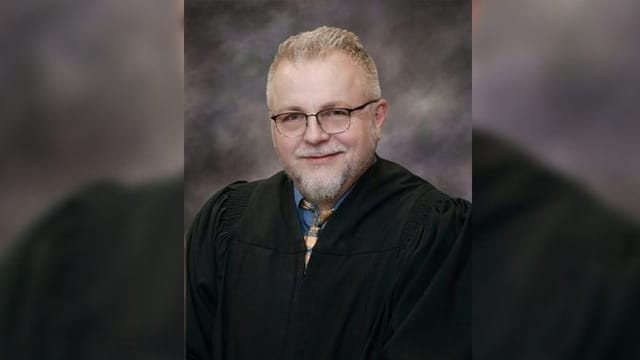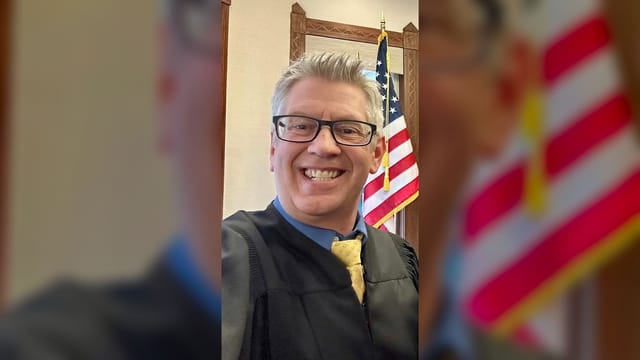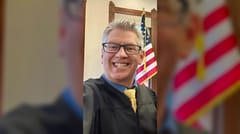
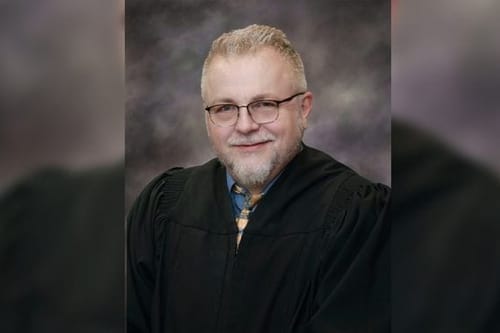

FREMONT, Ohio — The Supreme Court of Ohio suspended Sandusky County Common Pleas Judge Jon Ickes from the practice of law for two years on Wednesday and ordered him off the bench immediately, without pay, for the length of that suspension.
Ickes, a Republican, is still on the ballot in November. He is seeking a full term that begins Jan. 1, 2027, and a two-year suspension imposed Wednesday runs into 2028 — covering roughly the first 19 months of it. His opponent is Kimberly J. Ontko, a Fremont attorney running as an independent, who announced her candidacy in January, according to the Fremont News-Messenger. Ontko is also a magistrate in the same courthouse, assigned to the general division’s other judge, Jeremiah S. Ray.
Ray is the judge who reported Ickes.
The court was not close to the sanction its own disciplinary board wanted. The Board of Professional Conduct, after a four-day hearing and testimony from 19 witnesses, recommended a one-year suspension entirely stayed, meaning Ickes would have served no time off the bench at all. The justices threw that out.
“An actual suspension is necessary to protect the public and demonstrate that we will not tolerate the childish, inappropriate, and vulgar behavior Ickes exhibited in chambers and in the courtroom,” Chief Justice Sharon L. Kennedy wrote for the majority.
What the court found
The justices adopted 10 findings of misconduct spanning five counts, under rules requiring judges to promote confidence in the judiciary, to be patient and courteous, to disqualify themselves when their impartiality might reasonably be questioned, and to hold their staff to the same standard.
The most consequential finding involves Ickes’s stepson, Christian Ortolani, a Fremont police officer and detective. Ortolani helped investigate three criminal cases that landed on Ickes’s docket. Ickes presided anyway, and in the case of defendant Curtis L. Elkins he never disclosed the relationship on the record or asked the parties to waive the conflict — even as prospective jurors were being asked whether they were related to any of the state’s witnesses, Ortolani among them. Ortolani testified at trial. Ickes sentenced Elkins to six to nine years.
In a separate case, Leroy A. Stratton was indicted for raping an 18-month-old child and live-streaming it. Stratton asked Ickes to step aside because Ortolani had arrested him, read him his rights, executed a search warrant and worked the investigation. Ickes refused, ruling that the standard was not met. Ortolani then testified at trial, authenticated video of the crime and sat at the prosecution’s table. Stratton was convicted and sentenced to life without parole.
The Sixth District Court of Appeals reversed both convictions. In Elkins’s case it found an “unconstitutional potential for bias.” In Stratton’s it found the probability of bias violated his due-process rights. Both cases were sent back for new trials. Stratton was tried a second time in January 2026, before a visiting judge, and sentenced again on Feb. 4 to life without the possibility of parole, according to the Fremont News-Messenger — the identical sentence, reached at the cost of putting the case in front of a second jury.
Kennedy called it a “glaring conflict of interest,” and wrote that Ickes’s failures “not only wasted prosecutorial, public-defender, and judicial resources but also caused incalculable harm to public confidence in the independence, integrity, and impartiality of the judiciary.” The court added an aggravating factor the board had not: that Ickes harmed vulnerable victims, because his conduct “left Elkins, Stratton, and their victims to endure a second trial.”
The chambers
For the eight months the Stratton case sat on his docket, Ickes referred to it as the “baby cocksucker case.” He testified that the phrase helped him process a disturbing case. One staff member called it disgusting; another said it left her extremely uncomfortable and disturbed.
During Stratton’s February 2024 trial, Ickes texted from the bench with three court employees. They mocked a man sitting in the gallery during jury selection — Ickes called him a “potential defendant in the array” and then “next Christian creeper,” a reference to the kind of child predator his stepson investigated. While a video of the crime was being discussed in testimony, Ickes sent the group a video of a woman eating a banana, and then a dancing banana.
The court found that conduct “demeaned the seriousness of the charged offense.”
A separate count concerned Ickes’s treatment of a pregnant employee, his assignment commissioner, identified in the opinion as J.D. In April 2024 he told her to “wait until the titty fairy comes.” She told him she did not want to hear it again. He asked whether they could talk about the “butt fairy.” After she complained to the court administrator, Ickes had his wife call her; kept raising it; asked whether she wanted to be there; and insinuated he would fire her. J.D. testified that she was pregnant, had maternity leave banked, and her husband’s factory was closing. “The writing was on the wall,” she said. “And I was very scared.” She left for the other judge’s office.
That judge, Ray, reported it. Ickes then instructed county administrators to halt their investigation and hired an outside firm instead.
Another count concerned a January 2024 morning when Ickes, in his assignment commissioner’s office, quoted a line from “Blazing Saddles” containing the n-word. Nathaniel Simmons, a Black defendant with a pretrial hearing that day, was sitting in the hallway and heard all of it. Simmons’s attorney asked for a different judge. Ickes recused without explanation and self-reported. A second Black defendant, Timothy Norris, later sought Ickes’s removal from his own case, arguing the slur “applie[d] to all colored people.” Ickes said he was quoting a movie, denied the motion from the bench, and never entered a written ruling.
The opinion also catalogs a Nerf gun Ickes fired at staff in chambers and in the courtroom, including when defendants facing serious charges were present; the time he reached for the drawer with his handgun in it by mistake and joked about it afterward; the acronyms he assigned to probation titles; calling the probation secretary “Boris” because she was Black; calling his assignment commissioner a “libtard” when she disagreed with his politics; and saying “snatch chat” instead of Snapchat while instructing juries.
It also describes how he treated probation officer Logan Risch, who, according to court records, overdosed and blacked out after airborne fentanyl was released during a routine pat-down, hit her head, and needed physical therapy for a neck injury. Ickes handled the resulting case. Afterward he asked Risch in front of a colleague why she had not testified, calling her a “dumbass.” Later, discussing the same incident in chambers, he said “some dumbass” correction officer had touched fentanyl without gloves. Risch testified that she did not believe Ickes treated her as a victim at all.
Who stood by him
None of this was secret when Sandusky County Republicans put Ickes on the November ballot.
The disciplinary complaint became public in October 2024. The four-day hearing was held in May 2025. The board’s findings — all 10 of them, including the conflict of interest, the case nickname and the texting from the bench — were filed with the Supreme Court in October 2025. The case was submitted to the justices on Dec. 10, 2025. Ontko announced her independent campaign in January. The primary was held on May 5.
No Republican filed against him. No Democrat filed at all. The party had four months’ notice that the seat would be contested in November and did not put up an alternative. Of the 7,737 Republican ballots cast in Sandusky County on May 5, 5,092 were marked for Ickes and 2,645 were left blank in his race.
Two of the county’s most prominent Republican officeholders had already testified on his behalf. Sandusky County Prosecutor Beth Tischler, who was running for the other common pleas seat at the time, rated Ickes a nine out of 10 as a trial judge under cross-examination by his attorney. “Since I was taught by somebody you don’t give anybody a perfect score, I’ll go with nine,” she said, according to the hearing transcript.
Probate and Juvenile Judge Brad Smith called Ickes “a solid human being and a good judge” and attributed the courthouse tensions entirely to Ray — the judge who had reported the conduct — calling it “a one sided problem.” Disciplinary counsel wrote in post-hearing briefs that Smith “seemed to minimize respondent’s conduct” and noted he lacked firsthand knowledge of what happened in Ickes’s chambers. From the stand, Smith said: “I still don’t know as I sit here today, what is quite factual and accurate and what might be twisted or exaggerated.”
Tischler lost her primary to Ray by roughly 18 points. Before that vote she told TiffinOhio.net: “My decision to run against Judge Ray, and the fractured relationship between Judge Ray and my office have nothing to do with him reporting Judge Ickes to discipline.”
As of Wednesday, the Sandusky County Republican Party’s website still listed Ickes among its county officeholders, photograph and all, under the heading “Common Pleas Court Judge.” The party is chaired by Justin Smith, whom the central committee appointed to a county commissioner seat in April.
Ickes reached the bench in the first place by appointment. Gov. Mike DeWine named him to the vacancy in June 2020, replacing retiring Judge John P. Dewey. He was elected that November and to a full term beginning Jan. 1, 2021.
Even at the top, two justices wanted less
The Supreme Court’s majority went harder than its board. But not unanimously.
Justice R. Patrick DeWine would have imposed one year with six months stayed. Justice Joseph T. Deters would have imposed the full two years but stayed all of it, on the conditions that Ickes commit no further misconduct and complete an antiharassment course — an outcome that would have left him on the bench, drawing his salary, through the end of his term and into the next one.
Chief Justice Kennedy was joined by Justices Patrick F. Fischer, Daniel R. Hawkins and Megan E. Shanahan, along with Fourth District Court of Appeals Judge Michael D. Hess, who sat in place of Justice Jennifer Brunner.
The majority pointed to what Ickes had not done. He never resigned. The board did not credit him with accepting responsibility. And judges, the court said, are held to a higher standard than other attorneys precisely because “misconduct committed by a judge vested with the public’s trust causes incalculable harm to the public perception of the legal system.”
Ickes testified that he behaved as he did in order to be liked. The court was unmoved: “His misguided attempt to make some people like him was completely self-serving at the expense of others and the justice system.”
What happens next
Ickes is off the bench and off the payroll as of Wednesday. Costs of the disciplinary proceedings are taxed to him.
The opinion does not address who covers his docket. It does not address the November election. And it does not say whether the seat is treated as vacant — the order suspends him from judicial office rather than removing him from it, a distinction that determines whether the governor gets to appoint anyone.
What voters will see Nov. 3 is a two-name race with no party labels beside either one. Ohio runs partisan primaries for common pleas judgeships and nonpartisan general elections, so nothing on the ballot will indicate that one candidate is the Republican nominee, that he is currently barred from practicing law in Ohio, or that the other is an independent who works down the hall for the judge who turned him in.