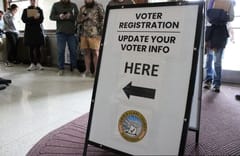
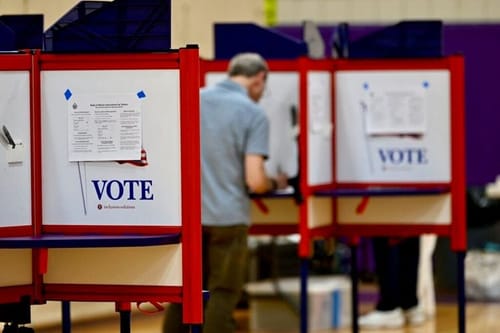

Ohio officials can continue using a new proof of citizenship requirement for people who register to vote at the Bureau of Motor Vehicles. In a divided ruling, The Sixth Circuit Court of Appeals lifted a lower court order on Wednesday.
It comes less than two weeks before Ohio’s voter registration deadline.
The case
Under 2025’s Ohio House Bill 54, BMV clerks offer clients the opportunity register to vote, but only after completing a driver’s license application which requires documentary proof of citizenship.
Two civic organizations, The Ohio Alliance for Retired Americans and Red Wine & Blue, challenged those provisions.
The National Voter Registration Act, commonly known as the motor voter law, requires vehicle registration agencies to offer the opportunity to register when someone submits a driver’s license application. It also directs states to require the “only the minimum amount of information necessary.”
Voter registration forms — including those available at many other public agencies around Ohio — have no proof of citizenship requirement. Instead, applicants declare under penalty of perjury that they are eligible to vote.
Red Wine & Blue and the Ohio Alliance for Retired Americans argued the BMV conditioning access to voter registration services on proof of citizenship violates the minimum information standard.
The groups presented two members who were initially barred from registering, both women, whose documents didn’t reflect their name change after marriage.
In one case, Margaret Dutcher showed up with a valid U.S. Passport — documentary proof of her citizenship — but was still unable to register because she did not have all the documents necessary to get a license.
Research from the University of Maryland indicates 21 million Americans don’t have readily available, up-to-date citizenship documents.
The district judge attempted to cut a middle path. He ordered state officials to stop requiring BMV visitors produce proof of citizenship to register. He added that his order applied to those whose license applications are “ultimately unsuccessful” over lack of documents, but not those who affirmatively indicate they are not a citizen.
The Circuit Court majority opinion
Circuit Judges John Nalbandian and Whitney Hermandorfer, both Trump appointees, downplayed Ohio’s policy and the alleged injury the plaintiffs suffered.
The BMV’s electronic system walks applicants through their license application and once it’s accepted, moves forward to a prompt asking the applicant if they’d like to use their information to register to vote. That’s a reasonable arrangement, the majority opinion concludes, because the universe of eligible license holders is includes minors and non-citizens — neither of whom can vote.
The majority also noted the BMV has paper forms available, and clerks are required to process applications. The state argued a more proactive effort to offer registration would require “wholesale retraining and restructuring of the BMV application process.” The majority bought that argument.
But the majority’s central problem with the case was the underlying harm.
The majority didn’t buy the idea that the individuals identified in the case had suffered an injury, and without injury, there’s no standing to sue.
“Neither Dutcher nor Fazio ever encountered anything having to do with the Associations’ H.B. 54 voter-registration challenge,” the majority wrote, “Instead, BMV officials rejected their driver’s-license applications based on independent paperwork defects.”
The majority contends the challengers aren’t so much finding fault with Ohio’s new law as its administration of drivers licenses, and so enjoining the law wouldn’t address their concerns.
The majority also determined the case is moot because the women in the case have since gotten their licenses and registered to vote.
The dissent
Circuit Judge Kevin Ritz, a Biden appointee, sees the case differently. He brushed aside the majority’s questions of standing and mootness. Two people who wanted to register weren’t afforded that opportunity when they applied for a license. “That is enough,” he said.
The plaintiffs later getting registered, doesn’t mean the case is moot, he added, because that injury could happen again to others.
“A contrary ruling as to rnootness would mean that potential voters who challenge an unlawful state law governing voter registration would have to forgo their registration and right to vote for as long as it took to litigate their challenge to the law,” he wrote. “I am reluctant to construct a Catch-22 that would require a litigant to renounce a ‘fundamental’ right in order to bring suit.”
Like the district court judge, Ritz focused on the importance of “submission.” Under the motor voter law, BMV clerks have to offer registration to people who “submit” a driver’s license application.
To Ritz and the district court, that happens when a person seeks a license, not when the BMV agrees to accept their application. So even people who don’t have all the documents necessary for a license should still be afforded an opportunity to register.
Ritz also said “there’s nothing in the record” to support the state’s argument that a more proactive approach to registration could create voter confusion.
“There is no proof, for instance,” he wrote, “that voters will be confused by a deputy registrar offering them a paper form that is already available elsewhere at the BMV.”
Follow Ohio Capital Journal Reporter Nick Evans on X or on Bluesky.
This story is republished from the Ohio Capital Journal under a Creative Commons license. View the original article.