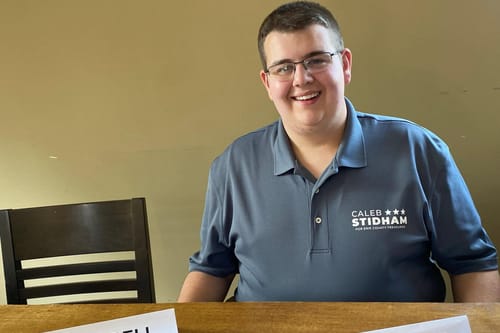
SANDUSKY, Ohio — Caleb Stidham, the Erie County treasurer and chairman of the Erie County Republican Party, has now acknowledged in an Ohio Supreme Court filing that he participated in the six-member Republican committee meeting that selected him as the replacement nominee for Ohio House District 89 — and voted for himself.
Stidham became the Republican nominee after incumbent state Rep. D.J. Swearingen withdrew from the race following the May primary, triggering an Ohio law that gives a district committee of Republican Party officials from Erie, Ottawa and Huron counties the power to choose a replacement candidate.
In a proposed answer filed Thursday with his motion to intervene in the case challenging his nomination, Stidham admits that the district committee selected him and that he “participated in the District Committee meeting and voted in favor of his selection,” while maintaining that Ohio law allowed him to do so.
The committee selected Stidham 4-2. Had Stidham abstained and every other vote remained unchanged, he still would have prevailed 3-2. His own vote was not mathematically necessary to secure the nomination.
But the filing removes any remaining uncertainty about his role in the selection: Stidham was simultaneously a candidate for the House seat and one of the six Republican officials deciding who would receive the nomination, participated in the committee meeting and ultimately cast a vote for himself.
Ottawa County Republican Party Secretary Toni DeLuca, another member of the six-person committee, previously said Stidham left while the other candidates made their presentations but returned for the committee’s deliberations.
“I found it odd that a candidate for a position was given the right to deliberate on other candidates,” DeLuca wrote after the selection.
And while the committee deliberated inside, Erie County Board of Elections member MaryAnn Groot says she was outside trying to get in.
Groot says she was told the meeting was closed
The unusual selection process began after Swearingen formally withdrew Aug. 4, leaving Republicans only days to fill the vacancy on the general-election ballot.
Under Ohio Revised Code 3513.31(B), when a party nominee withdraws from a legislative district covering multiple counties, the replacement can be selected by a district committee consisting of the chairperson and secretary of the party’s county central committee in each county within the district.
House District 89 includes Erie and Ottawa counties and part of Huron County, producing a six-member Republican committee.
Stidham held one of those six seats because he chaired the Erie County Republican Party. He was also one of the Republicans seeking Swearingen’s nomination.
In a sworn affidavit, Groot said she arrived at the Erie County administrative building at the scheduled time of the Aug. 10 committee meeting and told two Republican elections board members who were present that she believed the meeting was required to be open to the public.
“I was told by the two Republican board members that the meeting was a closed meeting, not an open meeting,” Groot wrote.
She said she was directed to a nearby room to wait for the result.
Stidham’s proposed Supreme Court answer denies the paragraph of the amended complaint containing Groot’s account, but does not specify which portion of the paragraph he disputes.
The committee ultimately selected Stidham 4-2.
Nine days later, the fight over whether that process complied with Ohio law had landed on Secretary of State Frank LaRose’s desk.
Arguments arrived. LaRose attended the Republican event. He ruled the next day.
The new Supreme Court filings establish a tight chronology surrounding LaRose’s decision to certify Stidham.
The amended complaint states that the parties’ final written arguments in the certification dispute were submitted to LaRose’s office on or about Aug. 19.
LaRose admits that allegation.
That same day, LaRose attended an Erie County Republican women’s event at the Sandusky Yacht Club.
LaRose now confirms that as well.
On Aug. 20, one day later, LaRose broke a 2-2 Erie County Board of Elections tie and certified Stidham as the Republican nominee for House District 89.
LaRose admits that allegation, too.
The sequence is therefore established in LaRose’s own Supreme Court answer: final arguments in the Stidham dispute reached his office Aug. 19, LaRose attended the Erie County Republican women’s event that day, and he ruled in favor of Stidham’s certification Aug. 20.
TiffinOhio.net first reported Aug. 19 that LaRose was appearing as the featured guest at the event while his office was receiving the final arguments in the Stidham dispute.
The invitation obtained by TiffinOhio.net advertised an “America’s 250th Birthday Bash” at the Sandusky Yacht Club and said the event was being held “in support of our Erie County candidates.” Admission was $50 per person, with sponsorship packages ranging from $250 to $1,000.
At the time, Stidham was not only the disputed House candidate but chairman of the Erie County Republican Party.
Stidham’s answer: “Deny”
The contrast between Stidham’s filing and LaRose’s filing is particularly notable on the Aug. 19 event.
Stidham admits that the final written arguments were submitted to LaRose’s office on Aug. 19.
The next paragraph of the amended complaint states: “On the same day, Secretary LaRose attended an Erie County fundraiser hosted by the Erie County Republican Party.”
Stidham’s entire response to that paragraph is one word:
“Deny.”
He then admits the central fact in the next paragraph: LaRose broke the elections board tie in favor of his certification on Aug. 20.
LaRose’s own filing provides an explanation that Stidham’s does not.
LaRose also formally denies the fundraiser paragraph as written, but immediately adds: “Respondent LaRose attended an event held by the Erie County Women’s Republican Club on August 19, 2026.”
The distinction is who hosted the event. Koebel’s amended complaint describes it as an Erie County Republican Party fundraiser. LaRose identifies the host as the Erie County Republican women’s organization.
That distinction is consistent with TiffinOhio.net’s contemporaneous reporting. The invitation identified the Erie County Republican Women’s Club as the organization behind the event, rather than the county Republican Party itself.
The organizations are separate, but their leadership overlapped. Public promotion for the fundraiser identified Melissa Pelletier as president of the women’s club, while the Erie County Republican Party listed Pelletier as its secretary. The invitation also expressly described the event as being held “in support of our Erie County candidates.”
TiffinOhio.net asked Stidham attorney W. Stuart Dornette before publication whether Stidham was denying that LaRose attended the Aug. 19 event or instead disputing the amended complaint’s identification of the organization that hosted it.
TiffinOhio.net separately asked attorneys representing LaRose whether the pending Stidham certification dispute was discussed with Stidham or anyone else at the event.
Neither responded directly to those questions by TiffinOhio.net’s 5 p.m. Thursday deadline.
LaRose’s subsequent court filing independently confirms that he attended the Aug. 19 Republican women’s event. It does not address whether the pending Stidham matter was discussed there.
A 2-2 elections board split put the decision in LaRose’s hands
The Aug. 10 committee vote did not automatically end the dispute.
Four days later, the Erie County Board of Elections met to consider Stidham’s certification.
Republican board members John Adams and Gary Smith voted in favor of certification. Democratic members Edward Leonard and Groot voted against it, producing a 2-2 deadlock.
Leonard and Groot raised objections to the closed committee meeting and Stidham’s participation in the process that selected him.
Under Ohio law, a tie or disagreement by a county elections board is submitted to the secretary of state for resolution.
That made LaRose the official responsible for deciding whether Stidham would be certified.
The parties submitted their final written arguments Aug. 19. LaRose attended the Republican women’s event later that day and issued his decision Aug. 20, breaking the tie in favor of Stidham.
LaRose rejected the objection based on Ohio’s Open Meetings Act, writing that the certification proceeding was “not the proper forum for an extra-judicial expansion of Ohio’s open meetings laws beyond their established statutory application.”
What the filings establish — and what they do not
Neither the lawsuit nor the new filings establish that Stidham’s vote for himself was unlawful.
Koebel’s amended complaint expressly states that Stidham “was not legally prohibited from participating in deliberations or voting on a nomination in which he was personally interested” and does not contend that his participation or vote was itself illegal.
Stidham similarly argues that no conflict-of-interest rule, recusal requirement or statutory prohibition prevented him from participating or voting.
His own vote also did not provide the winning margin. The committee selected him 4-2, meaning the same remaining votes would have produced a 3-2 result had Stidham abstained.
The lawsuit instead focuses on what happened around that vote: whether a committee created and empowered by state election law to place a replacement nominee on the general-election ballot was required to conduct its deliberations publicly.
Koebel argues that although political party officials ordinarily conduct private internal party business, they were exercising authority delegated by the state when they selected a replacement candidate under R.C. 3513.31(B), bringing that limited function within Ohio’s Open Meetings Act.
Stidham and LaRose reject that interpretation.
Stidham argues that choosing a replacement Republican nominee remained a “core associational function” of the political party and that the district committee therefore was not a public body subject to the Open Meetings Act.
The statute itself establishes the committee’s membership, notice requirements, quorum, voting threshold and certification procedure, but does not expressly state whether the meeting must be open to the public. :contentReference[oaicite:0]{index=0}
LaRose event attendance is not alleged to be an ethics violation
Koebel’s lawsuit also does not allege that LaRose committed an ethics violation merely by attending the Aug. 19 Republican event.
The amended complaint instead argues that the timing created an appearance concern because LaRose was serving as the statutory tiebreaker in a dispute involving the chairman of the Erie County Republican Party.
LaRose’s filing does not address whether he spoke with Stidham at the event or whether the pending certification dispute was discussed.
His answer maintains that his eventual decision was consistent with Ohio law and asks the Supreme Court to dismiss Koebel’s claims.
Stidham moves to personally join the case
Stidham has now asked the Ohio Supreme Court for permission to intervene as a respondent rather than leaving LaRose and the Erie County Board of Elections to defend the certification without him.
His attorneys argue that Stidham has a direct interest because the lawsuit seeks to remove him from the Nov. 3 ballot and that the government respondents do not fully represent his personal interest in remaining a candidate.
The motion says the litigation is diverting Stidham’s campaign time and resources and has placed a “cloud over the candidacy” as the election approaches.
Stidham’s proposed answer asks the court to reject Koebel’s challenge and dismiss the case.
Among his defenses, Stidham argues that Koebel waited too long to sue.
LaRose issued his tie-breaking decision Aug. 20. Koebel, a Port Clinton resident and former Ottawa County commissioner, filed the Supreme Court action Sept. 14.
Stidham argues that the approximately three-and-a-half-week delay created the urgency Koebel now cites and prejudiced his campaign as ballots and early voting approach.
LaRose raises similar defenses, including standing, delay and his contention that the Aug. 20 certification decision complied with applicable law.
The elections board remains divided
The Erie County Board of Elections’ own Supreme Court answer reflects the same 2-2 division that sent the certification dispute to LaRose.
The board admits Stidham was selected as the replacement Republican nominee but says it lacks sufficient information to admit or deny several allegations about what occurred during the Aug. 10 committee meeting.
On a number of the lawsuit’s central legal claims, the board says it cannot take a unified position because its four members divided evenly over Stidham’s certification.
The board likewise says it lacks sufficient knowledge to admit the amended complaint’s allegation concerning LaRose’s Aug. 19 Republican event appearance.
LaRose’s own filing, however, now confirms his attendance.
Supreme Court case is moving quickly
Koebel is asking the Ohio Supreme Court to direct LaRose to deny Stidham’s certification and order the Erie County Board of Elections not to place him on the Nov. 3 ballot.
Alternatively, he wants the matter returned to the elections board with instructions to investigate whether the requirements governing the replacement nomination were satisfied.
The Supreme Court has treated the case as an expedited election matter and imposed compressed filing deadlines as the general election approaches.
The court has not ruled that Stidham’s nomination violated Ohio law, nor has it ordered his removal from the ballot.
What the new filings do settle are several of the underlying facts that previously surrounded the dispute: Stidham, the Erie County Republican chairman and a candidate for the nomination, participated in the committee meeting and voted for himself; his vote was not mathematically necessary to the 4-2 result; Groot says she arrived at the meeting and was told it was closed; final arguments in the certification dispute reached LaRose’s office Aug. 19; LaRose attended the Erie County Republican women’s event that same day; and LaRose broke the tie in Stidham’s favor the following day.
The question now before the Ohio Supreme Court is whether the process that produced Stidham’s nomination complied with the requirements of Ohio law.