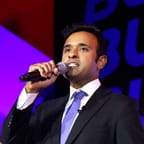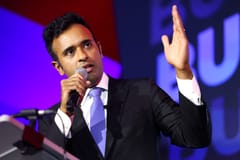
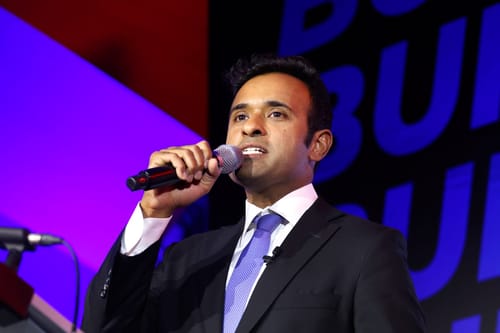

For months, Vivek Ramaswamy has tried to make the Ohio governor’s race about affordability, taxes, crime and Amy Acton’s record during the COVID-19 pandemic.
A federal judge just handed Democrats a very different closing argument.
On Aug. 25, U.S. District Judge Julien Xavier Neals refused to dismiss the central whistleblower claims brought by former Strive Asset Management executive Joyce Rosely, who alleges Ramaswamy demanded that employees violate securities laws, received their repeated objections and participated in firing her afterward.
Ramaswamy and Strive deny the allegations.
But politically, the timing could hardly be worse.
The Republican nominee is heading into the final stretch of a race that has settled into a statistical dead heat, while Democratic groups are already spending heavily to portray his business career not as the qualification he says it is, but as evidence that he cannot be trusted.
Now a federal court has ensured that one of the most serious disputes from that business career will remain alive while Ohioans are deciding who should run the state.
A tied race leaves little room for a new liability
Ramaswamy is not entering the fall with a commanding Republican advantage.
The latest public polling has repeatedly shown the race within a few points. A mid-August Wedgewood Polls survey had Democrat Amy Acton ahead 47% to 46%, while a Fox News survey conducted around the same period had Ramaswamy ahead 50% to 48%. A July Siena College survey found the race tied at 47%.
RealClearPolling’s current average puts the race essentially even, with Acton holding only a fractional advantage. 270toWin’s polling table shows the same pattern: neither candidate has established a durable lead.
The Statehouse News Bureau reported Aug. 29 that the contest has entered an increasingly negative phase as both campaigns race to define the other candidate before the election.
That is precisely the environment in which an adverse court ruling can matter most.
There is no post-ruling public poll yet showing that the Strive case has changed voters’ minds. But in a race separated by roughly a point in polling averages, Ramaswamy does not need a scandal to move 10 points to create a serious political problem.
He needs it to reinforce doubts among a small number of persuadable voters.
Democrats were already building a ‘conman’ case
The Strive ruling did not create the political attack on Ramaswamy’s business career.
It landed directly on top of one that was already being built.
On Aug. 19, Ohioans for Lower Costs, a group backed by the Democratic Governors Association, launched an advertisement literally titled “Conman.”
The spot attacks Ramaswamy over his pharmaceutical business record, including the Alzheimer’s drug at the center of separate scrutiny of his former company Axovant.
The Democratic Governors Association had already been calling Ramaswamy a “pathological scammer” in an Aug. 12 attack centered on his biotech record.
The Ohio Democratic Party has adopted similar language.
Its recent releases have repeatedly described Ramaswamy as a “scammer,” including an Aug. 28 campaign roundup accusing him of a series of “lies and scams,” and a Sept. 1 release attacking the accuracy of one of his campaign ads.
That matters because the Strive lawsuit fits the same narrative without requiring Democrats to invent a new line of attack.
A former senior executive says Ramaswamy personally demanded conduct she believed violated securities laws.
She says she and another executive repeatedly objected.
Both were fired.
Ramaswamy tried to get the individual whistleblower claim against him dismissed.
The judge refused.
The political frame Democrats have spent August constructing — Ramaswamy as a businessman whose record deserves scrutiny rather than admiration — just acquired a fresh federal-court news peg.
The ruling strikes directly at Ramaswamy’s central qualification
For another candidate, an employment lawsuit involving a former company might be easier to compartmentalize.
For Ramaswamy, business is the résumé.
His own campaign biography describes him as “one of the most successful business leaders of his generation” and says he is running on a “business-grounded agenda.”
The campaign’s homepage calls him an “accomplished business leader” who spent his career “turning bold ideas into real results.”
Ramaswamy has repeatedly made the same argument himself: he is an entrepreneur rather than a conventional politician, and the skills he used building companies are the skills he would bring to state government.
That makes scrutiny of how those companies were run unusually relevant to his campaign.
The Strive case does not attack an incidental chapter of Ramaswamy’s biography.
It attacks the chapter he is presenting as evidence that he should be governor.
The allegations are no longer just a 2023 headline
Rosely’s lawsuit was first reported nationally three years ago.
At the time, Forbes reported that Rosely accused Ramaswamy and Strive co-founder Anson Frericks of pressuring employees to violate securities laws.
Another former Strive employee, John Phillips, filed a separate lawsuit containing overlapping accusations about pressure to violate securities rules and alleged misrepresentations about the company’s finances.
Those stories largely disappeared from the political conversation as Ramaswamy moved through his presidential campaign and then into the race for Ohio governor.
The Aug. 25 decision changed that.
Neals did not find that Ramaswamy actually violated securities laws. At the motion-to-dismiss stage, the court accepts well-pleaded allegations as true and determines whether they state a claim that can proceed.
But Ramaswamy specifically asked the court to conclude that Rosely had not alleged enough to keep him personally in the whistleblower case.
The judge rejected him.
When Ramaswamy’s lawyers argued there were no allegations showing he had been directly involved in Rosely’s firing, Neals wrote:
“The Court disagrees.”
The judge pointed to Rosely’s allegations that Ramaswamy supervised her, demanded that she and colleague Jeff Nye violate securities laws, heard their objections and participated in the decision to fire her.
“Taking her allegations as true, Plaintiff sufficiently states a CEPA claim against Ramaswamy,” Neals wrote.
That ruling turns what Ramaswamy could previously dismiss politically as an old employee lawsuit into an active federal case moving forward during his gubernatorial campaign.
The details are more damaging than the old headlines
The renewed scrutiny is also arriving with details that received relatively little attention when the case was first filed.
As TiffinOhio.net reported after reviewing more than 150 pages of court filings, Rosely identified five categories of conduct she says Ramaswamy and Frericks demanded.
She alleges employees were pressured to use noncompliant sales materials promising future investment returns, engage in sales activity before securities licenses had transferred to Strive, distribute materials before compliance approval, put unregistered workers on calls with prospective clients and solicit business for products before those products were registered and trading.
Rosely also alleges Ramaswamy personally engaged in what she considered unlawful securities-sales activity on Twitter.
Ramaswamy and Strive deny those allegations and argue Rosely failed to identify sufficient dates, statutes and specific conversations.
But another piece of the case could prove politically potent: Rosely says she and Nye were the two workers who repeatedly objected to the alleged conduct.
Strive fired both of them on the same day.
That fact played a central role in the federal court’s decision to allow the retaliation claim to proceed.
“Firing both objecting employees is enough to support the inference that Defendants fired Plaintiff because she objected,” Neals wrote.
Ramaswamy now has to fight two campaigns at once
The practical political problem is not merely that Ramaswamy has another negative headline.
It is that the case competes directly with the message his campaign wants voters hearing.
Ramaswamy’s campaign has spent millions trying to define the election around lower costs, property taxes, crime and education. In March, the campaign announced a $10 million statewide advertising campaign built around affordability and public safety.
Now every day spent answering questions about whether he pressured employees to violate securities laws is a day spent talking about something else.
And because Democrats had already begun airing “Conman,” they do not need to persuade voters that the new lawsuit belongs in a separate category.
They can simply add it to the pile.
Pharmaceutical profits.
“Pump-and-dump” accusations.
A former executive alleging pressure to break securities laws.
A second former employee making overlapping allegations.
A federal judge refusing to dismiss the whistleblower case against Ramaswamy personally.
Individually, Ramaswamy has defenses to each accusation.
Collectively, they threaten the brand he has spent his political career selling.
The calendar makes the problem harder to outrun
The lawsuit also reentered the campaign at a point when time is becoming scarce.
Early voting is only weeks away.
That leaves Ramaswamy far less time to allow an unfavorable story to fade before voters begin making decisions.
And the case itself is not disappearing.
Neals’ Aug. 25 order allowed Rosely to amend the three claims that were dismissed without prejudice. Her attorneys have already requested and received additional time to file that amended pleading.
The two central whistleblower claims against Strive and against Ramaswamy and Frericks personally remain alive regardless.
In other words, this is not a one-day controversy created by an old complaint being rediscovered.
The docket is active.
The plaintiff is preparing another filing.
And the surviving case is moving toward its next phase at the same time the governor’s race moves toward its final one.
No evidence yet of voter movement — but the vulnerability is obvious
There is an important distinction between a damaging political development and proof that voters have already punished a candidate for it.
No public poll released since the Aug. 25 ruling has yet measured whether the case has changed support for Ramaswamy.
His campaign also retains enormous financial resources, a Republican-leaning statewide electorate and the endorsement of President Donald Trump.
But this is no longer the kind of Ohio governor’s race in which a Republican can assume a comfortable margin.
Axios reported in August that Ohio’s marquee races had become unexpectedly difficult for Republicans, while Axios Cleveland described the governor’s race as one of several toss-up contests emerging amid broad voter dissatisfaction.
In a race like that, the political significance of the Strive decision is not that it proves Ramaswamy will lose.
It is that the ruling lands directly on an existing weakness, reinforces an attack already being broadcast to voters and keeps the conversation centered on the part of Ramaswamy’s biography his campaign most needs to protect.
The business record is now part of the closing argument
Ramaswamy has spent his campaign telling Ohioans that his success in business is evidence he can successfully run state government.
Democrats have increasingly argued that voters should look more closely at how that success was built.
The Aug. 25 ruling ensures that debate will not remain confined to old clips, opposition research or attack advertisements.
There is now an active federal whistleblower case in which a former senior executive alleges Ramaswamy personally pushed employees toward securities-law violations and helped fire her after she objected.
Ramaswamy tried to get himself out of that case.
The judge said no.
With the governor’s race effectively tied and voting approaching, a three-year-old lawsuit has suddenly become a 2026 campaign problem.
And the part of Vivek Ramaswamy’s résumé he has spent years presenting as his greatest political asset is becoming one of the central liabilities he will have to defend before Ohioans make their choice.