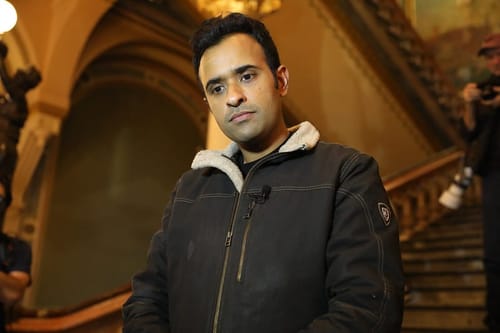

“How is Vivek Ramaswamy not in prison?” That was the question posed in a viral post about Ramaswamy’s business career in late 2024, when critics began recirculating the story of how the future Ohio gubernatorial candidate made his first enormous fortune.
The outrage centered on Axovant Sciences, the biotechnology company Ramaswamy built around an experimental Alzheimer’s drug that GlaxoSmithKline had already tested unsuccessfully four times. Ramaswamy acquired the rights for $5 million upfront, put the drug at the center of what became the biggest biotechnology IPO in U.S. history at the time, and watched Axovant briefly reach a valuation of about $2.8 billion.
Meanwhile, Ramaswamy sold nearly $40 million in shares of Axovant’s parent company, Roivant Sciences, during the same year the Axovant story was electrifying investors. Two years later, the Alzheimer’s drug failed its decisive Phase 3 trial. Axovant shares plunged more than 70% in a single day.
Yale School of Management professor Jeffrey Sonnenfeld later accused Ramaswamy of cashing out while publicly hyping Axovant and wrote that the sequence “almost resemble[d] a classic pump-and-dump scheme.”
That controversy alone raises obvious questions about the businessman now asking Ohioans to make him governor. But in 2026, the Axovant story is no longer the whole story.
New reporting has exposed how Ramaswamy’s mother, while working for Axovant for a $250,000 salary and holding hundreds of thousands of deeply discounted stock options, helped reanalyze the failed clinical data into results the company presented more favorably to investors. A federal judge this month allowed a whistleblower claim against Ramaswamy to continue after a former executive at his next company alleged that he instructed employees to violate securities laws. His gubernatorial campaign spent more than half a million dollars through a credit card without initially disclosing the individual purchases, then amended its reports after state auditors flagged the filings. The campaign has also spent nearly $560,000 leasing an aircraft through a company tied directly to Ramaswamy.
And while campaigning as an enemy of elite privilege and political self-dealing, Ramaswamy is proposing tax and cryptocurrency policies that stand to benefit people with financial portfolios very much like his own.
The $5 million drug that became a $2.8 billion company
Ramaswamy was a hedge-fund investor before he became the biotech entrepreneur whose fortune would later bankroll his political career. In late 2014, his company acquired worldwide rights to an experimental Alzheimer’s drug then known as RVT-101 and later renamed intepirdine.
The price was startlingly small: a $5 million upfront payment to GlaxoSmithKline. Axovant later paid another $5 million and would have owed additional milestone payments and royalties if the drug succeeded, according to the company’s SEC filings.
The reason Glaxo was willing to let it go was no secret. The drug had already missed its primary endpoint in four clinical trials, according to Forbes. Three trials tested the drug by itself. A fourth tested it alongside donepezil, an existing Alzheimer’s treatment, and also failed one of its principal statistical tests.
Ramaswamy saw something Glaxo did not — or at least convinced investors that he did.
Axovant was formed in October 2014. Eight months later, it went public.
On June 11, 2015, Axovant shares debuted at $15. The company raised hundreds of millions of dollars, and the stock jumped roughly 90% on its first trading day. A company that had not existed the previous summer was suddenly worth about $2.8 billion, according to Forbes.
The company’s later SEC filing records $362.3 million in gross IPO proceeds from the sale of 24.15 million shares.
Axovant had no approved drugs. It had generated no product revenue. Its enormous valuation rested overwhelmingly on the prospect that Ramaswamy was right about the Alzheimer’s drug Glaxo had abandoned.
Asked by Forbes at the time how a drug acquired for $5 million could suddenly support a multibillion-dollar valuation, Ramaswamy called it a “great drug candidate” and said approval could make a “huge difference” for patients.
Ramaswamy cashed out nearly $40 million as the hype peaked
The most explosive part of the Axovant story is not simply that Ramaswamy made a risky scientific bet and lost. It is what happened to his own finances while investors were buying the story.
Axovant was controlled by Ramaswamy’s holding company, Roivant Sciences. Ramaswamy did not personally dump publicly traded Axovant shares. He sold part of his ownership in Roivant.
His own tax records show that he sold nearly $40 million worth of Roivant stock in 2015, the same year Axovant exploded onto public markets.
Sonnenfeld, a Yale professor who has spent years examining Ramaswamy’s business record, laid out the transaction in a 2023 Fortune commentary.
Ramaswamy’s spokesperson initially told Sonnenfeld that the suggestion Ramaswamy made money from Axovant’s failure was false. The campaign then acknowledged the Roivant sale, arguing that Ramaswamy and other shareholders sold a small portion of their stakes to make room for an outside investor.
Sonnenfeld was unsparing.
He wrote that Ramaswamy was “busy cashing out while shamelessly hyping Axovant’s prospects in media interviews,” describing the sequence as “almost resembling a classic pump-and-dump scheme.”
Two years after the IPO, the scientific verdict arrived.
Axovant’s 1,315-patient Phase 3 MINDSET trial found that intepirdine failed both of its co-primary efficacy endpoints. The drug did not meaningfully improve either cognition or patients’ ability to perform daily activities compared with placebo. Axovant announced the failure on Sept. 26, 2017, and its stock collapsed by roughly 70%.
Ramaswamy called it the “single greatest failure” of his career.
He had already made his money.
His mother helped turn failed data into a better sales pitch
Axovant’s investor pitch did not rely only on Ramaswamy’s confidence. The company went back into Glaxo’s old clinical-trial data and found more favorable ways to analyze it.
One of the people doing that work was Ramaswamy’s mother.
Axovant hired Geetha Ramaswamy as vice president of medical and scientific strategy. According to company filings reviewed in an August 2026 Oligarch Watch investigation, she received an annual salary of $250,000 and an option to purchase 262,500 Axovant shares at 90 cents apiece.
She co-authored analyses that went back through the same 684-patient Glaxo trial that had failed its primary objective.
One was a “responder analysis,” which divided subjects into responders and non-responders. Another was a “completer analysis,” which examined patients with complete data at each study visit rather than the full randomized population.
Those methods produced a much more attractive picture of the drug.
The completer analysis reported statistically significant improvements on certain cognition and daily-function measures. Axovant then included the favorable data in securities filings and publicity supporting its decision to move the drug into Phase 3.
Days before Axovant’s IPO, the company told investors in an SEC filing that the old Glaxo data supported its belief that intepirdine had the potential to become a “best-in-class” Alzheimer’s treatment. In July 2015, Axovant cited the reanalysis to announce “statistically significant benefits.”
The methodology drew skepticism even then. Chardan analyst Gbola Amusa rated Axovant a sell and criticized the completer analysis as less scientifically rigorous and less relevant to regulators. Medical statisticians have long warned that excluding patients who drop out of clinical trials can introduce bias into the results.
The Phase 3 trial eventually tested the proposition on a fresh group of more than 1,300 patients.
It failed.
TiffinOhio.net reported earlier this month that the California State Teachers’ Retirement System was among the investors burned by the collapse. Its reported Axovant position fell from roughly $1.23 million to about $68,000.
Ramaswamy, meanwhile, had reported tens of millions of dollars in capital gains during the year of the IPO.
A federal judge just kept another securities-law controversy alive
Axovant was not the last Ramaswamy company to produce accusations involving securities laws.
After leaving biotech management, Ramaswamy co-founded Strive Asset Management, selling it as an “anti-woke” alternative to firms such as BlackRock. Former Strive executive Joyce Rosely later sued Strive, co-founder Anson Frericks and Ramaswamy.
Her complaint says Ramaswamy and Frericks began demanding “almost immediately” after she joined Strive that she violate securities laws. Rosely says she and another employee repeatedly objected to those demands and to securities-law violations they believed Ramaswamy and Frericks were committing themselves.
On Aug. 25, U.S. District Judge Julien Xavier Neals refused to dismiss Rosely’s whistleblower claim against Ramaswamy under New Jersey’s Conscientious Employee Protection Act.
The court summarized the allegations against Ramaswamy directly: Rosely says he instructed her to violate securities laws, personally engaged in conduct she believed violated securities laws, exercised supervisory authority over her and received her objections in meetings before she was fired.
The judge ruled that those allegations state a legally sufficient whistleblower claim against Ramaswamy and allowed that portion of the case to proceed. Other discrimination-related counts were dismissed.
Three years after Ramaswamy launched Strive as another example of his supposed business acumen, one of its former senior executives is now pursuing a federal whistleblower case accusing him personally of pressuring workers to break securities rules.
His Ohio campaign put $509,473 behind the words ‘credit card payment’
The financial questions followed Ramaswamy into his campaign for governor.
From April 2025 through June 2026, his campaign reported $509,473 in credit-card spending without initially itemizing the underlying purchases. Instead of telling voters who was paid and what the campaign bought, reports listed large monthly payments to American Express.
Ohio law requires campaigns to disclose individual expenditures and their purposes. The Ohio Capital Journal reported in June that Ramaswamy’s campaign had effectively placed a wall around more than half a million dollars in spending.
This was not a campaign unfamiliar with itemized credit-card reporting. During Ramaswamy’s presidential run, his federal campaign separately reported individual purchases made by credit card.
Ohio auditors eventually flagged the gubernatorial campaign’s filings. The campaign amended them in July, and the Secretary of State’s Office said the reports had been corrected.
The new disclosures showed where the money had gone: printing, mailing, events, transportation, hotels, software, tolls and other campaign expenses. Some individual charges ran into tens of thousands of dollars.
The details became public only after the original filings obscured them and state auditors demanded corrections.
Nearly $560,000 in campaign money went to a jet company tied to Ramaswamy
The corrected credit-card reports were followed by another striking campaign-finance revelation.
Ramaswamy’s campaign has spent nearly $690,000 leasing aircraft since he began running for governor, according to campaign-finance records reviewed by the Ohio Capital Journal.
Nearly $560,000 went to V Leasing LLC.
The address listed for V Leasing in campaign records is a house owned by Ramaswamy. His state financial disclosure lists V Leasing among his business interests, and reporting by Signal Ohio identified the company as the owner of the private aircraft he uses.
Campaign records show another roughly $130,000 went to a separate aircraft-leasing company.
Ramaswamy has used private aircraft not merely for cross-country campaign travel but for short hops between Ohio cities. Flight records have documented trips between Columbus and Cleveland or Akron that can be driven in roughly two hours.
Ramaswamy has personally loaned more than $25 million to his gubernatorial campaign. The arrangement produces a remarkable financial loop: Ramaswamy’s fortune finances his campaign, and his campaign reports hundreds of thousands of dollars in payments to a company tied to Ramaswamy for aircraft use.
The anti-affirmative-action candidate took an immigrant-only fellowship while already a millionaire
Ramaswamy’s political brand depends heavily on his attacks against affirmative action, DEI and institutions that distribute opportunities based in part on identity.
His own résumé contains exactly the kind of identity-based advantage he now condemns.
In 2011, Ramaswamy received a Paul & Daisy Soros Fellowship for New Americans while attending Yale Law School. The program exists for immigrants and the children of immigrants. Ramaswamy, who was born in Cincinnati to parents who immigrated from India, qualified through his family’s immigrant status.
He was also already making extraordinary money.
Ramaswamy’s released tax returns show he reported $2.25 million in income in 2011, the year he accepted the fellowship, after reporting another combined $1.17 million during the previous three years.
Ramaswamy later said he accepted the fellowship when he “didn’t have the money” for law school.
Then, shortly before launching his presidential campaign, Ramaswamy paid someone to remove the fellowship from his Wikipedia page.
A paid editor disclosed that Ramaswamy had hired him to make changes to the biography. On Feb. 9, 2023, the editor removed the Soros fellowship and Ramaswamy’s participation in Ohio’s COVID-19 Response Team. Ramaswamy announced his presidential candidacy less than two weeks later, according to Mediaite.
The fellowship was eventually restored by other Wikipedia editors.
Ramaswamy had already collected the money.
His tax agenda would benefit fortunes like his — including his own
Ramaswamy’s financial interests have not stopped intersecting with his political agenda now that he is running for governor.
One of his signature proposals is eliminating Ohio taxation of capital gains as a step toward abolishing the state income tax entirely.
Ramaswamy knows capital gains well. His own released tax returns show approximately $211 million in capital gains across just two years — about $37 million in 2015 and roughly $174.5 million in 2020.
A nonpartisan Ohio Legislative Service Commission analysis of a legislative proposal to exempt capital gains found 81.6% of the benefit would flow to Ohioans earning more than $200,000. The proposal would reduce state revenue by hundreds of millions of dollars annually.
As TiffinOhio.net previously reported, the candidate demanding that Ohio stop taxing capital gains is himself precisely the kind of taxpayer who can generate nine-figure capital gains.
Ramaswamy has spent years selling himself as someone wealthy enough to be immune from political corruption. His tax agenda demonstrates the other side of enormous personal wealth: government decisions worth very little to an ordinary wage earner can be worth millions to someone with Ramaswamy’s portfolio.
He backs opening Ohio public money to crypto while holding millions in a bitcoin company
The same problem appears in Ramaswamy’s cryptocurrency agenda.
Ramaswamy has praised Ohio House Bill 18, dubbed the Ohio Strategic Cryptocurrency Reserve Act. The legislation would permit the state treasurer to put certain state funds into digital assets and rewrite investment laws governing Ohio’s five public retirement systems to allow cryptocurrency-linked exchange-traded products.
Ramaswamy is not merely an ideological supporter of cryptocurrency. He has substantial personal money riding on the industry.
A securities filing analyzed by TiffinOhio.net showed Ramaswamy beneficially owned roughly 5.7 million shares of Strive, worth approximately $69 million at the market price used in the analysis.
Strive has transformed itself from Ramaswamy’s “anti-woke” asset-management startup into a publicly traded bitcoin treasury company. Its corporate strategy now depends heavily on bitcoin, and Ramaswamy’s state ethics disclosure separately lists his personal holdings in bitcoin and ether.
The candidate pushing Ohio government toward greater cryptocurrency investment is already heavily invested in the same financial ecosystem.
From Alzheimer’s patients to Ohio voters, Ramaswamy is still selling the businessman
Ramaswamy’s campaign does not ask voters to overlook any of this because his business history is irrelevant. It does the opposite. His wealth, investing background and supposed talent for spotting opportunities are central to his argument that Ohio should hand him control of state government.
That makes the record behind the fortune essential.
Ramaswamy took a drug Glaxo had tested unsuccessfully four times and bought the rights for $5 million upfront. Eight months after creating Axovant, he took the company public. Its valuation exploded to nearly $3 billion. He publicly promoted the drug’s potential while selling nearly $40 million of stock in parent company Roivant. His mother, employed by Axovant and holding cheap stock options, helped produce favorable reanalyses of the old failed data. The drug failed again when subjected to the decisive Phase 3 test, and shareholders watched Axovant collapse.
That is the episode Sonnenfeld said almost resembled a classic pump-and-dump.
Ramaswamy then built Strive, where a former executive says he personally demanded securities-law violations and retaliated against her when she objected. A federal judge has now allowed her whistleblower claim against him to proceed.
His Ohio campaign initially buried more than $500,000 in individual purchases behind generic American Express payments until state auditors forced corrected disclosures. The campaign has reported nearly $560,000 in aircraft payments to a company tied to Ramaswamy. He accepted an immigrant-status fellowship while earning millions, then paid to remove it from Wikipedia before entering national politics. He wants Ohio to eliminate a tax on the kind of enormous capital gains that made him rich and backs expanding public exposure to cryptocurrency while holding a multimillion-dollar stake in a bitcoin company.
The question that went viral two years ago was deliberately provocative: “How is Vivek Ramaswamy not in prison?”
Ohio voters do not have to decide whether Ramaswamy belongs in prison. They do have to decide whether this is the business record they want in the governor’s office.
Ramaswamy has spent a decade selling investors, customers and voters on one big idea after another. The Alzheimer’s drug changed. The company changed. The investment pitch changed. The political pitch changed.
The man collecting the upside has remained remarkably consistent.