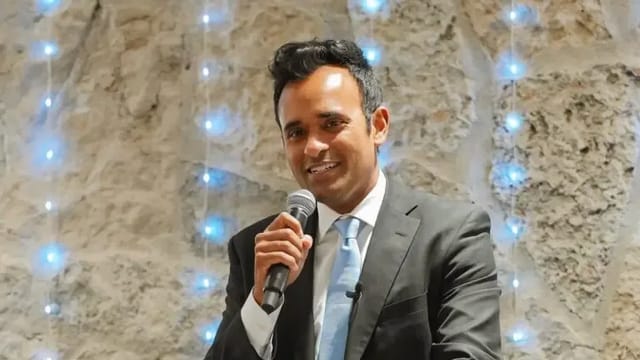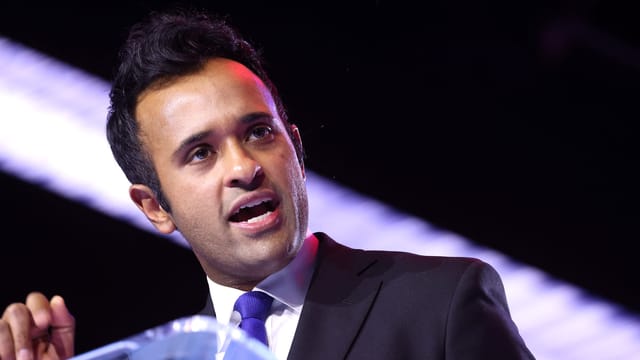

Vivek Ramaswamy has made eliminating Ohio’s tax on capital gains a centerpiece of his campaign for governor. Tax returns the Republican released during his 2023 presidential run show he personally reported roughly $211 million in such gains across two years – the precise category of income his proposal would exempt from state tax.
The returns, which Ramaswamy made public when he ran for the GOP presidential nomination, report $37 million in capital gains in 2015 and $174.5 million in 2020. Together, the two years total about $211.6 million. Yale’s Jeffrey Sonnenfeld and Steven Tian, writing in Fortune in 2023, reviewed the same filings and reported essentially the same figures, noting the 2020 windfall was tied to the sale of stakes in his holding company, Roivant, to Japan’s Sumitomo.
Ramaswamy has been explicit about where ending the capital gains tax fits in his agenda. “That’s part of the first step to eventually get to zero income taxation,” he told News 5 Cleveland in a June 2025 interview. “The beauty of getting rid of capital gains taxation in Ohio is the fact that actually we don’t even as a state derive that much revenue from it and yet it is a great point to draw other entrepreneurs and capital owners to the state.”
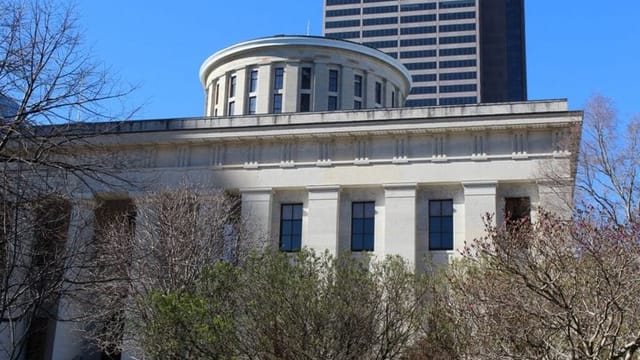
Ohio does not levy a separate capital gains tax. It treats capital gains as ordinary income, taxed since the start of 2026 at a flat 2.75% on income above $26,050 under the budget bill that consolidated the state’s former graduated brackets. The idea Ramaswamy has promoted – fully exempting capital gains from state and municipal income tax – has been introduced in the legislature as House Bill 617, the Capital Gains Tax Repeal Act, sponsored by Rep. Tom Young of Washington Township. The measure remains in committee and has not become law.
The Legislative Service Commission, the legislature’s nonpartisan research arm, estimated in its fiscal analysis of House Bill 617 that repeal would cost the state between $615 million and $645.6 million in tax year 2027, growing to between $647.8 million and $679.8 million the following year. Capital gains revenue feeds Ohio’s General Revenue Fund, which supports public schools, Medicaid and other core services.
A separate LSC memo obtained by the Statehouse News Bureau found the benefit would be concentrated at the top: 81.6% of it would go to Ohioans earning more than $200,000 a year, while those making under $100,000 – the large majority of the state – would receive 7.3%.
Against that distribution, Ramaswamy’s own filings place him among the Ohioans who would gain the most. Applying the current 2.75% rate to the capital gains reported on his two released returns yields roughly $5.8 million – about $1 million on the 2015 gains and $4.8 million on the 2020 gains. The figure is illustrative: Ohio’s rates were higher in 2015 and 2020, so the actual state tax he paid on those gains at the time was larger. It is offered as a measure of the scale of capital gains income the repeal would shield from state tax going forward.
That income stream has continued. Ramaswamy’s financial disclosure filed April 6 with the Ohio Ethics Commission reported more than $1.1 million in dividends and capital gains in 2025, including $768,968 from a single sale of BlackBerry stock – again, the category of income his proposal would exempt.
Supporters of the repeal argue the lost revenue would be recovered through growth. Young, the bill’s sponsor, has said the static cost estimates rely on what he called a “stagnant approach” and that cutting the tax would draw investment to the state, pointing to past income-tax reductions. “We cut the income tax. What did we see? Increase in revenue,” he told reporters. Ramaswamy has framed the move as a way to keep entrepreneurs and capital in Ohio. Policy Matters Ohio, a progressive research group, counters that income-tax cuts since 2005 have cost the state billions a year without the promised economic gains, and it has called the capital gains exemption a costly benefit weighted toward the wealthiest residents.
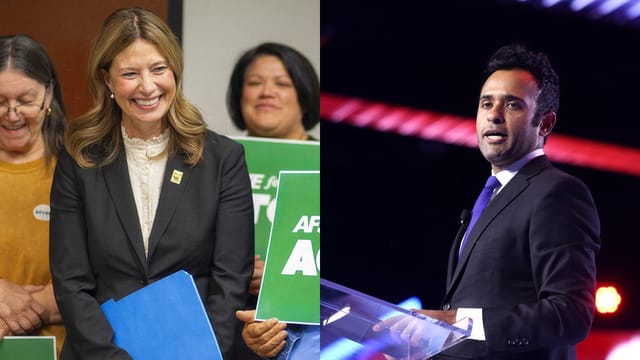
Ramaswamy faces Democrat Amy Acton in the general election on Tuesday, Nov. 3.