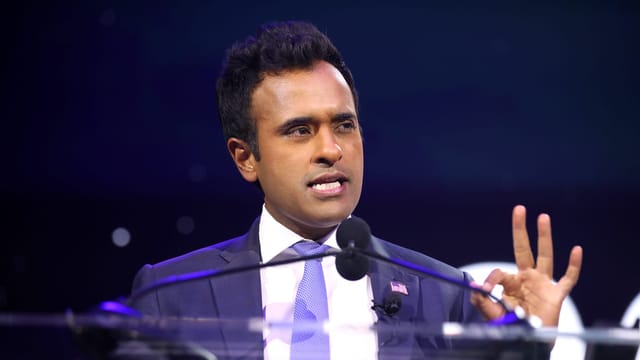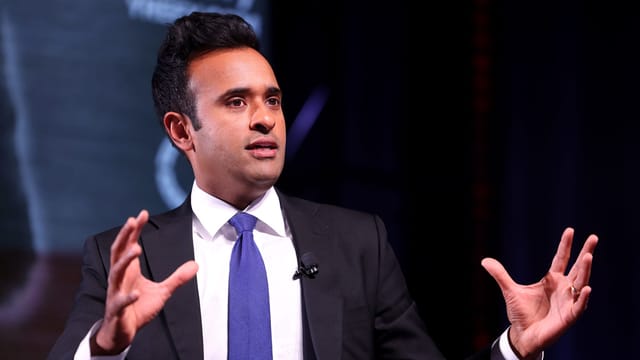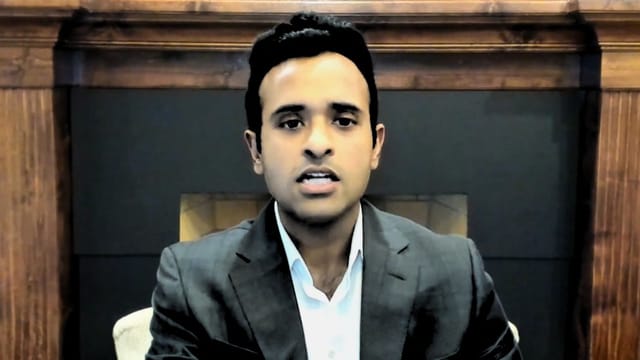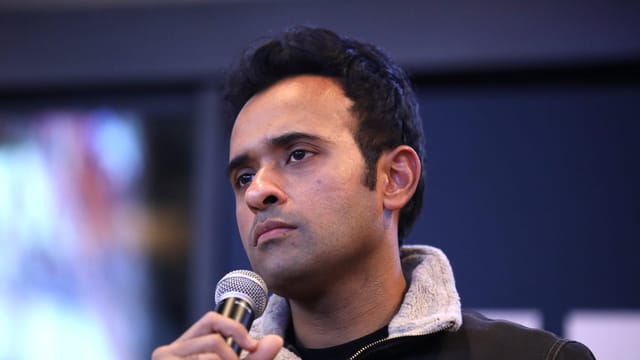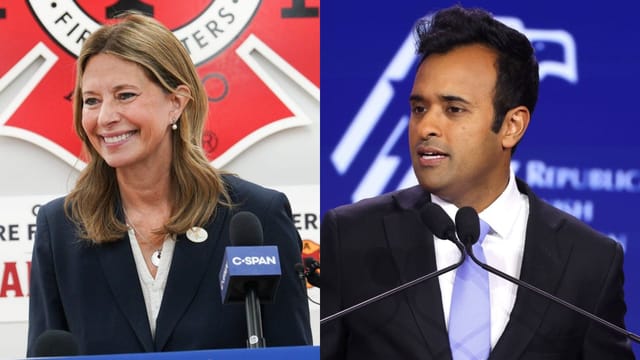

Vivek Ramaswamy asked a federal judge to throw out the whistleblower claim against him.
His lawyers argued there were “no allegations in the Complaint” showing the Republican nominee for Ohio governor was directly involved in firing Joyce Rosely, a former senior executive at Strive Asset Management.
U.S. District Judge Julien Xavier Neals answered in three words:
“The Court disagrees.”
In a 24-page opinion issued Aug. 25, Neals laid out the allegations that kept Ramaswamy personally in the case: Rosely says he supervised her, demanded that she and another employee violate securities laws, received their repeated objections and participated in the decision to fire her after she refused.
“Taking her allegations as true, Plaintiff sufficiently states a CEPA claim against Ramaswamy,” Neals wrote.
That sentence revived a lawsuit that spent years largely outside the political spotlight while Ramaswamy moved from Strive into presidential politics and then became the Republican nominee for governor of Ohio.
The court record goes far beyond the shorthand description of a “securities-law whistleblower case.” TiffinOhio.net reviewed the original complaint, both sides’ briefs, a federal magistrate judge’s recommendation, Ramaswamy’s objections, Neals’ Aug. 25 ruling and the filings that followed.
Taken together, they describe a senior Strive executive who says she was ordered to cross securities-law lines almost as soon as she arrived, repeatedly objected directly to Ramaswamy, received a positive performance review, and was then fired alongside the only other employee she says joined her securities-law objections.
Ramaswamy, Strive and co-founder Anson Frericks deny Rosely’s allegations. Their own court filings describe her as an underperforming employee terminated during a legitimate reorganization and attack the complaint as vague, conclusory and unsupported.
A federal magistrate judge recommended allowing the central whistleblower claims to proceed. After Ramaswamy and the other defendants objected, the district judge reached the same result.
What the judge actually decided
Neals was not deciding whether Ramaswamy violated securities laws or retaliated against Rosely. He was deciding whether Rosely’s complaint alleged enough facts for those claims to proceed.
At the motion-to-dismiss stage, a court accepts well-pleaded factual allegations as true and asks whether they state a plausible legal claim.
On the core whistleblower theory, Neals said they did.
He allowed two central claims to continue: Count I, Rosely’s whistleblower-retaliation claim against Strive under New Jersey’s Conscientious Employee Protection Act, and Count IV, which seeks to hold Ramaswamy and Frericks individually liable for that alleged retaliation.
The court’s Aug. 25 order dismissed three other claims involving age discrimination and retaliation tied to a separate internal complaint without prejudice, meaning Rosely can amend them.
The ruling therefore did not validate every accusation in the lawsuit. It rejected Ramaswamy’s argument that the whistleblower case against him was too thin to proceed.
Rosely says the pressure began “almost immediately”
Strive hired Rosely in August 2022 as executive vice president and co-head of institutional sales and distribution. She worked remotely from New Jersey for the Dublin, Ohio-based investment firm Ramaswamy co-founded with Frericks.
Rosely’s complaint says both men exercised supervisory authority over her.
Then came the demands.
“Almost immediately” after starting work, Rosely alleges, Ramaswamy and Frericks directed her to violate securities laws.
Her complaint identifies five categories of conduct, which are also detailed in Rosely’s federal court brief:
-
using noncompliant sales material that improperly promised future investment returns;
-
having new employees engage in sales activity before their securities licenses had been transferred to Strive;
-
sending sales materials before they had been approved by Strive’s outside compliance vendor, Foreside;
-
having unregistered employees discuss Strive securities products with prospective clients by telephone; and
-
creating deal books and soliciting business for investment products before those products were registered and actively trading.
Rosely also alleges that Ramaswamy and Frericks personally engaged in securities-sales activity without licenses. She says Frericks called and emailed individual investors while Ramaswamy engaged in what she considered unlawful securities-sales activity on Twitter.
Rosely says she and Jeff Nye, Strive’s executive vice president and head of wealth management distribution, repeatedly objected to the conduct in conversations with both Ramaswamy and Frericks.
Those five allegations appear in the original complaint and are repeated nearly verbatim in the defendants’ own objections filed in federal court.
Ramaswamy’s lawyers attacked them as too vague. They argued Rosely failed to identify dates, exact conversations, specific securities statutes or which alleged instructions came personally from which co-founder.
The core whistleblower claim survived.
The two employees who objected were both fired
The retaliation theory does not rest only on a complaint followed months later by a firing.
Rosely says she and Nye were the two employees who repeatedly objected to the alleged securities-law conduct.
On March 21, 2023, Strive fired both of them.
That same day, Strive also fired senior vice presidents John Phillips and J.P. Towey.
The company told Rosely it was “reorganizing” and there was “no longer a position” for her.
Ramaswamy and Strive made the passage of time a centerpiece of their effort to dismiss the whistleblower claim. Rosely says the securities-law pressure began soon after she joined Strive in August 2022. She was fired roughly seven months later.
The defendants argued that seven months was too long to support an inference of retaliation.
Magistrate Judge Cathy Waldor rejected that argument in her July 2024 report and recommendation. She focused on another allegation: Strive fired the other employee who allegedly engaged in the same protected activity at the same time.
Neals reached the same conclusion.
“According to Plaintiff, Defendants asked her and Nye to break the law; Plaintiff and Nye repeatedly refused to do so and complained to management; and Defendants fired Plaintiff and Nye seven months later,” Neals wrote.
Then came the key finding:
“Firing both objecting employees is enough to support the inference that Defendants fired Plaintiff because she objected.”
A positive review, then “we had to do this”
Rosely’s complaint says her sales numbers were strong and that she received a positive written performance evaluation in February 2023, about one month before Strive fired her. Her attorneys highlighted the evaluation in their brief opposing dismissal.
Strive later described the termination differently. In federal court, Ramaswamy and the company said Rosely was fired “for underperformance” as part of a broader reorganization.
The defense argued in its February 2024 reply brief that the positive review weakened Rosely’s retaliation case: an employer preparing to fire someone for complaining, they said, would not logically give that employee a favorable evaluation first.
Rosely’s account puts the same facts in a different sequence. She says she repeatedly objected to alleged securities-law violations, received a positive review, and then was abruptly fired alongside the only other employee she says joined those objections.
The next day, according to Rosely, Ramaswamy appeared at Strive’s Dublin office to reassure the remaining employees about their jobs.
She says he referred to the four dismissals and told employees:
“we had to do this”
Ramaswamy’s lawyers argued that the statement did not show he personally participated in Rosely’s firing.
In their objections to the magistrate judge’s recommendation, they argued that the statement fell “far short” of plausibly showing Ramaswamy played a role in Rosely’s specific termination or acted with a retaliatory motive.
Judge Neals rejected that argument.
The judge pointed to the full set of allegations against Ramaswamy: that he supervised Rosely, demanded that she and Nye violate securities laws, received their repeated objections and participated in the decision to terminate her.
Ramaswamy told the court the complaint did not plausibly connect him to Rosely’s firing.
“The Court disagrees,” Neals wrote.
The other allegations — and what did not survive
Rosely’s lawsuit contains two other major storylines, but neither survived the Aug. 25 ruling in its current form.
One involves an internal complaint about alleged sexual misconduct by Strive Chief Operating Officer Ben Pham.
Rosely says that in January 2023, Nye told her a newly hired employee had reported that Pham was pursuing her romantically in an “aggressive manner.” Rosely says she had traveled with the two and found their interactions “very uncomfortable to observe.”
She brought the issue to Strive’s head of people strategy, Laura Brady, and says Brady told her to:
“keep an eye on them and report back”
Rosely says she later raised the issue with Frericks, who told her it was none of his business, and confronted Pham directly, who told her to mind her own business.
Two months later, Rosely was fired.
Those allegations are detailed in Rosely’s court filing.
They formed the basis of a separate retaliation claim under New Jersey’s Law Against Discrimination. Neals dismissed that claim without prejudice, finding the complaint did not plead enough to establish the required causal link.
Rosely also alleged age discrimination. She was 52 when Strive fired her. Nye was 54 and Phillips was 53. Her complaint says the three were the only Strive employees age 50 or older at the time. Towey, the fourth employee fired that day, was 40.
Waldor initially recommended allowing the age claim to proceed, but Neals disagreed. He ruled that Rosely had not pleaded enough information about the age and circumstances of the younger employee she said was retained in her place.
That count and the related individual claim against Ramaswamy and Frericks were dismissed without prejudice.
Those claims can be amended.
The whistleblower claims do not need to be. They survived.
Ramaswamy spent years trying to move or kill the case
The Aug. 25 ruling came after a long procedural fight.
Ramaswamy and Strive first tried to move the case from New Jersey to the Southern District of Ohio.
Rosely’s employment agreement said actions brought to “enforce” the agreement had to be filed in Ohio. The defendants argued that Rosely was effectively enforcing it because she sought lost compensation tied to the contract.
Waldor rejected that argument, finding the forum clause covered lawsuits to enforce the employment agreement itself, not statutory whistleblower and discrimination claims.
Ramaswamy and Strive objected to that recommendation.
Neals rejected them again.
“The Court cannot transform the word ‘enforce’ into ‘arise out of or relate to,’” he wrote.
The effort to move the case to Ohio was denied.
Then came the delay.
Waldor issued her report and recommendation on July 24, 2024. Ramaswamy and the other defendants objected on Aug. 7, 2024.
For the next 19 months, the district court did not rule on those objections.
On March 6, 2026, Rosely’s attorney Christopher Lenzo wrote directly to Neals, noting that the defendants’ objections had been pending for 19 months and asking the judge to issue a decision “so that the litigation can proceed.”
It took another five months.
Neals finally ruled Aug. 25, 2026, more than two years after Waldor first recommended keeping the central whistleblower claims alive.
The timing transformed the political context of the case. A lawsuit filed while Ramaswamy was running for president is now moving forward while he is the Republican nominee for governor of Ohio.
Rosely was not the only former Strive employee making securities-law allegations
Rosely’s lawsuit did not emerge in isolation.
Former Strive regional sales chief John Phillips filed a separate lawsuit in 2023 accusing Strive and its founders of misrepresenting the company’s financial condition and pressuring employees to violate securities laws.
Forbes and the Columbus Dispatch reported on both lawsuits in 2023. Phillips had left JPMorgan to join Strive and alleged he relied on representations that the startup was well financed and that Ramaswamy intended to remain committed to it.
Phillips was one of the four employees Strive fired on March 21, 2023.
Later that year, Bloomberg Law reported that Strive changed its top legal and compliance leadership while the two lawsuits were pending. Strive said that personnel change was unrelated to the layoffs or litigation.
Strive said when the lawsuits first surfaced that it intended to “vigorously defend itself.”
The existence of the allegations was news in 2023. What is new now is what happened after years of litigation: Ramaswamy tried to get the central whistleblower claim against him dismissed, and a federal judge refused.
The case is moving again
The docket became active almost immediately after Neals ruled.
On Aug. 25, the judge’s order gave Rosely 30 days to amend the three claims he dismissed without prejudice.
Two days later, Rosely’s attorneys requested an additional 30 days because the lawyer primarily responsible for the case was dealing with a personal emergency.
Neals granted the extension Aug. 28.
An amended complaint is now expected while the surviving whistleblower claims against Strive, Ramaswamy and Frericks continue.
The case is no longer waiting for a judge to decide whether its central allegations can move forward.
They can.
Why this matters in the Ohio governor’s race
Ramaswamy has made his business career one of the central arguments for electing him governor.
He founded Strive as a direct challenge to the largest firms on Wall Street, accusing asset managers of allowing politics to override their duties to investors. The company’s public brand was built around fiduciary responsibility, merit and a promise to strip ideological agendas out of investment management.
The lawsuit describes a different Strive behind the scenes.
A senior executive says the firm’s founders pressured employees to use noncompliant materials, market securities before required approvals were complete, involve unregistered employees in sales conversations and solicit business before products were registered and trading.
She says she objected directly to Ramaswamy.
She says the only other employee who joined those objections was fired the same day she was.
She says Ramaswamy appeared at the office the next day and told the remaining workforce, “we had to do this.”
Ramaswamy says the allegations are false and that Rosely was an underperforming employee let go in a legitimate reorganization.
He asked the federal courts to move the case to Ohio or throw it out.
First a magistrate judge rejected the core of that effort. Ramaswamy objected. Nineteen months later, Rosely’s lawyer had to ask the court to finally rule.
Now the district judge has ruled.
Ramaswamy remains a defendant.
The whistleblower claims remain alive.
And the business record he is asking Ohio voters to trust is headed deeper into federal litigation.