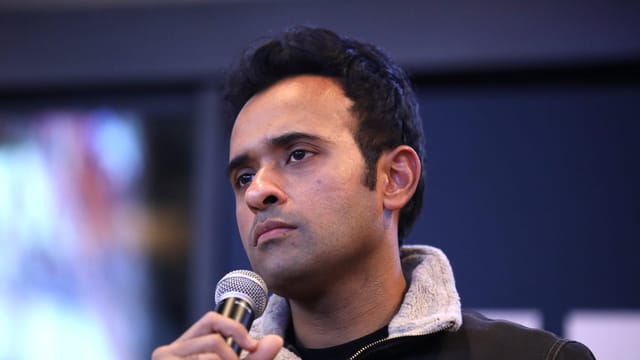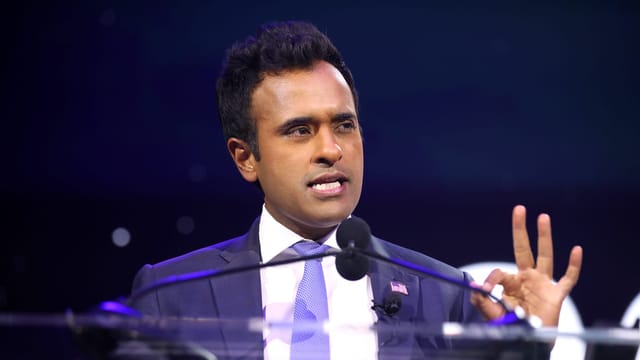


Republican gubernatorial nominee Vivek Ramaswamy’s campaign featured a convicted child sex offender in a television advertisement, despite public court records documenting his guilty pleas for sexually abusing his niece, who was younger than 13, and an eight-year prison sentence. The campaign removed the man from the commercial after a news organization confronted it with his criminal history.
Vernon Edwards, an Amherst resident classified by Ohio authorities as a sexual predator, appeared repeatedly alongside his wife in Ramaswamy’s advertisement about rising property taxes. His criminal record was not difficult to find: A nearly 20-year-old Ohio appellate court ruling documents his conviction, while the state’s public sex offender registry lists his offenses, photograph and identifying information. According to The Bulwark, which exposed Edwards’ appearance Wednesday, his registry photograph even shows him apparently wearing the same patriotic shirt Ramaswamy personally complimented when they met at a county fair.
Rather than discovering the conviction before producing and distributing the commercial, Ramaswamy’s campaign acknowledged it had been unaware of Edwards’ history after The Bulwark asked about it. Campaign spokesperson Evan Machan said the man had been removed from the advertisement. The campaign also deleted an earlier social media video showing Ramaswamy interacting with Edwards, according to the publication.
Eight-year sentence for sexually abusing a child
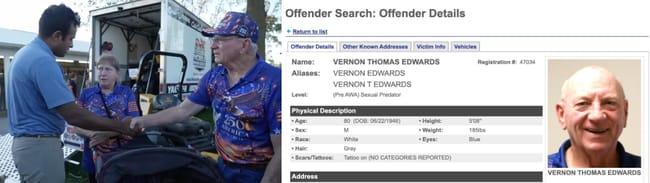
Edwards’ criminal history is documented in a November 15, 2007, decision from Ohio’s Eighth District Court of Appeals, which upheld his eight-year prison sentence.
According to the ruling, a Cuyahoga County grand jury indicted Edwards on four counts of gross sexual imposition involving his niece, who was younger than 13. Edwards pleaded guilty to two counts under an agreement that dismissed the remaining charges and required him to stipulate to classification as a sexual predator. A judge imposed two consecutive four-year prison terms, totaling eight years.
The proceedings also revealed allegations involving additional children in Edwards’ family. The appellate court recounted that evidence presented at sentencing indicated Edwards had molested several other nieces. Those incidents were never separately prosecuted because the statute of limitations had expired.
Edwards appealed his sentence, arguing that the trial judge improperly considered conduct for which he had not been charged. The appellate court rejected that argument, finding that the additional conduct was not the sole basis for his punishment. The court noted that the sentencing judge considered the lasting harm inflicted on the victim, the impact on both families and Edwards’ risk of committing another offense.
The appellate judges upheld the sentence. Edwards’ conviction remains documented in the court’s published opinion, and the Ohio Attorney General’s offender registry continues to identify him under the state’s former sexual predator classification, which carries lifetime registration requirements.
None of those records were confidential. The criminal case, the eight-year sentence and Edwards’ sex-offender registration were publicly documented long before Ramaswamy’s campaign selected footage of him for its television advertising.
Ramaswamy complimented the same shirt visible in sex-offender registry
The encounter that eventually put Edwards in a gubernatorial campaign commercial began at the Lorain County Fair in Wellington, which ran August 23 through 30, according to the fair’s official schedule.
Footage subsequently published by Ramaswamy’s campaign showed Edwards greeting the candidate and shaking his hand. Ramaswamy complimented Edwards’ patriotic shirt. Later, Edwards’ wife, Patricia “Patty” Edwards, approached Ramaswamy and became emotional while describing her struggle with rising property taxes and her fear that the family could lose its farm.
According to The Bulwark, the patriotic shirt Ramaswamy admired appears to be the same one Edwards wore in the photograph displayed on Ohio’s sex offender registry. The registry also listed identifying information matching the Amherst address associated with the family.
The interaction became the foundation of a professionally produced campaign advertisement. Ramaswamy’s team contacted Patty Edwards about recording the commercial, which featured her speaking directly to the camera and sitting at a kitchen table while discussing the financial pressures facing her family.
Although Patty Edwards was the principal spokesperson, the campaign incorporated several shots of her husband into the television spot. The original advertisement was publicly circulated before the campaign acknowledged Edwards’ conviction and announced his removal.
The distinction between the two appearances is central to the episode. Ramaswamy’s initial handshake with Edwards was an encounter with a member of the public at a county fair. The subsequent television advertisement was a campaign production, assembled from selected footage and distributed to promote Ramaswamy’s candidacy for governor. At that stage, his campaign had the opportunity to check the identities and backgrounds of the people it chose to feature.
Campaign claims ignorance, then removes Edwards
When The Bulwark confronted Ramaswamy’s campaign with Edwards’ criminal history, spokesperson Evan Machan said the campaign did not know about the conviction and was changing the commercial.
“We had no knowledge of the circumstances now being reported,” Machan told the publication. He added: “The man has been removed from the ad.”
Machan defended the advertisement’s central message, arguing that high property taxes were forcing Ohio families to consider leaving their homes and that Ramaswamy would address the issue.
The campaign’s explanation did not account for how Edwards passed through the production process without his publicly documented criminal history being identified. His conviction was available through Ohio’s court system, his sexual predator classification was listed in a searchable state registry, and his photograph provided another means of identifying him.
After supplying its statement to The Bulwark, the campaign also removed the earlier social media video of Ramaswamy’s interaction with Edwards. The publication reported that at least one Republican state representative who had shared the footage also deleted the post. The removals followed the news organization’s inquiry, although the reporting did not establish whether those accounts independently decided to delete the footage.
Wife disputes allegations despite guilty pleas and upheld sentence
Patty Edwards, whose concerns about property taxes were the focus of the commercial, defended her participation in an interview with The Bulwark. She said Ramaswamy’s campaign had approached her about telling her story, not her husband, and emphasized that she was not accused of any wrongdoing.
She also disputed the accusations underlying her husband’s criminal case, alleging that prosecutors had withheld evidence favorable to his defense. She argued that he had served his punishment and had since been an exemplary citizen.
Her account does not change the disposition of the criminal proceedings. Vernon Edwards pleaded guilty to two felony sexual offenses involving a child younger than 13, received an eight-year prison sentence and unsuccessfully challenged that sentence before an Ohio appellate court. The separate allegations concerning other nieces were considered during sentencing but did not result in additional convictions.
Nothing in the reporting indicates that Patty Edwards committed a crime or was involved in her husband’s offenses. The campaign’s vetting failure concerns its decision to place Vernon Edwards in the advertisement without identifying a criminal history that had been publicly documented for nearly two decades.
Ramaswamy’s campaign has said it removed Edwards from the commercial, but its response did not disclose how widely the original advertisement aired or what background checks, if any, had been performed before its release.
The footage was not merely an unplanned encounter captured on the campaign trail. Ramaswamy’s team selected it for a television advertisement intended to influence Ohio voters, distributed that advertisement and only announced Edwards’ removal after journalists brought his conviction to its attention. By then, the public records establishing his crimes had been available for almost 20 years.