

Five of Ohio’s biggest data center companies have announced major donations to a program helping people cover their utility bills.
Meta’s contribution alone — $10 million over the next five years — amounts to a tenfold increase in the Neighbor to Neighbor program’s funding. The program offers up to $500 in direct bill credits for low-income customers.
To receive a grant, residents must fall below 300% of federal poverty income guidelines and have previously applied for other state assistance like Ohio’s Home Energy Assistance Program. However, recipients can’t be enrolled in Ohio’s percent of income payment plan.
Amazon, Google, QTS, and Softbank all donated $1 million or more to Neighbor to Neighbor, and AEP pitched in another $1 million, as well. All told, the commitments come to $18.5 million.
“These additional funds are a significant infusion for a program that helps Ohioans in need,” AEP Ohio President Marc Reitter said. “This fund has always been about neighbors helping neighbors and we are happy that our data center customers are a part of it.”
It’s a dramatic expansion for a lifeline program at a moment when hundreds of thousands of Ohioans are struggling to cover their electric bills. The highest profile culprit for those rising utility costs are the data centers themselves.
Outside observers see the donations as a transparent bid for positive publicity as a nationwide datacenter backlash grows.
So how bad is it?
Heatmap News, an outlet focused on climate reporting, has been polling Americans on data centers since this time last year.
In August of 2025, attitudes for and against a data center going up nearby were evenly split — 42% to 43%. But in its most recent survey, Heatmap found opposition has rocketed to 75% of respondents.
In March, the Ohio Environmental Council polled likely voters in Ohio. Not only did they find that energy costs were a top issue, but 82% of voters believe “A.I. computing and data centers are driving up the cost of energy for everyday households.”
That frustration has spilled into political races around the country. Ohio is no exception.
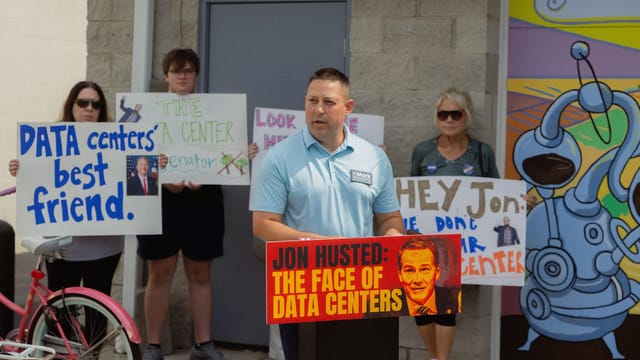
Each candidate running for governor has released plans to rein in data center development. Organizers throughout Ohio are campaigning for local moratoriums and one group is collecting signatures to put a statewide ban on the 2027 ballot.
Last week, Axios reported Republicans’ main campaign committee for the U.S. Senate sent out a data center memo.
The National Republican Senatorial Committee said data centers could decide Ohio’s U.S. Senate race, and currently they’re dragging down Ohio Republican U.S. Sen. Jon Husted.
“More than any other thing in this race, data centers are the anchor hanging around Husted’s neck,” the memo reads. “If he loses and data centers get the blame, politicians across the country will take notice — and they will not go near the next one.”
The memo went on to urge tech companies to “fix” the way Ohioans perceive data center development. Otherwise, “elected officials everywhere will treat Ohio as their reason to work against data centers in the future.”
The very same day that memo went out, AEP announced the multimillion-dollar donations to its Neighbor to Neighbor program.
Reactions
Tom Bullock heads up the Citizens Utility Board of Ohio, a nonprofit advocating for residential and small business utility customers.
“I think it’s good that they’re doing it,” he said of the companies’ commitments, before adding, “I wish it was not just utility bill assistance but instead getting to root causes.”
Bullock explained old homes all over the state aren’t properly insulated or air sealed; many households rely on old, less efficient appliances.
“Energy efficiency, home weatherization, more efficient appliances,” Bullock said, “Those kinds of programs save money four seasons out of the year, 12 billing cycles out of the year and grow over time.”
Notably, Google earmarked $500,000 of its $1 million contribution for energy efficiency upgrades for low-income households.
Helping people avoid utility disconnects is a “noble goal,” Columbus Stand Up Co-founder Morgan Harper said, but she still criticized the announcement.
“This seems like a PR play from both big tech companies and AEP,” Harper said.
Particularly rankling for Harper was AEP’s contribution. Ohioans across the income spectrum are struggling with electric bills, she explained. So why is a regulated utility like AEP making so much that it can give away a million dollars?
In an emailed statement an AEP spokesperson said the company shares its customers’ concerns about rising energy costs.
“Our employees live and work in these same communities and feel the same pressures,” the statement read. “So, we focus on what we can do: helping customers manage their bills and connecting them with every assistance program available.”
AEP operates in 11 states. Aside from its utility distribution business in Ohio, the company earns a profit through energy generation and building high volume transmission projects. The statement explained AEP’s contribution comes from AEP shareholders.
Still, Harper is skeptical of relying on handouts from what she sees as the companies contributing to the problem.
“This is not just going to be solved through charity,” Harper said. “We need structural solutions and also the government to play a role in holding these entities accountable. And and a little bit of you know millions here there is not going to be able to contend with the trillions of dollars in in value and money that these guys can throw around.”
Follow Ohio Capital Journal Reporter Nick Evans on X or on Bluesky.
This story is republished from the Ohio Capital Journal under a Creative Commons license. View the original article.