Chevron reported $12.1 billion in earnings for the three months ending in June, nearly five times what it made in the same quarter a year earlier, as the war between the United States and Iran drove crude prices into the $90-per-barrel range.
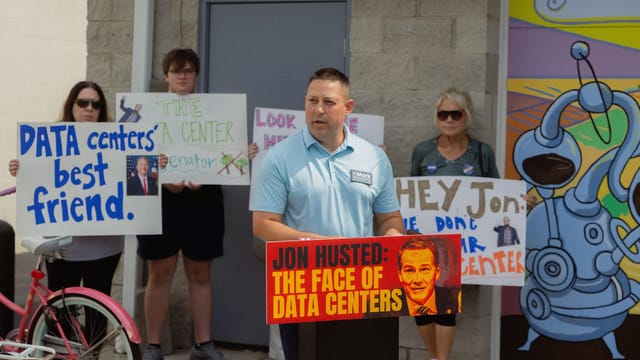
Over roughly the same stretch, the oil giant put $200,000 into a super PAC that exists for one purpose: reelecting Ohio Republican Sen. Jon Husted.
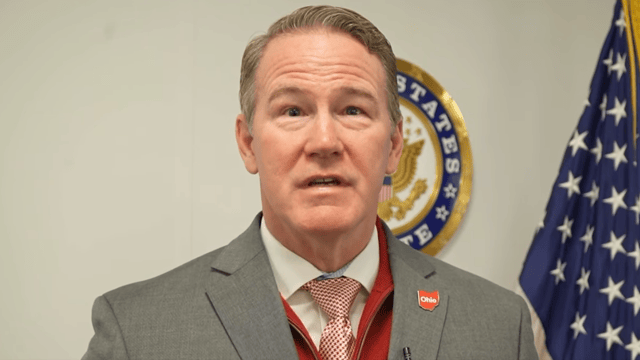
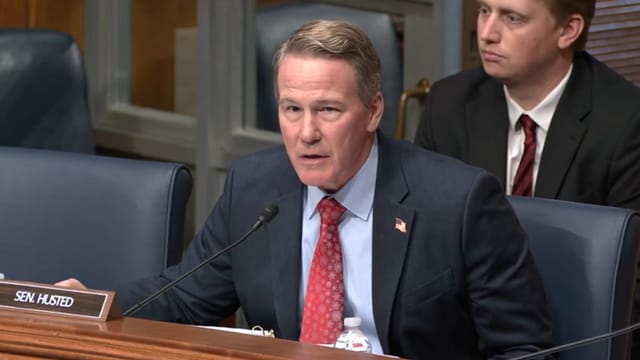
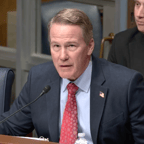
And across 2026, Husted has voted 13 times against measures that would have directed the removal of U.S. forces from the war — every such vote the Senate has taken, according to a review of federal roll call records by TiffinOhio.net.
There is no evidence in the public record that the contributions influenced how Husted voted. The donations are legal, publicly disclosed, and of a kind that flows routinely to senators in competitive races from industries with business before Congress. Husted has said repeatedly that he wants the conflict finished. Speaking to reporters in Dayton on March 6, eight days into the fighting, he said his goal for the operation “is that it should be brief and successful,” adding: “We don’t want to have hostilities linger on any longer than they need to, but if we’re going to undertake this, let’s finish it.” He has since acknowledged that the war’s end is not clear.
What the records do establish is the scale of the oil industry’s financial stake in keeping him in office, and the consistency of his voting record on the war that has enriched it.
Thirteen votes, thirteen times no
The Senate has taken 13 roll call votes in 2026 on resolutions directing the president to withdraw U.S. forces from hostilities with Iran that Congress never authorized. Husted voted against every one.
The most recent came on Thursday, July 30, when the Senate rejected a motion to discharge Senate Joint Resolution 181 from committee, 49 to 50. Husted voted no. Republican Sens. Susan Collins of Maine, Lisa Murkowski of Alaska and Rand Paul of Kentucky crossed over to support it, and Democratic Sen. John Fetterman of Pennsylvania voted against.
The pattern runs back to the war’s early weeks. Husted voted no on March 4, March 18 and March 24; on April 15, April 22 and April 30; on May 13 and May 19; on June 16, June 23 and June 24; and on July 23 and July 30. Two of those measures cleared anyway without him — a May 19 discharge motion that passed 50 to 47 and a June 23 concurrent resolution that passed 50 to 48.
Husted’s July 23 vote came a day after he told CNN he wanted the war over. That measure failed 47 to 49.
Where the oil money went
Federal Election Commission filings show three separate streams of oil industry money supporting Husted’s campaign. It is not the first industry to concentrate money on his race: insurers and their executives have given his campaigns more than $679,000 over his career, and he voted in June against two amendments directing federal investigations into insurance denials.
The largest by far is a single $200,000 contribution from Chevron Corporation, recorded on Monday, June 1, to Ohio Flyer PAC. The committee is registered with the FEC as an independent-expenditure-only super PAC and is dedicated solely to supporting Husted’s election. Super PACs face no contribution limits and may accept corporate treasury money directly, but are barred from coordinating with the candidate’s campaign. Chevron’s gift was the fourth-largest the committee reported this cycle.
Separately, two corporate PACs gave the maximum allowed to Husted’s campaign committee itself. Chevron Employees Political Action Committee gave Husted for Senate $5,000 in March 2025 and another $5,000 in February 2026. ExxonMobil’s PAC gave $10,000 across four contributions between May and October 2025. Both totals represent the ceiling a multicandidate PAC may give a Senate candidate for a primary and general election combined.
Taken together, Chevron-affiliated money supporting Husted’s reelection totals $210,000. Adding ExxonMobil’s contributions brings the figure from the two companies to $220,000.
A record quarter, built on a war
Both companies reported second-quarter results on Friday, July 31, and both credited the market disruption the war produced.
Chevron told the Securities and Exchange Commission it earned $12.1 billion, or $6.11 per diluted share, compared with $2.5 billion in the same quarter of 2025. The company reported record U.S. production, worldwide output up 20 percent, and U.S. refinery crude unit utilization above 97 percent.
ExxonMobil reported earnings of $14.5 billion, or $3.48 per share, roughly double its year-earlier result and its strongest quarter since 2022. Chairman and chief executive Darren Woods said the quarter “was shaped by disruption, but defined by execution.”
What Ohio drivers are actually paying
The pain at the pump is real, though the Ohio picture is more moderate than the national one.
Ohio’s average price for a gallon of regular was $3.86 on Tuesday, July 28, up from $3.07 a year earlier — an increase of 79 cents, according to AAA. The national average that day stood at $4.09, having risen 15 cents in a week from $3.16 a year earlier. Ohio drivers are paying less than the national average, not more.
AAA attributed the increase to the war. Prices in the United States are set on a global market, which is why a blocked shipping lane 7,000 miles away shows up at Ohio pumps. “Volatility along the Strait of Hormuz and instability in the region have pushed crude oil prices into the $90 per barrel range and could continue driving up costs during the second half of summer,” the association said.
Ohio prices climbed considerably higher earlier in the conflict, reaching $4.78 a gallon in May. It was at that level that Husted, asked on the Northeast Ohio podcast “Strictly Speaking Unfiltered” on Tuesday, May 19, what he was doing about gas prices, replied: “What do you want me to do?” Hours later he voted against the war powers resolution that passed anyway, 50 to 47.
The race
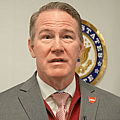
Husted was appointed to the Senate in January 2025 by Gov. Mike DeWine to fill the seat vacated by Vice President JD Vance. The former Ohio lieutenant governor and secretary of state now faces Democrat Sherrod Brown, a three-term former senator, in a special election on Tuesday, Nov. 3. The Cook Political Report rates the contest a toss-up.
Brown has made the war central to his comeback bid, echoing the anti-Iraq-war message that first sent him to the Senate in 2006. He raised $14.1 million in direct contributions from April through June, more than double Husted’s $3.4 million, though Husted’s campaign said the figure was the largest second-quarter total ever posted by an Ohio Republican Senate candidate. Outside groups have committed more than $174 million to the race.
The Ohio Democratic Party seized on the oil contributions. In a statement, Senior Communications Advisor Tony Wen said:
“As Jon Husted votes time and time again to continue the war in Iran, massive oil companies are making billions in profit while Ohio families get crushed by skyrocketing gas prices. Husted has taken maximum contributions from both Chevron and Exxon corporate PACs, and Ohioans deserve to know why he keeps siding with his billionaire donors instead of fighting to lower costs at home.”
The party’s statement did not mention the $200,000 Chevron gave to the super PAC backing Husted, which dwarfs the direct PAC contributions it cited.
Why it matters here
Northwest Ohio households and farm operations absorb fuel costs directly, through commuting, freight, diesel and fertilizer. Regular gas in Tiffin ran as high as $4.99 a gallon at the peak in May. When a senator casts the same vote 13 times on a conflict that moves those prices, the public has a straightforward interest in knowing who is financing his campaign and what they stand to gain — regardless of whether any connection between the two can be drawn.
Those disclosures are the mechanism the public has. The next federal campaign finance reports are due Oct. 15, three weeks before the election.