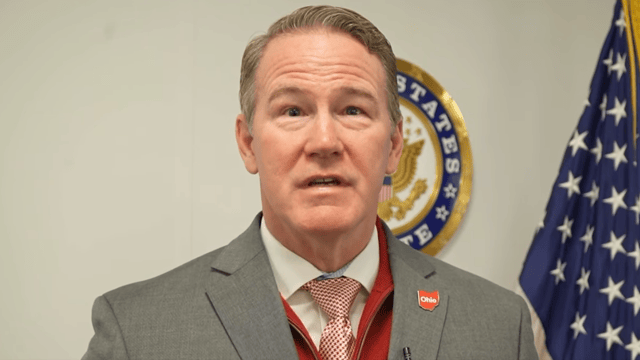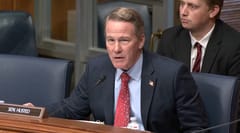
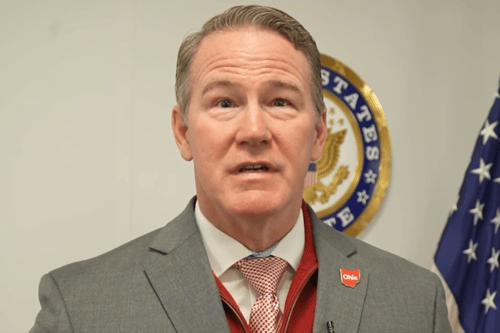
WASHINGTON — U.S. Sen. Jon Husted told CNN on Wednesday that he wants the war in Iran to be over. On Thursday he voted against the measure that would have forced American troops out of it.
Stopped in a Capitol hallway and asked about backing new funding for the war and about blowback from voters in November, the Ohio Republican told CNN chief congressional correspondent Manu Raju: “We have to protect America, we have to protect American troops. I want the war to end, I want the war to be over, I want gas prices to come down but I also don’t want to weaken our military.”
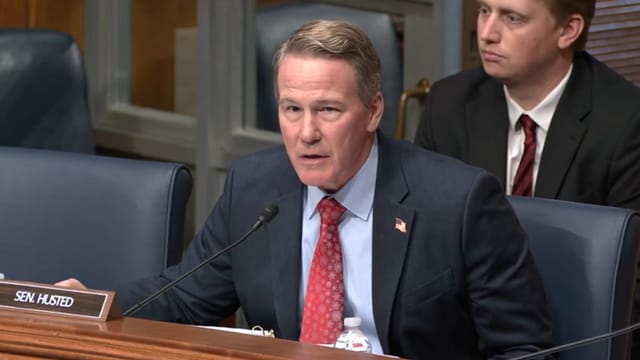
The next day the Senate rejected a resolution directing the removal of U.S. armed forces from hostilities against Iran that Congress never authorized. The vote was 47–49, with the result recorded at 12:31 p.m., according to the official roll call. Husted voted no. So did Ohio’s other Republican senator, Bernie Moreno.
What the vote was
The resolution, sponsored by Sen. Chris Van Hollen, D-Md., was a joint resolution — binding, had it cleared both chambers and survived a veto. It had been sitting in the Senate Foreign Relations Committee, which never acted on it. What failed Thursday was Van Hollen’s motion to pull it out of that committee and onto the floor.
Sen. Susan Collins of Maine was the only Republican who voted to advance it. Sen. John Fetterman of Pennsylvania was the only Democrat who voted against. Sen. Bill Cassidy of Louisiana, who supported a similar measure in June, voted no this time. Four Republicans did not vote: Katie Britt of Alabama, Mitch McConnell of Kentucky, Lisa Murkowski of Alaska and Rand Paul of Kentucky. Murkowski and Paul have both backed earlier attempts to limit the president’s war powers in Iran.
An Ohio Republican in the House voted the other way
Roughly two hours before the Senate vote, the House passed its own war powers resolution 214–208. Four Republicans joined every Democrat in supporting it, among them Rep. Warren Davidson of Ohio. The others were Brian Fitzpatrick of Pennsylvania, Tom Barrett of Michigan and Thomas Massie of Kentucky.
That measure, sponsored by Rep. Pramila Jayapal, D-Wash., is a concurrent resolution. Even if the Senate adopted an identical version, it would not reach the president’s desk and would not carry the force of law. It was the House’s fifth vote on reining in the administration’s military actions in Iran and the second one it has passed.
The chambers have split before. In June the Senate approved a House-passed War Powers Resolution 50–48, the first time both chambers rebuked the president over the war, then reversed course on a separate resolution the following day. The administration maintains the underlying law is unconstitutional.
145 days, 18 dead, $37.5 billion
Thursday marked the 145th day of a war that began Feb. 28. It was the first congressional vote since the president told lawmakers he had restarted hostilities after peace negotiations collapsed.
Eighteen U.S. service members have died since the fighting began, according to the Pentagon, four of them since July 17. Nearly 500 have been injured, about 100 in the past two weeks. Defense Secretary Pete Hegseth told senators this week the war has cost $37.5 billion so far.
The funding Husted was asked about moved the same day he was asked about it. The House passed a $1.15 trillion defense authorization bill Wednesday on a 216–212 vote and separately advanced a $95 billion budget blueprint setting aside more than $70 billion for the Iran war. Senate Democrats have blocked the defense bill in protest over the conflict.
At home, the war shows up at the pump. With the Strait of Hormuz still closed, oil topped $100 a barrel this week. GasBuddy’s Monday survey put the national average at $3.95 a gallon, up 13 cents in a week and roughly 86 cents higher than a year ago. Ohio’s average was $3.87. In Columbus it was $3.90 — 93.8 cents higher than the same week last year. Cincinnati was at $3.80. Diesel, which farmers and freight haulers buy by the hundreds of gallons, is back above $5 nationally. AAA figures published July 18 put the national average just under $4 and about 34% above where it stood before the war.
What Husted has said since March
Husted has wanted the war finished for nearly as long as it has been running, and has voted against every mechanism to finish it.
On March 6, eight days into the fighting, he told reporters in Dayton the operation was going “much better than anyone thought it would,” even after six U.S. soldiers had died. “My goal for the operation, as I’ve articulated to the president and his team, is that it should be brief and successful,” he said. “We don’t want to have hostilities linger on any longer than they need to, but if we’re going to undertake this, let’s finish it.”
In April he called the war “good news for the global economy” in remarks reported as inflation hit a three-year high of 4.2%.
On May 19, asked on the Northeast Ohio podcast “Strictly Speaking Unfiltered” what he was doing about gas prices that had climbed as high as $4.78 in Ohio, Husted replied: “What do you want me to do?” Hours later he voted against a war powers resolution, which advanced anyway 50–47 — the first time such an effort cleared a procedural hurdle after seven failed attempts.
In a May interview with CNN, Husted said he did not want his constituents paying higher prices for anything, and that there was no doubt gas prices were too high and action was needed to make life more affordable.
The Senate race
Husted was appointed to the seat in January 2025 by Gov. Mike DeWine after JD Vance resigned to become vice president. He faces former U.S. Sen. Sherrod Brown, a Democrat, in the Nov. 3 special election for the final two years of the term.
Brown has built his campaign around the war and its cost at the pump, the same approach that carried him to the Senate against the Iraq war in 2006. At a spring campaign stop in Austintown, Brown said Husted had never called the war a bad idea and had offered no plan for ending it.
Public opinion has hardened. A Washington Post-Ipsos survey released last week found 68% of Americans said the war was not worth fighting, against 28% who said it was — a wider negative margin than either the Iraq or Afghanistan wars recorded in comparable polling.
The Senate adjourned Thursday until Monday afternoon.